
Trolley
You have no items in your shopping cart

 Budgets
 Dumbers
 Discs
 Benches
 Racks and Rigs
 Weights Holders
 Isotonic machines
 Calisthenics
 Cardio
 Kettlebells
 Flooring
 Gym Set
 Accessories
 Combat
 ARTI MARZIALI
 CONTAINER GYM
 Tug-Of-War
 Used Gym Equipment
 PILATES MACCHINARI
 GINNASTICA ARTISTICA
 CAMPI DA PADEL
 Prodotti in Pronta Consegna
 Informazioni
 IRONMAN
 Gift Card
- Donatif
- General information
- 0 I like it
- 57 Views
- 0 comments
- gym flooring, safety flooring, gym safety, shock-absorbing materials
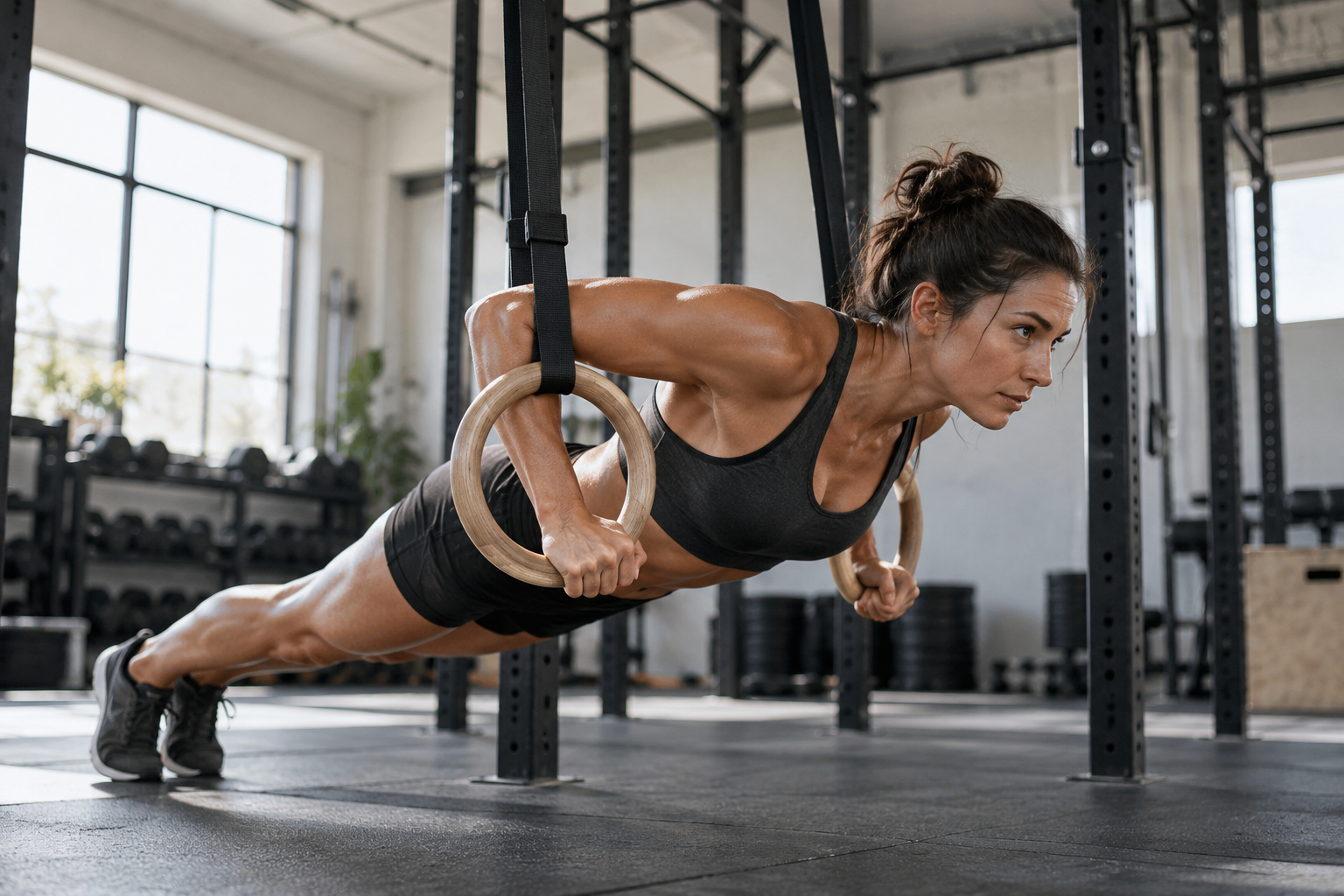
Ring Training: Building a Controlled Progression
Ring-training progression is not a race towards a spectacular skill. Rings are moving supports: users must manage orientation, path and body position as well as produce force. An apparently simple exercise can therefore require different control from a related movement on fixed equipment.
Progress means selecting a manageable task, making it repeatable and changing it deliberately. Ring height, foot position, body angle, range and assistance alter the work. There is no identical sequence for everyone or universal repetition count that authorises advanced skills. Experience elsewhere helps but does not replace specific learning.
This guide provides general planning criteria rather than an individual programme or acrobatic instruction. Suitable anchoring, manufacturer-compliant installation and appropriate space come first. If these cannot be assessed confidently, involve a competent person before suspending the body from the structure.
- Prepare equipment and surroundings
- Understand difficulty variables
- Begin with manageable supports
- Develop controlled pulling and pushing
- Suspension and support need learning
- Workload, recovery and quality
- Combine rings with other equipment
- Decide when to progress
Prepare equipment and surroundings
Check the complete system: rings, straps, buckles, attachments and supporting structure. Holding weight in a brief trial does not prove suitability for the planned training. Consider declared operating conditions and anchor compatibility. Do not use pipes, furniture or improvised supports for convenience. Without a documented, suitable installation, postpone use and clarify the arrangement.
Settings and clear space
Adjust straps and check locking according to instructions. Symmetrical exercises require the intended setup rather than compensating for accidental height differences. Allow space for body, feet and ring movement. Clear ground directly underneath is insufficient if walls or other people interfere laterally. Any protective surface must fit the activity and must not justify attempting unmastered movements.
Understand difficulty variables
With feet supported, body angle changes the task. Foot distance, ring height and range also influence force and control. Relationships depend on the exercise: lowering rings does not universally make everything harder. Observe the actual movement and configuration. Progress is understandable when the changed variable and elements that must remain stable are explicit.
Change one element at a time
Avoid changing angle, range and volume simultaneously without reason. Keep a variation stable enough to assess control improvements. Record useful settings and movement conditions, not only the exercise name. Two sets called rows may demand different work when supports and body position differ. Simple records prevent reliance on memory or fatigue alone.
Begin with manageable supports
Choose exercises appropriate to the person, using supports that allow load adjustment. Feet-supported pulling or a suitably configured push can be more adjustable than full suspension. Neither is automatically easy or suitable for everybody. The variation must permit controlled entry, movement and exit. Do not start an exercise simply because it is labelled basic if its conditions cannot be managed.
Exiting is part of competence
Before each set, know how to stop and return to the intended supports. Do not wait until exhaustion to discover that dismounting requires an unfamiliar movement. Assistance must be organised by someone who understands the task; proximity alone is not a procedure. Finishing with the same control as starting matters before adding difficulty or removing support points.
Develop controlled pulling and pushing
Rings require coordination of arms, shoulder blades and torso while supports move. Initially seek a repeatable path and manageable position rather than rigidly freezing the body. Increasing swings, substantially different repetitions or lost supports mean the task should be reviewed. Moving rings do not justify every deviation as stabilisation work: added demands are useful only when controlled.
Range without forcing
Range must fit the exercise and person. Do not chase extreme positions from a video while losing control. A deliberately reduced variation can serve a purpose but is not identical to the full movement. An instructor can distinguish planned adaptation from unintended compensation. Stop for pain or unexpected symptoms and obtain appropriate assessment.
Suspension and support need learning
Removing supports changes the task beyond a simple numerical increase. Hanging and supporting the body on rings require specific management of grip, orientation and position. No universal hold time qualifies someone for every next exercise. Static control does not automatically establish control in transition. Preparation must assess the actual demands of the intended movement.
Separate positions from transitions
Entering, holding and leaving a position are related but different skills. Combining isolated exercises does not automatically create a complex transition. Advanced skills require specific preparation, appropriate supervision and suitable surroundings. This guide offers no shortcuts to muscle-ups, inversions or acrobatics. They are not compulsory milestones for general ring training.
Workload, recovery and quality
Account for work quantity and recovery between sessions. Increasing ring difficulty while adding other training can obscure the response. There is no need always to reach loss of position. Work should remain connected to goals and capabilities under the programme. This guide does not prescribe universal sets, repetitions or frequency because experience and context change requirements.
Read the session's information
Observe consistent technique, manageable settings and controlled endings. Improvement can mean greater repeatability rather than more repetitions. Fatigue alone does not establish good load selection. Review unexpected difficulties or persistent quality decline with a competent person. Pain or persistent discomfort is not a prerequisite for earning the next progression.
Combine rings with other equipment
Rings can form part of a programme without replacing everything else. Fixed supports, machines and free weights organise different tasks and may suit different goals. Instability is not automatically superior or evidence of better muscle work in every situation. Compare the objective with the variation's demands. If support control mainly limits the task, separate control learning from other training components where useful.
Avoid misleading comparisons
Repetitions on rings are not directly equivalent to bar or machine repetitions because geometry and conditions differ. Use comparisons to understand differences rather than assign an absolute performance value. Keeping a stable variation for a period and changing it when manageable can be coherent. Constant novelty makes development and goal assessment harder.
Decide when to progress
Before increasing demands, assess control, repeatability, equipment handling and exit. Record execution conditions for clear references next session. Define the next change and its evaluation without skipping steps to accelerate. If quality changes substantially, returning to an earlier setup is useful rather than failure. Timelines need not be identical: development follows consolidated skills and organised work, not a race through figures.
Equipment and continuity
The Donatif catalogue can help explore equipment. For rings, verify documentation, permitted use and installation rather than infer compatibility from a name. Maintain prescribed inspections and report wear or abnormalities before continuing. Sustainable progression requires suitable equipment, prepared surroundings and coherent learning, with difficulty managed from beginning to end.
Comments (0)