
Trolley
You have no items in your shopping cart

 Budgets
 Dumbers
 Discs
 Benches
 Racks and Rigs
 Weights Holders
 Isotonic machines
 Calisthenics
 Cardio
 Kettlebells
 Flooring
 Gym Set
 Accessories
 Combat
 ARTI MARZIALI
 CONTAINER GYM
 Tug-Of-War
 Used Gym Equipment
 PILATES MACCHINARI
 GINNASTICA ARTISTICA
 CAMPI DA PADEL
 Prodotti in Pronta Consegna
 Informazioni
 IRONMAN
 Gift Card
- Donatif
- General information
- 0 I like it
- 55 Views
- 0 comments
- gym flooring, safety flooring, gym safety, shock-absorbing materials
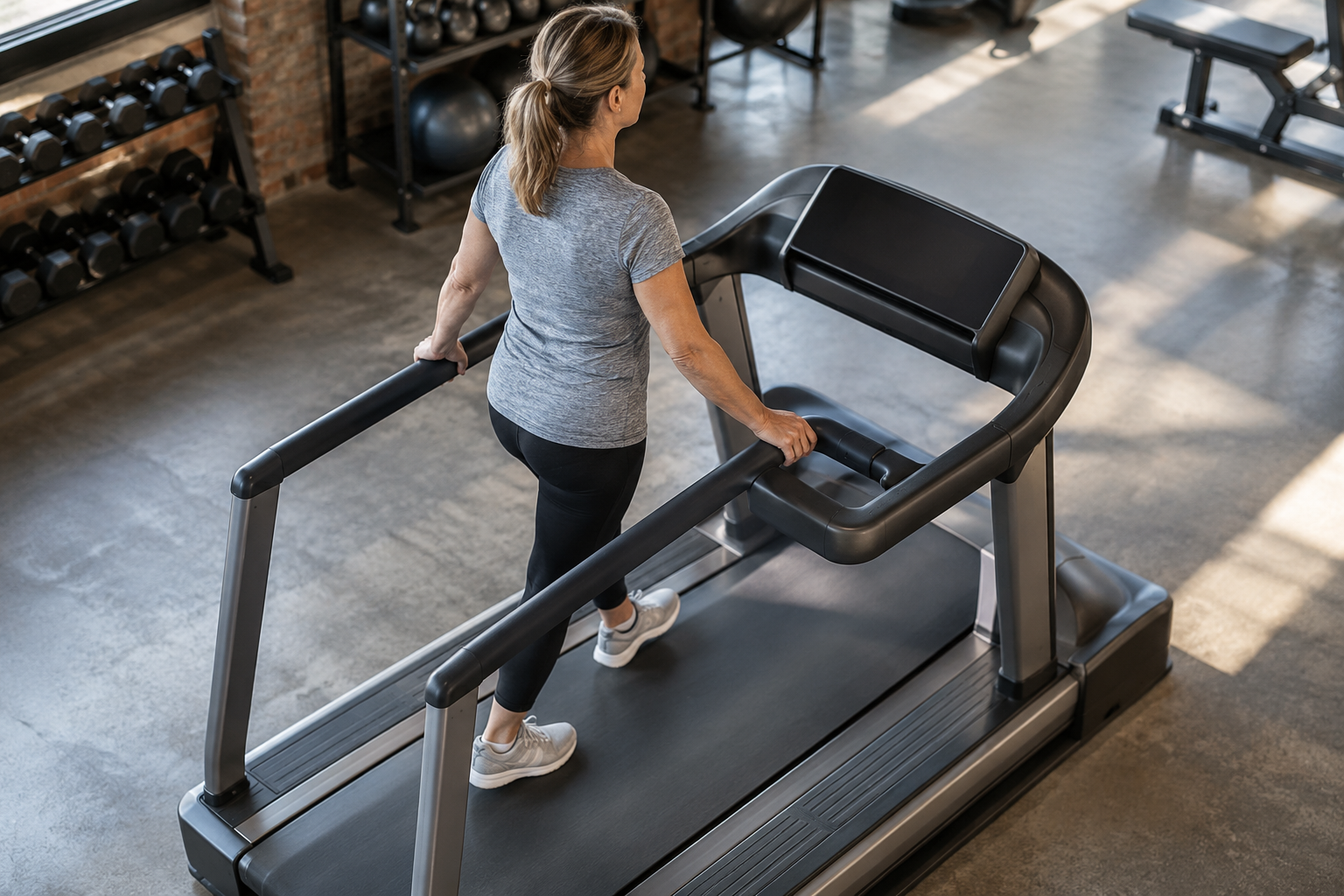
Treadmills with Handrails: Selection, Access and Controlled Walking
A treadmill with handrails offers supports for operations permitted by its design, but rails do not automatically make every walk safe. The belt is a moving surface: entry, starting, adjustment and stopping require attention and suitable equipment. Assess the complete station and the user's ability to manage it.
Rails vary in shape and length. A bar near the console does not necessarily serve the same function as an extended side support, and neither should be assumed to support body weight universally. Capacity, permitted use and support technique must come from manufacturer documents rather than sturdy appearance.
This guide covers general selection and organisation for walking treadmills. It does not define rehabilitation programmes or establish individual suitability. Where balance, independence or personal circumstances make a moving surface difficult to manage, appropriate assessment is needed; adding a rail alone cannot resolve the issue.
- What are handrails for?
- Understandable controls and stopping
- Speed and belt characteristics
- Mounting, starting and dismounting
- Controlled walking and supports
- Position and operating space
- Checks, cleaning and maintenance
- Choose for the actual use
What are handrails for?
Use supports according to the machine's instructions. They can assist certain operations but do not replace controls, stopping procedures or the ability to maintain a controlled position. Do not assume every bar withstands arbitrary loading in any direction. Its purpose must be understood before training. If someone needs a forceful grip simply to remain on the belt, review settings, equipment selection and assistance rather than assume the problem has been solved.
Shape and reach
Assess position, continuity and distance in the actual setting. Supports should be reachable as intended without sudden searching movements during walking. No measurement suits everybody. A controlled trial, where appropriate, helps assess entry and grip. Initial perceived solidity still does not replace verification of the declared function and operating conditions.
Understandable controls and stopping
Assess the console for tasks needed during use rather than programme count. Start, speed adjustment and stop must be identifiable and reachable from the intended position. Before moving the belt, users should understand the main buttons. Do not learn a new function while the machine accelerates. Also understand behaviour after pausing or interruption, since models do not all resume in the same way.
Manufacturer-provided devices
Where a safety key or connection is provided, use it as instructed. Do not disable it for convenience or substitute improvised devices. It does not eliminate risk or permit exceeding capabilities. Staff must know procedures and keep necessary controls accessible. Emergency stopping is not automatically equivalent to every normal dismounting procedure; the manual describes the functions and sequences to follow.
Speed and belt characteristics
Walking requires a manageable pace and gradual adjustment within the model's capabilities. Advertised top speed is not the main criterion. Check minimum speed, adjustment increments and startup behaviour through documents and demonstration. There is no universal walking speed. Belt dimensions and rail positions must suit the user; a motor capable of low speed alone does not establish suitability.
Incline is not compulsory progression
Incline, where available, changes the task and should follow programme and instructions. It is not necessary to make walking worthwhile. Understand controls and maintain command of the movement before adding it. Changing speed and slope simultaneously may obscure the cause of difficulty. Sensible progression prioritises workload management rather than reaching the maximum setting at any cost.
Mounting, starting and dismounting
Entry requires the model's specific procedure. Identify foot placement before starting and how to begin walking according to instructions, without transferring habits from another treadmill. Learn the intended use of any side platforms rather than improvise. Do not step onto a moving belt merely to save time. Plan the exit before starting so controls and supports do not need to be found when already tired.
Avoid distractions at sensitive stages
Keep access clear and prepare needed items before starting. Retrieving a dropped object while the belt moves can disrupt balance and attention. Follow stopping procedures instead of making sudden movements. Anyone assisting must understand the machine and where to stand without interfering with belt or moving components. Supervision must match actual requirements, rather than simply mean standing nearby.
Controlled walking and supports
Pace and settings must allow understandable movement control. Pulling strongly on rails can alter walking and conceal an unsuitable speed. This does not prescribe hands-free walking for everyone: support must be considered in context and under instructions. Avoid using a rigid grip to justify continuing an unmanageable task. Stop appropriately for unexpected symptoms and obtain the necessary help.
Display values and perception
Time and settings help record work, but calorie estimates are not exact personal expenditure measurements. Different support use can also make sessions less comparable. Record relevant conditions instead of chasing the highest number. Programmes should consider experience, recovery and capabilities, not only displayed distance. Individual goals require suitable planning rather than a standard duration assigned to every user.
Position and operating space
Before installation, verify floor, power supply, access and manual-specified clearances. Structural footprint is insufficient: allow space for operation and assistance. Minimum distances cannot come from a photograph or another model. The layout should prevent furniture, routes or adjacent machines from obstructing entry and exit. Extended rails, where present, also change the approach and must be included in planning.
Orderly surroundings and connections
Arrange cables under installation requirements and manufacturer instructions without walkway obstacles. Do not improvise connections or extensions to reach a distant socket. Lighting and object placement should make belt, rails and controls identifiable. Check delivery route and assembly before buying: a machine fitting the final room may encounter stairs, doors or lifts along the way. Clarify services and responsibilities with the supplier.
Checks, cleaning and maintenance
Belt, structure, rails and controls need prescribed inspections. Belt tensioning, centring and lubrication procedures are not identical across treadmills. Some tasks require qualified personnel and specific stopping or disconnection conditions. Follow the manual and do not correct faults while the machine is moving. Loose parts, visible wear or unusual behaviour require reporting and assessment before continued use.
Management in shared facilities
Organise cleaning and checks without residues or objects obstructing grip and access. Cleaning products must suit materials and technical instructions. Retain model details and documentation for parts and support. Declared intended use must match the facility: long rails alone do not establish suitability for every service. Continuity also depends on clear responsibilities for checks, reporting and fault management.
Choose for the actual use
Compare supports, controls, starting settings, operating dimensions and permitted use. Include support, maintenance and delivery conditions. Exclude offers missing an essential requirement despite numerous automatic programmes. Ask about missing information instead of assuming an accessory resolves every need. Keep a written summary of confirmed points and open questions to improve comparison beyond marketing presentation. Assess the treadmill as a complete system with a clear sequence from entry to completion.
Connect selection with demonstration
The cardio machines section can help explore options. Consult each model's documents and declared conditions, connecting them to a demonstration where available and appropriate. Rails are a feature to assess, not a promise of no risk. A coherent choice supports walking, assistance and maintenance according to real requirements while keeping equipment limits and intended use clear.
Comments (0)