
Trolley
You have no items in your shopping cart

 Budgets
 Dumbers
 Discs
Discs
 Benches
 Racks and Rigs
 Weights Holders
 Isotonic machines
 Calisthenics
 Cardio
 Kettlebells
 Flooring
 Gym Set
 Accessories
 Combat
 ARTI MARZIALI
 CONTAINER GYM
 Tug-Of-War
 Used Gym Equipment
 PILATES MACCHINARI
 GINNASTICA ARTISTICA
 CAMPI DA PADEL
 Prodotti in Pronta Consegna
 Informazioni
 IRONMAN
 Gift Card
- Donatif
- General information
- 0 I like it
- 1 Views
- 0 comments
- gym flooring, safety flooring, gym safety, shock-absorbing materials
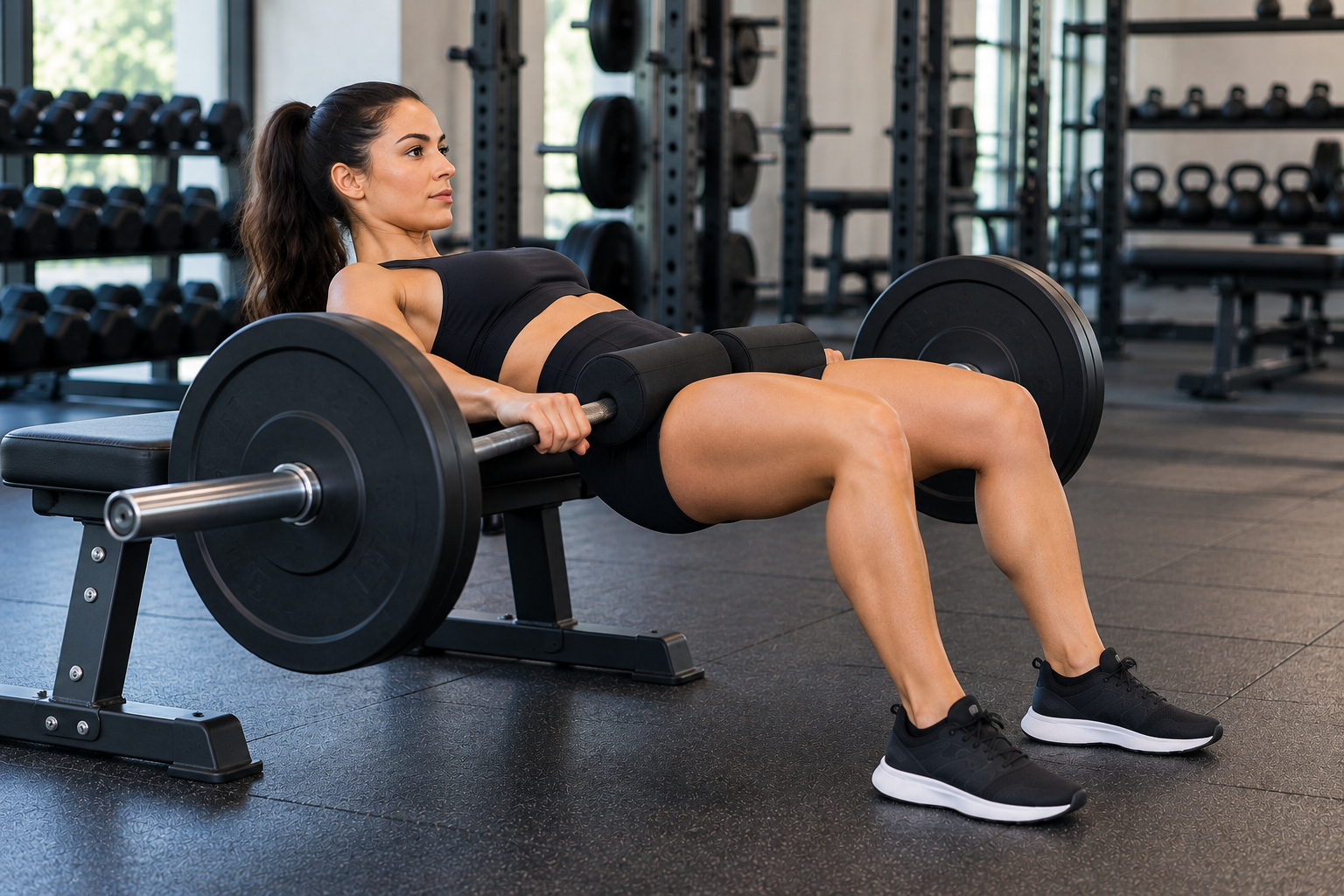
Safety in the hip thrust: how to avoid lumbar hyperextension and unstable bench
Safety during the execution of the hip thrust depends mainly on the correct setup of the station, the stability of the equipment, and the control of movement. Two of the most frequent errors are hyperextension of the lumbar spine in the final phase of hip extension and the use of an unstable bench, situations that can compromise the technical quality of the exercise.
Before increasing the load, it is therefore advisable to verify that the bench, barbell, flooring, and workspace are adequately prepared. A simple and repeatable checking procedure allows you to reduce setup errors and make the exercise more technically effective.
This guide proposes practical criteria to improve hip thrust safety, focusing on the prevention of lumbar hyperextension and bench instability without delving into the complete technique of the exercise or comparison with other variants.
- Quick answer
- What are the main risks?
- Station safety requirements
- Checks to perform before training
- How to avoid lumbar hyperextension
- How to prevent an unstable bench
- Most common errors
- FAQ
- Why careful preparation improves safety
How to make the hip thrust safer?
To perform a hip thrust safely, it is important to use a stable bench, verify the correct positioning of the equipment, control the movement throughout the entire hip extension, and avoid compensating with excessive extension of the lumbar area in the final phase of the exercise.
Safety derives from the combination of station preparation, technical control, and the use of equipment in good condition.
Each session should start with a quick check of the work area.
What is the fundamental principle?
Maintain a stable station configuration and controlled movement while avoiding compensations that alter the intended technique.
What instructions should be followed?
For dedicated equipment, always respect the manufacturer's instructions regarding installation, use, and maintenance.
What are the main risks?
Many problems stem from preparation errors rather than the movement itself.
Identifying critical situations preventively allows them to be corrected before training.
Systematic verification reduces the risk of repeated errors.
Lumbar hyperextension
In the final phase of hip extension, it is advisable to avoid continuing the movement by compensating with excessive extension of the lumbar spine. Maintaining position control throughout the repetition helps perform the gesture more consistently.
Bench instability
A bench that slides, wobbles, or does not rest correctly on the floor can compromise exercise stability and make it harder to maintain a controlled trajectory.
What requirements must the station have?
Station preparation is one of the most important aspects of the exercise.
Each element should be verified before loading the barbell.
An orderly environment also facilitates the management of subsequent sets.
Flooring and space
The surface must be stable, even, and free of obstacles. The surrounding area should allow the positioning of the bench and barbell without interference with other equipment.
Equipment control
Verify that the bench, supports, barbell, and plates are intact and correctly positioned before starting the workout. To set up the station, you can use an olympic barbell compatible with the rest of the equipment.
What checks to perform before use?
A brief checklist allows you to standardize station preparation.
The checks take a few minutes but can prevent numerous errors.
It is useful to always maintain the same control sequence.
Check the bench
Verify that the bench is stable, that it shows no wobbling, and that it maintains proper support throughout the execution of the exercise.
Check the barbell
Make sure the load is distributed correctly, that the plates are secured with the provided collars, and that the barbell can be positioned without obstacles.
How to avoid lumbar hyperextension?
Movement control is more important than the maximum range of the repetition.
A regular technique facilitates the repeatability of the exercise.
Initial adjustments influence the entire execution.
Control the final phase
In the concluding part of the movement, it is useful to focus on hip extension while avoiding seeking further range through excessive movements of the lumbar spine.
Use a manageable load
A weight consistent with one's level facilitates maintaining technique and reduces the likelihood of compensations during the last repetitions.
How to prevent an unstable bench?
Bench stability depends on both the characteristics of the equipment and the preparation of the station.
A preventive check is generally sufficient to identify any critical issues.
Periodic maintenance of the equipment helps maintain its reliability.
Position the bench correctly
The bench should be placed on a uniform surface and maintain stable support for the entire duration of the exercise.
Perform a preliminary test
Before using the working load, it is useful to perform a few test repetitions to verify that the bench remains stable and that the station configuration is correct.
What errors to avoid?
Many problems can be prevented with more careful preparation.
Haste in the initial phase increases the probability of non-optimal configurations.
A consistent procedure makes it easier to maintain high safety standards.
Neglecting station preparation
Starting the exercise without verifying bench stability, flooring, and equipment layout can compromise execution quality.
Seeking only maximum range of motion
An excessively emphasized movement in the final phase can promote technical compensations. It is preferable to maintain continuity and control along the entire repetition.
FAQ
How to check if the bench is stable?
Before training, check that the bench rests uniformly on the floor, shows no wobbling, and remains stable during a few test repetitions.
Does lumbar hyperextension always depend on the load?
Not necessarily. Station setup, technique, and movement control can also influence the appearance of compensations.
Is it useful to perform a station check before each set?
Yes. A quick check of the bench, barbell, and work area helps keep preparation quality constant throughout the session.
Why spend time preparing the station?
Careful preparation of the hip thrust helps reduce the most common errors related to lumbar hyperextension and bench instability, favoring a more controlled execution consistent with training goals.
Systematically checking equipment, flooring, available space, and barbell configuration helps maintain constant standards during each session and makes it easier to identify any anomalies before use.
Adopting a repeatable checklist represents a practical approach to improve workout organization and use the station more safely over time.
Comments (0)