
Trolley
You have no items in your shopping cart

 Budgets
 Dumbers
 Discs
Discs
 Benches
 Racks and Rigs
 Weights Holders
 Isotonic machines
 Calisthenics
 Cardio
 Kettlebells
 Flooring
 Gym Set
 Accessories
 Combat
 ARTI MARZIALI
 CONTAINER GYM
 Tug-Of-War
 Used Gym Equipment
 PILATES MACCHINARI
 GINNASTICA ARTISTICA
 CAMPI DA PADEL
 Prodotti in Pronta Consegna
 Informazioni
 IRONMAN
 Gift Card
- Donatif
- General information
- 0 I like it
- 11 Views
- 0 comments
- gym flooring, safety flooring, gym safety, shock-absorbing materials
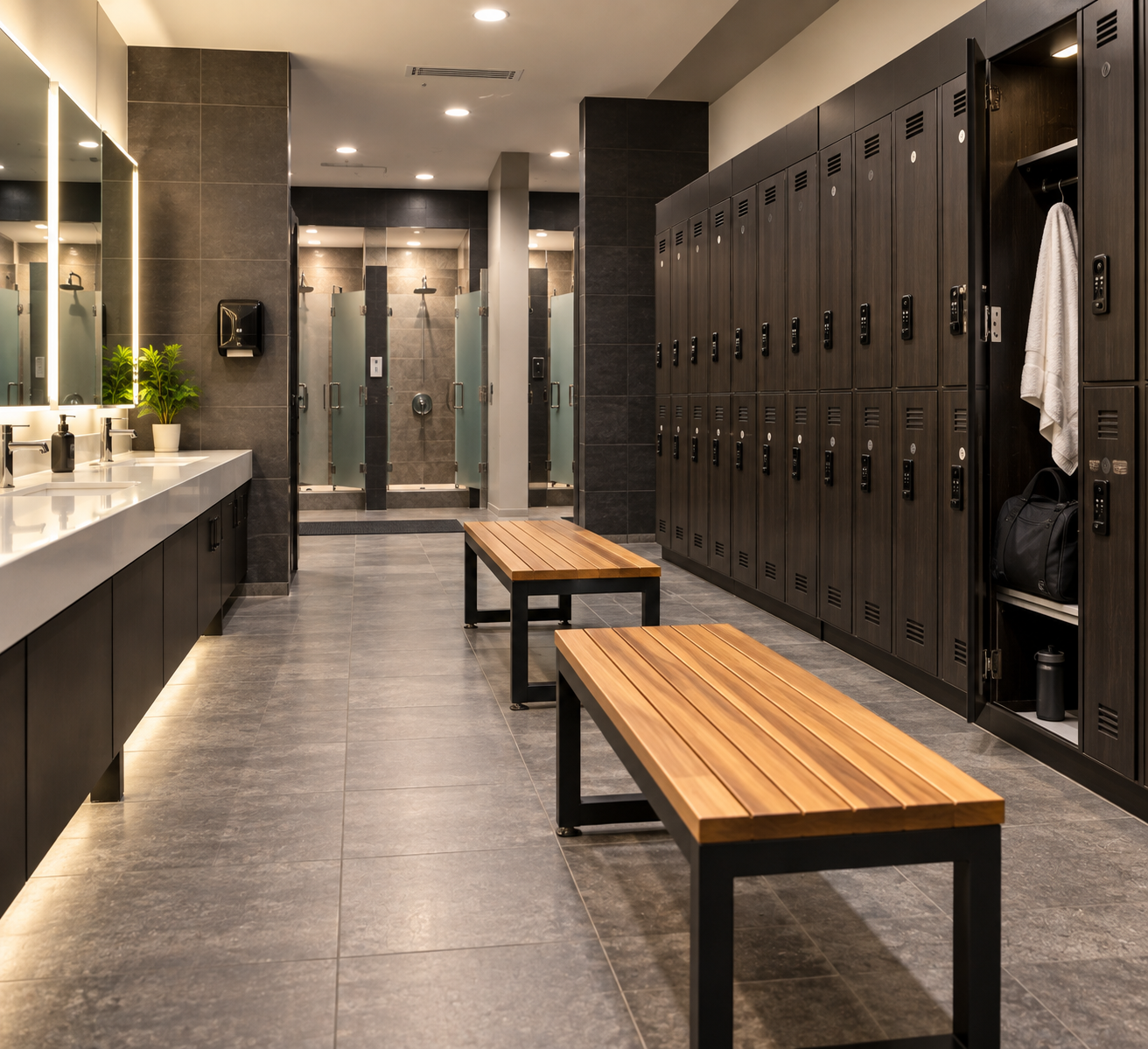
How many lockers do you need in gym locker rooms? Practical guide to proper sizing
Determining how many lockers to install in gym locker rooms does not mean applying a fixed number of items based on available surface area. Proper sizing depends above all on the number of users present at the same time, the type of activity performed, the average time spent in the locker rooms, and the organization of the facility.
An insufficient number of lockers generates waiting, clutter, and a worse experience for members, while an excess of furniture can unnecessarily reduce passageways, compromise the usability of the locker room, and limit future modifications to the environment.
This guide provides practical and verifiable criteria to calculate locker requirements without addressing the general aspects of locker room design, material selection, or ventilation, which are covered in dedicated insights.
- Quick answer
- How to calculate the number of lockers
- What factors influence sizing
- How to organize the lockers
- Errors to avoid
- How to check if the number is correct
- FAQ
- Sizing lockers as an investment
How many lockers are needed in a gym?
There is no universal number valid for every gym. Requirements must be determined by evaluating the maximum number of users present in the locker rooms at the same time, turnover during the day, average duration of stay, and space availability. The correct criterion is to design the lockers based on actual use rather than the total number of members.
Each facility has different operational characteristics and therefore requires a specific evaluation.
The availability of lockers should also allow for orderly management even during peak hours.
What is the main criterion?
The most useful parameter is represented by the simultaneous use of the locker rooms, that is, the maximum number of users who may need a locker at the same time.
Why doesn't the number of members matter?
Members attend the gym at different times. Sizing the lockers based on the total number of subscribers would almost always lead to oversizing the spaces.
How is the necessary number of lockers calculated?
The calculation should start from the analysis of the facility's daily flows.
Observing peak hours makes it possible to obtain much more reliable data than a simple theoretical estimate.
Collecting information for a few weeks normally allows you to identify times of maximum use.
Analyze usage flows
Recording the number of users present during peak hours, distinguishing entrances, exits, and average stay in the locker rooms, makes it possible to estimate the real demand for lockers.
Provide an operational margin
It is advisable to maintain additional availability to manage occasional peaks in turnout, sporting events, particularly busy classes, or seasonal variations.
What elements influence sizing?
The correct number of lockers depends on several organizational factors.
Considering only one parameter can lead to unreliable results.
The evaluation should always be comprehensive.
Type of facility
A gym dedicated mainly to free fitness has different needs compared to a center with numerous group classes, competitive activities, or multi-sport facilities, in which accesses tend to be concentrated in well-defined time slots.
Time spent in locker rooms
The longer users occupy the lockers, the greater the number needed to manage the same flows without creating waiting times.
How to organize the lockers in the locker rooms?
Proper sizing depends not only on the number of lockers but also on their arrangement.
Rational organization improves the circulation of people and makes daily use easier.
The distribution should always maintain easily navigable pathways.
Keep pathways clear
Lockers should not narrow corridors nor interfere with the opening of doors, panels, or the use of benches.
Integrate accessories
The layout must coordinate with benches, coat racks, mirrors, and other gym accessories. If it becomes necessary to complete the setup, you can evaluate dedicated solutions in the category gym accessories.
What errors are best avoided?
Some errors are recurrent in locker room design.
Avoiding them makes it possible to improve environmental functionality without necessarily increasing available surface area.
Preventive planning also reduces future modification interventions.
Install too many lockers
Completely filling available space can compromise pathways, accessibility, comfort, and ease of use of the locker rooms.
Underestimate peak hours
Calculating lockers on the daily average rather than peak times can quickly cause organizational problems.
How to tell if the number is adequate?
After opening the gym, it is useful to periodically monitor locker room operations.
Direct observation makes it possible to identify any critical issues.
Collected data can guide future setup updates.
Signs to observe
Queues in locker rooms, constantly occupied lockers, use of benches for storage, and frequent user requests can indicate suboptimal sizing.
When to review the project?
It is advisable to reassess the number of lockers after gym expansions, introduction of new activities, significant increases in members, or changes in class schedules.
FAQ
Is there a regulation establishing the minimum number of lockers?
There is no single number valid for all facilities. The quantity must be determined considering the intended use, locker room organization, and any regulations applicable to the individual facility.
Is it worth installing spare lockers?
Yes. Providing additional availability facilitates the management of usage peaks and offers greater flexibility over time.
Does the number of lockers depend on surface area?
Surface area represents only one of the elements to be evaluated. The true criterion is maintaining the correct balance between storage capacity, pathways, comfort, and user safety.
Why is properly sizing lockers an investment?
A well-organized locker room improves daily gym management, reduces waiting times, and helps provide a more orderly experience for users.
Analyzing actual flows, periodically checking the occupancy rate, and planning for growth margins makes it possible to avoid both oversizing and locker shortages, optimizing available space.
An approach based on concrete data allows you to keep gym locker rooms efficient over time and plan any expansions without makeshift interventions.
Comments (0)