
Trolley
You have no items in your shopping cart

 Budgets
 Dumbers
 Discs
 Benches
 Racks and Rigs
 Weights Holders
 Isotonic machines
 Calisthenics
 Cardio
 Kettlebells
 Flooring
 Gym Set
 Accessories
 Combat
 ARTI MARZIALI
 CONTAINER GYM
 Tug-Of-War
 Used Gym Equipment
 PILATES MACCHINARI
 GINNASTICA ARTISTICA
 CAMPI DA PADEL
 Prodotti in Pronta Consegna
 Informazioni
 IRONMAN
 Gift Card
- Donatif
- General information
- 0 I like it
- 115 Views
- 0 comments
- gym flooring, safety flooring, gym safety, shock-absorbing materials
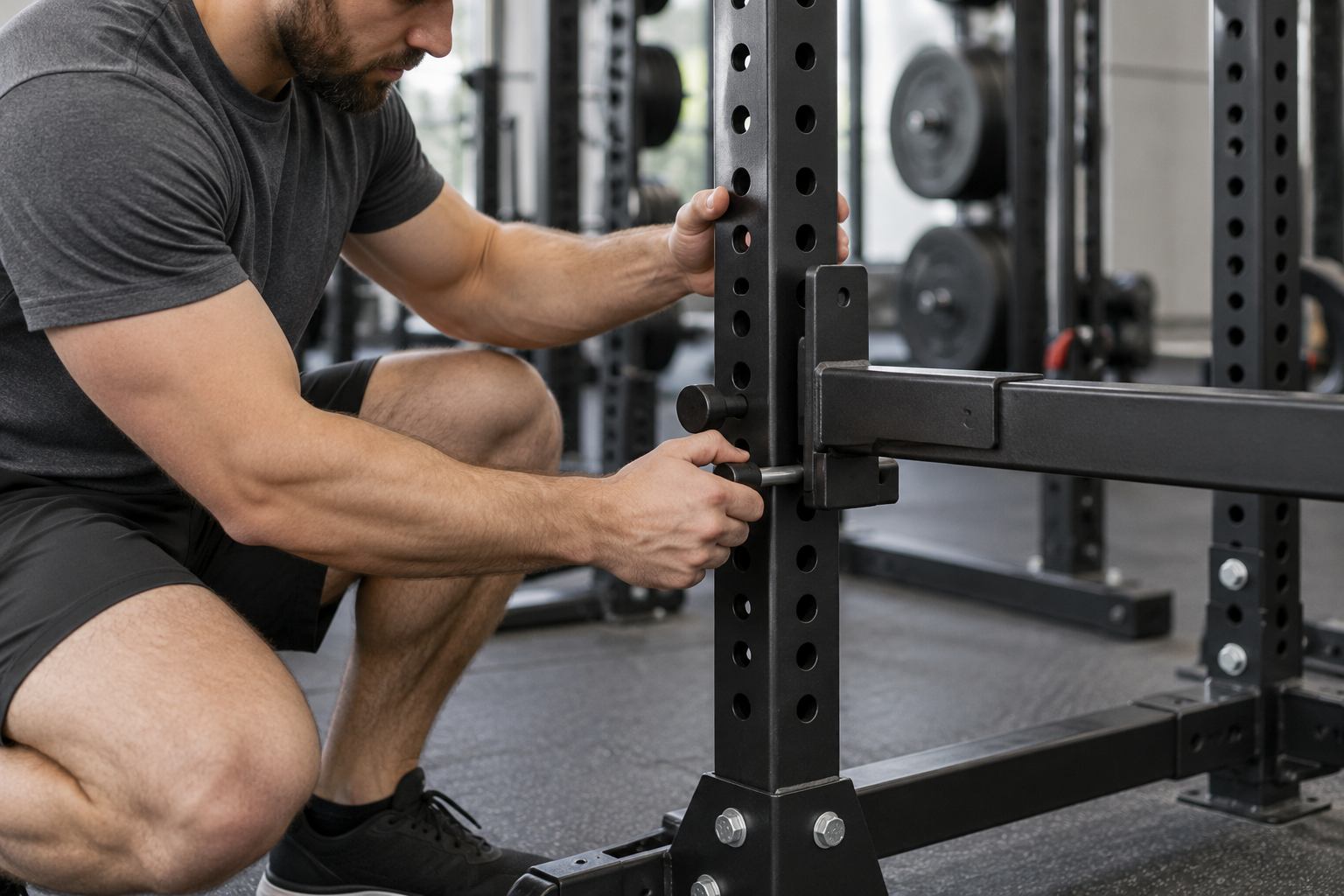
Adjusting squat supports: height and checks
A poorly adjusted barbell support can make it difficult to unrack the load or re-rack it at the end of the set. In the squat, the position of the hooks and any safety bars must be defined for the individual, the exercise, and the rack actually used.
Understanding how to adjust the squat supports means preparing the station before adding weight: checking the components, choosing a height that allows a controlled unrack, and verifying the safeties within the expected range of motion.
This guide offers practical references for instructors and weight room managers. Specific procedures depend on the model: always follow the manufacturer's manual, observe the stated limits, and ask qualified staff for assistance when you are not familiar with the setup.
Effective adjustment also takes into account variations between exercises. Changing the position of the barbell on your back or using a different depth can alter the path relative to the safeties. Before a new variation, repeat the check with a light load and ask the instructor to observe critical points.
When multiple people take turns, communicating heights can speed up the change, but each person must personally verify that hooks and safeties are engaged. An annotated numbering does not replace the physical check of the station.
- Knowing the rack components
- Preparing the station
- Choosing the hook height
- Adjusting the safeties
- Unracking and re-racking
- Common errors and corrections
- Managing a shared station
Knowing the rack components
Support hooks and holders
The hooks, often called J-cups, support the barbell before and after the set. They must be the ones intended for or explicitly compatible with the rack and inserted according to the manufacturer's fastening system. Seemingly similar dimensions do not guarantee compatibility between holes, uprights, and locking devices.
Before adjusting the height, check that both supports are intact and correctly secured. Verify any pins or safeties, without using improvised substitute components. If a hook is deformed, unstable, or has a defect, take the station out of service and inform the manager.
Safety bars, arms, or straps
Protections can take various forms: internal bars, external arms, or straps, depending on the rack design. They serve to catch the barbell under the conditions intended by the manufacturer, but are not automatically interchangeable and do not replace technique or assistance when needed.
Check the assembly, orientation, and limits of the specific system. Some straps can flex under load and require an evaluation of the actual position, not just the height of the attachment points. The manual must guide adjustment and checks.
Preparing the station
Checks before loading
Position the rack on a suitable surface and check that the assembly and any anchoring comply with the instructions. Check uprights, fasteners, hooks, and safeties to identify damage or missing components. Proper adjustment does not compensate for an unsuitable or poorly assembled structure.
Clear the area of plates, benches, and other obstacles. Make sure the barbell can be loaded and unloaded and that spotters have space to intervene. Consult the limits of the rack, supports, and barbell: the most favorable limit of one component does not modify that of the others.
Empty barbell and instructions
Perform initial adjustments with an empty barbell and no person under the load. Set both hooks to the same height using markings or counting holes, then visually check engagement. Do not rely solely on the locking sound or a check performed by another user.
If the rack has different numbering on the two sides, check how to read the positions in the manual. When the structure is shared, ask the user to double-check before their set: the height used by the previous person may not be suitable.
Choosing the hook height
Starting position
Step under the barbell in the intended squat position, with a stance and grip agreed upon with the instructor. The height must allow you to lift it off the hooks by extending your legs in a controlled manner, without rising onto your toes and without performing a deep descent to free it.
A practical reference is to place the barbell slightly below the position where it will rest on your back when you are standing. The exact position depends on body type, footwear, and resting style. Test with an empty barbell and modify by one hole at a time if necessary.
Symmetry and unrack
The two hooks must be at the same height and the barbell centered. Verify that the ends are positioned consistently relative to the supports, without contact that could prevent the unrack. Even a visibly noticeable inequality on just one side requires re-adjustment before the set.
After unracking, perform only the steps necessary to clear the hooks, maintaining control and space to return. The number of steps depends on the station and technique: the goal is to avoid unnecessary movement, not to impose an identical sequence on every person.
Adjusting the safeties
Actual squat depth
With an empty barbell and appropriate assistance, observe the depth that the person can achieve while maintaining control. The safeties must leave the intended movement free but be able to catch the barbell if the athlete has to interrupt the repetition, within the limits of the system used.
Safeties set too high may be hit during every repetition; ones set too low might not offer the necessary clearance. Barbell height, back position, and depth vary between individuals. For this reason, a measurement derived from another athlete is not sufficient.
Testing the position without load
Follow the manufacturer's procedure and, with an instructor, verify the barbell's path and the ability to exit the position in a controlled manner. For strap systems, consider the expected deflection. Do not simulate a fall with a heavy load and do not deliberately strike the safeties to test them.
If the rack does not allow you to set safety heights appropriate for the person and exercise, modify the setup or choose a compatible station. The assistance of one or more spotters must be organized according to experience, load, and facility procedures; safety equipment does not eliminate this evaluation.
Unracking and re-racking
Exiting the supports
Before lifting, check your grip, foot placement, and position under the barbell. Lift it just enough to clear both hooks and stabilize your position before stepping back. If one side remains stuck or the load is unbalanced, stop and ask for assistance instead of twisting under the barbell.
Centering and checking the closures help maintain a consistent setup. Load the plates following the room's instructions and procedures, avoiding imbalances during loading. Every change to the load requires a new check before the set.
Returning to the hooks
At the end of the set, step forward in a controlled manner toward the rack and bring the barbell into contact with the uprights or into the position indicated by the instructor, then lower it onto both hooks. Verify that both sides are resting before releasing your grip or stepping out from under the barbell.
Do not search for the hooks by turning your head or backing up blindly. If you cannot locate the position or lose stability, the designated spotters must intervene according to the facility's procedures. A set is not finished until the barbell is securely re-racked.
Common errors and corrections
Hooks too high or too low
When hooks are too high, the person may have to rise onto their toes to free the barbell and have difficulty re-racking it. If they are too low, the unrack may require an uncomfortable position and drain energy before the set. In both cases, test a different height with an empty barbell.
Do not compensate for an unsuitable height with unstable surfaces under your feet. If the holes do not allow for a useful adjustment, check for authorized accessories or a different station with the manager. The goal is a repeatable position, not adapting at all costs to the available structure.
Uneven or unlocked safeties
One side higher than the other can change how the barbell is caught. Check markings and attachments on both sides and make sure each element is inserted and locked as intended. Straps should also be inspected for any wear according to the manual.
To choose the room configuration, you can consult the racks and rigs, then check the compatibility and weight capacities of the specific model. An accessory present in the catalog is not necessarily compatible with every structure.
Managing a shared station
Instructing users and spotters
Demonstrate how to adjust hooks and safeties, recognize locking, and check height before loading. Instructions must refer to the rack present in the room. For beginners, the instructor should observe the unrack and return with an empty barbell before granting autonomy.
Agree in advance on when to request assistance and how to communicate the start and end of the set. Spotters must understand their role and facility procedures. The presence of other people near the rack does not automatically equal organized spotting.
Checks and reports
Include supports, pins, and safeties in the manufacturer's scheduled inspection plan. Note anomalies such as insertion difficulties, deformations, or unexpected movements and make the station unavailable when safety is doubtful. Do not proceed by simply changing the side of the defective component.
After an intervention, a competent person verifies the configuration before reopening. Keep the instructions and make the reporting channel recognizable to users. A personal adjustment may change every day; the condition and compatibility of the equipment, however, must be managed by the facility.
Comments (0)