
Trolley
You have no items in your shopping cart

 Budgets
 Dumbers
 Discs
 Benches
 Racks and Rigs
 Weights Holders
 Isotonic machines
 Calisthenics
 Cardio
 Kettlebells
 Flooring
 Gym Set
 Accessories
 Combat
 ARTI MARZIALI
 CONTAINER GYM
 Tug-Of-War
 Used Gym Equipment
 PILATES MACCHINARI
 GINNASTICA ARTISTICA
 CAMPI DA PADEL
 Prodotti in Pronta Consegna
 Informazioni
 IRONMAN
 Gift Card
- Donatif
- General information
- 0 I like it
- 195 Views
- 0 comments
- gym flooring, safety flooring, gym safety, shock-absorbing materials
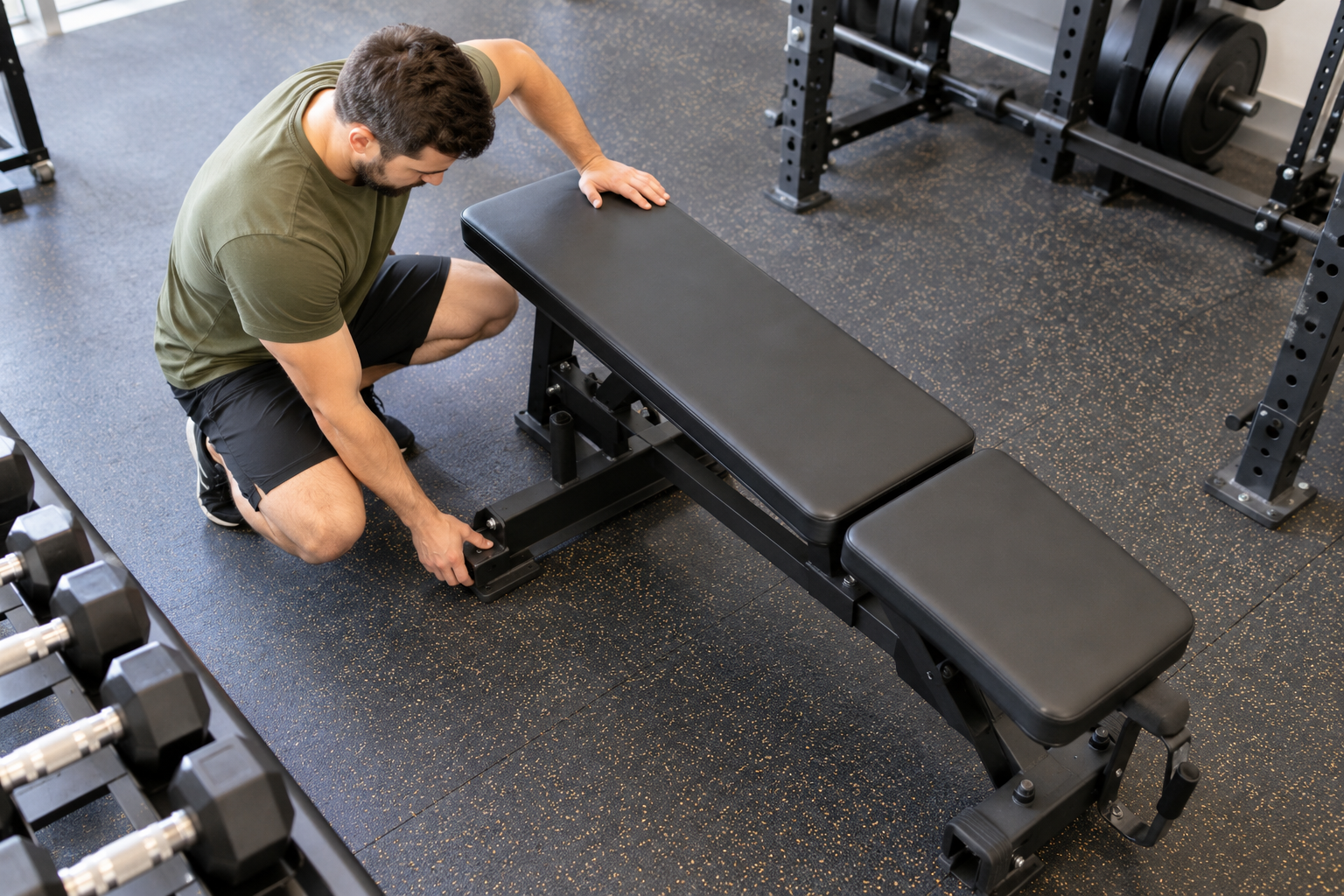
Stable training bench: pre-use checks
A bench that wobbles during a press can compromise concentration and make it difficult to maintain a consistent position. Stability depends on the structure, the supporting surface, the adjustments and the way the equipment is used. None of these elements should be judged in isolation.
To understand how to evaluate the stability of a training bench, the room manager must distinguish between a visual check and a controlled use test. Both are useful, but they do not replace the specifications and procedures indicated by the manufacturer.
This guide proposes practical checks for fixed and adjustable benches, from floor conditions to the management of anomalies. Observations must remain within the limits of the model: there is no need to overload or improperly use a bench to realize that it requires attention.
The check is particularly useful after transport, maintenance work or a layout modification. In each case, observe the bench in its intended configuration and keep a record of the conditions found, so staff can compare subsequent reports.
- Stability: what to observe
- Examining the frame and supports
- Checking an adjustable bench
- Testing the bench in a controlled manner
- Compatibility with the exercise and the room
- Maintenance and anomaly management
- Choosing a suitable bench
Stability: what to observe
Support and movement
A stable bench must offer predictable support during the exercises for which it was designed. Wobbling, shifting on the floor or unexpected movements of the backrest deserve a check. Before attributing the problem to the structure, observe when it occurs: during getting on, adjustment or the simple resting of the person.
A small amount of play perceived in an adjustable component should not be automatically interpreted without knowing the model. Consult the instructions and, if the behavior is anomalous or unexplained, suspend use and request a competent check. Do not try to eliminate movement by tightening random parts.
Stability and load capacity are different
The declared load capacity indicates a limit to be interpreted according to the manufacturer's instructions; it does not describe by itself the support on the floor or the correct locking of the adjustments. A bench that meets the load requirement may still be unstable if a foot is damaged or the floor is not flat.
Similarly, a bench that looks firm in a light test is not automatically suitable for any load. Verify that the limit includes the components provided by the manufacturer and that it is appropriate for the exercise. Do not exceed it to obtain a demonstration of stability.
Examining the frame and supports
Structure conditions
Before use, observe the frame, joints, visible welds and accessible fasteners. Look for deformations, cracks, significant corrosion or loose elements. An ordinary visual check can spot signs of anomaly, but it does not certify the internal integrity of the structure nor does it replace scheduled inspections.
If you find a defect, identify the bench and communicate the observed point to the manager. Avoid makeshift repairs, unauthorized welding or replacements with unapproved components. The manual and manufacturer assistance indicate the appropriate procedures for the model and the necessary skills.
Feet and ground contact
Check that all provided supports are present and in good condition. A worn, missing or improperly installed foot can change contact with the ground. Also check that dust, moisture or residue do not reduce grip and clean using methods compatible with the surface.
Soft or uneven flooring can alter the behavior of the bench. Position it on a flat and suitable area according to the instructions. Do not insert cardboard or makeshift shims under a leg: they can shift during exercise and hide a problem that needs to be resolved.
Checking an adjustable bench
Seat and backrest locks
On an adjustable bench, verify the correct engagement of the locking devices before each set. The procedure varies: pins, racks and other systems require specific actions. Observe that the chosen position corresponds to an intended adjustment and that the parts are correctly engaged.
Do not adjust the backrest while a person is resting on it or while there is a load, unless explicitly instructed by the manufacturer. If the lock does not engage easily or requires forced maneuvers, interrupt the procedure and report the problem. Forcing a component can worsen the defect.
Joints and position changes
A functional check without load allows you to observe whether the adjustment slides as expected and whether the bench remains firm in the positions used. Follow the instructions and keep hands and fingers away from pinch points. Unusual noises or undescribed movements deserve attention.
Record the position where the anomaly appears, because a defect may only manifest at certain inclinations. Do not assume that the stability observed flat automatically applies to all configurations. Each intended position must be used within the limits and conditions of the model.
Testing the bench in a controlled manner
First without external load
After the preliminary checks, a qualified person can verify the support with slow movements and without additional loads, following the instructions. Observe if the bench moves, if all supports maintain contact and if the backrest stays in the selected position. Stop the test immediately if an anomaly emerges.
A practical check must be carried out in the actual space of use, on the floor and with the configuration provided. If the bench is moved frequently, repeat the positioning checks. The test does not require sudden pushes, impacts or tipping attempts: these actions do not replace a technical evaluation.
With appropriate exercises
When the initial check is satisfactory, the instructor can observe an allowed exercise with light and manageable resistance. Evaluate the moment the person sits down, lies down and finishes the set, in addition to the core movement. Entering and exiting the position are also part of real use.
The check does not demonstrate long-term resistance nor does it authorize exceeding declared limits. If the bench moves, immediately reduce risk conditions and stop use. Documenting the incident and requesting the scheduled intervention, avoiding different users repeating uncoordinated tests.
Compatibility with the exercise and the room
Benches, racks and dumbbells
A bench placed in a rack must be compatible with the available space and the trajectory of the exercise. Check that the user can position themselves, reach the barbell and finish the set according to the room's procedures. The elements of the rack and the bench have distinct limits to respect.
For dumbbell exercises, consider the lateral area necessary to bring them into position and store them. The floor must remain clear and staff must be able to intervene without crossing neighboring stations. The stability of the bench is a component of overall safety, not the only requirement.
Dimensions and users
Height, width and shape of the padding influence the person's ability to support themselves with control. A bench may be stable as a structure but poorly suited to a specific user or exercise. The instructor should observe foot placement and the ability to maintain comfortable support.
Consult the datasheets of the gym benches to compare configurations and measurements, then verify the data of the actual model. The most suitable shape depends on the activities and people planned; a commercial description does not replace testing and documentation.
Maintenance and anomaly management
Scheduling checks
The manufacturer can indicate frequencies and methods of control for fasteners, moving components and coverings. Integrate these indications into the facility's plan and assign activities to competent people. A pre-use check helps detect obvious problems, but does not replace the required periodic maintenance.
Note the model, identification number, date and result of the check. If the bench is subject to intense use or is moved often, the manager can organize more frequent operational observations, always respecting the manual. A log also facilitates the recognition of a recurring anomaly.
Stopping and reactivating
When stability is doubtful, make the bench clearly unavailable and inform the manager. Describe the symptom without making a diagnosis: for example, perceived wobbling in the inclined position or missing foot. This information helps whoever intervenes to reproduce the problem under appropriate conditions.
Reactivation should follow the planned check and any repairs. Keep records of the intervention and inform staff that the station is available again. Do not leave the decision to a user who claims not to have perceived wobbling during a single test.
Choosing a suitable bench
Comparing data and conditions
To evaluate multiple models, gather intended use, dimensions, load limit and relative definition, adjustments, maintenance instructions and spare parts availability. Compare benches intended for the same functions and ask for clarifications on undocumented features. The weight of the frame alone does not demonstrate greater stability.
If possible, test the alternatives in the relevant configuration, using the same observation sheet. Record ease of access, feeling of support and simplicity of adjustments, distinguishing user judgments from declared data. A subjective test is useful, but does not replace specifications and limits.
From comparison to management
Before ordering, check included delivery, assembly and documentation, and define who will perform the first check. Prepare a space consistent with the dimensions and planned activities, without forgetting pathways and areas for storing weights. A good configuration makes it easier to use the bench as intended.
After installation, keep the manual and train staff on adjustments and reporting. Gather observations during the first few weeks and address any problems before they become habits. Stability must be maintained over time through correct positioning, checks and appropriate interventions.
Comments (0)