
Trolley
You have no items in your shopping cart

 Budgets
 Dumbers
 Discs
Discs
 Benches
 Racks and Rigs
 Weights Holders
 Isotonic machines
 Calisthenics
 Cardio
 Kettlebells
 Flooring
 Gym Set
 Accessories
 Combat
 ARTI MARZIALI
 CONTAINER GYM
 Tug-Of-War
 Used Gym Equipment
 PILATES MACCHINARI
 GINNASTICA ARTISTICA
 CAMPI DA PADEL
 Prodotti in Pronta Consegna
 Informazioni
 IRONMAN
 Gift Card
- Donatif
- General information
- 0 I like it
- 27 Views
- 0 comments
- gym flooring, safety flooring, gym safety, shock-absorbing materials
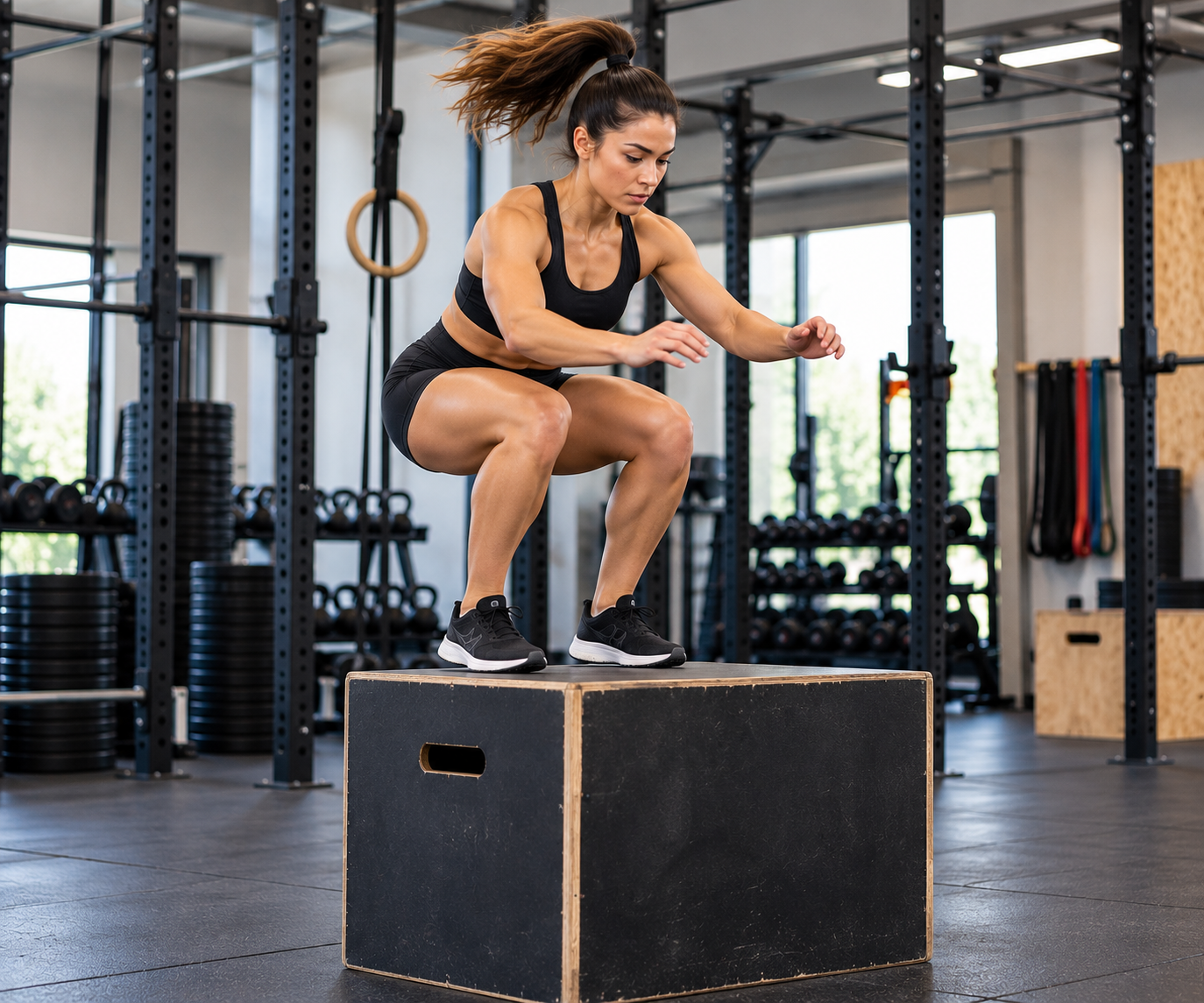
How to choose the height for the box jump: practical criteria for a safe choice
The choice of height in the box jump affects the quality of the exercise, the execution technique, and the ability to develop lower limb power without introducing unnecessary difficulties. A box that is too high can lead to technical compensations, while one that is too low might not be adequate for the training goals.
To determine the correct height, it is advisable to evaluate the athlete's experience, movement quality, landing control, and the purpose of the session. The choice should always prioritize correct execution over simply clearing a higher obstacle.
This guide offers verifiable criteria for choosing the height of the box jump, illustrating the technical aspects to observe, the most common mistakes, and ways to progress safely.
- Quick answer
- What features really matter?
- How to choose the box height
- Compatibility with level and goals
- Mistakes to avoid
- How to gradually increase the height
- FAQ
- Choosing the box as a technical investment
How to choose the height for the box jump?
The height of the box jump should allow the jump to be performed while maintaining correct technique, a stable landing, and a controlled position without excessive hip flexion or compensations. The choice depends on experience, jumping ability, training goals, and execution quality rather than the maximum achievable height.
A gradual progression allows the technical gesture to be consolidated before increasing the difficulty of the exercise.
The goal is to develop explosive qualities while maintaining consistency in technique across all repetitions.
What is the priority?
The priority is to preserve a clean and repeatable technique, preventing the height of the box from negatively affecting the movement.
When to increase the height?
Only when all repetitions are controlled and the landing remains stable without evident compensations.
What features really matter?
The choice of the box depends not only on the height but also on the stability of the structure, the support surface, and the available space to perform the movement.
A stable and adequately sized box allows you to focus on execution while reducing interference caused by the equipment.
The quality of the training surface also contributes to the safety of the exercise.
The takeoff technique
The takeoff should be fast and coordinated, maintaining an effective push without altering posture to reach an excessive height.
The landing on the box
Contact with the box must be stable and controlled, with secure footing and maintenance of balance before descending.
What criteria to use to choose the height?
The selection of height should follow a practical evaluation of the movement rather than standard references that apply to everyone.
Among the most useful criteria are landing quality, technical continuity, the ability to repeat the gesture, and the athlete's level of experience.
During training, it is preferable to maintain a technical margin that allows you to perform all scheduled repetitions with the same quality.
For beginners
Beginners should use heights that allow them to learn the movement without resorting to compensations or excessive knee flexion on the box.
For experienced athletes
Athletes with more experience can progressively increase the difficulty while keeping the technical quality of execution unchanged.
How to verify that the height is suitable?
An adequate height allows the jump to be completed while maintaining control before, during, and after landing.
Compatibility also depends on the training program and the exercises associated within the same session.
To organize a functional workstation, you can integrate dedicated tools by consulting the gym accessories section.
Integrate the step-up
The step-up can be used as a complementary exercise to improve control, coordination, and support management on the box.
Evaluate the space
The work area must allow for an adequate run-up when planned, a safe landing, and a controlled descent without obstacles.
What mistakes to avoid?
One of the most common mistakes is choosing a box that is too high to demonstrate one's jumping ability.
When the box exceeds the level manageable by the athlete, the probability of observing technical compensations increases, such as excessive knee tucking, loss of balance, or unstable landings.
Neglecting the quality of the surface and the stability of the equipment can also negatively affect the safety of the exercise.
Do not confuse with the jump squat
The jump squat and the box jump share some explosive characteristics but have different purposes and execution modes, and should not be considered interchangeable.
Check the flooring
The training surface should be stable, even, and maintained in good condition according to the manufacturer's instructions.
How to gradually increase the height?
The increase in height should be decided only after consolidating the technique at the previous level.
It is advisable to modify only one parameter at a time, avoiding a simultaneous increase in height, volume, and training intensity.
A gradual progression makes it possible to maintain high movement quality throughout the entire learning path.
Evaluate each session
Observing the quality of repetitions helps determine whether the height used remains adequate for the session's goals.
Schedule recovery
Adequate recovery times allow you to maintain technical precision and landing control even in subsequent sets.
FAQ on the box jump
Is it better to use the highest box possible?
No. The height should allow you to maintain correct and repeatable technique without compensations.
How to tell if the box is too high?
Useful signs include loss of balance, excessive leg tucking, unstable landing, or difficulty repeating the movement continuously.
Are there technical standards?
Execution modes can be explored further through scientific literature on plyometrics, methodological manuals of sports federations, and technical instructions from equipment manufacturers where applicable.
Is it necessary to always increase the height over time?
No. Progression can also concern technical quality, movement control, work volume, and exercise variants, without necessarily modifying the box height.
Choosing the box as a technical investment
The choice of height in the box jump should be guided by execution quality and consistency with preparation goals, avoiding the use of height as the sole indicator of exercise difficulty.
Evaluating technique, landing control, space organization, and program progression allows you to build more effective and easily monitorable workouts.
An approach based on verifiable criteria favors gradual technical growth, improves plyometric training management, and makes it easier to adapt the work to each athlete's characteristics.
Comments (0)