
Trolley
You have no items in your shopping cart

 Budgets
 Dumbers
 Discs
Discs
 Benches
 Racks and Rigs
 Weights Holders
 Isotonic machines
 Calisthenics
 Cardio
 Kettlebells
 Flooring
 Gym Set
 Accessories
 Combat
 ARTI MARZIALI
 CONTAINER GYM
 Tug-Of-War
 Used Gym Equipment
 PILATES MACCHINARI
 GINNASTICA ARTISTICA
 CAMPI DA PADEL
 Prodotti in Pronta Consegna
 Informazioni
 IRONMAN
 Gift Card
- Donatif
- General information
- 0 I like it
- 6 Views
- 0 comments
- gym flooring, safety flooring, gym safety, shock-absorbing materials
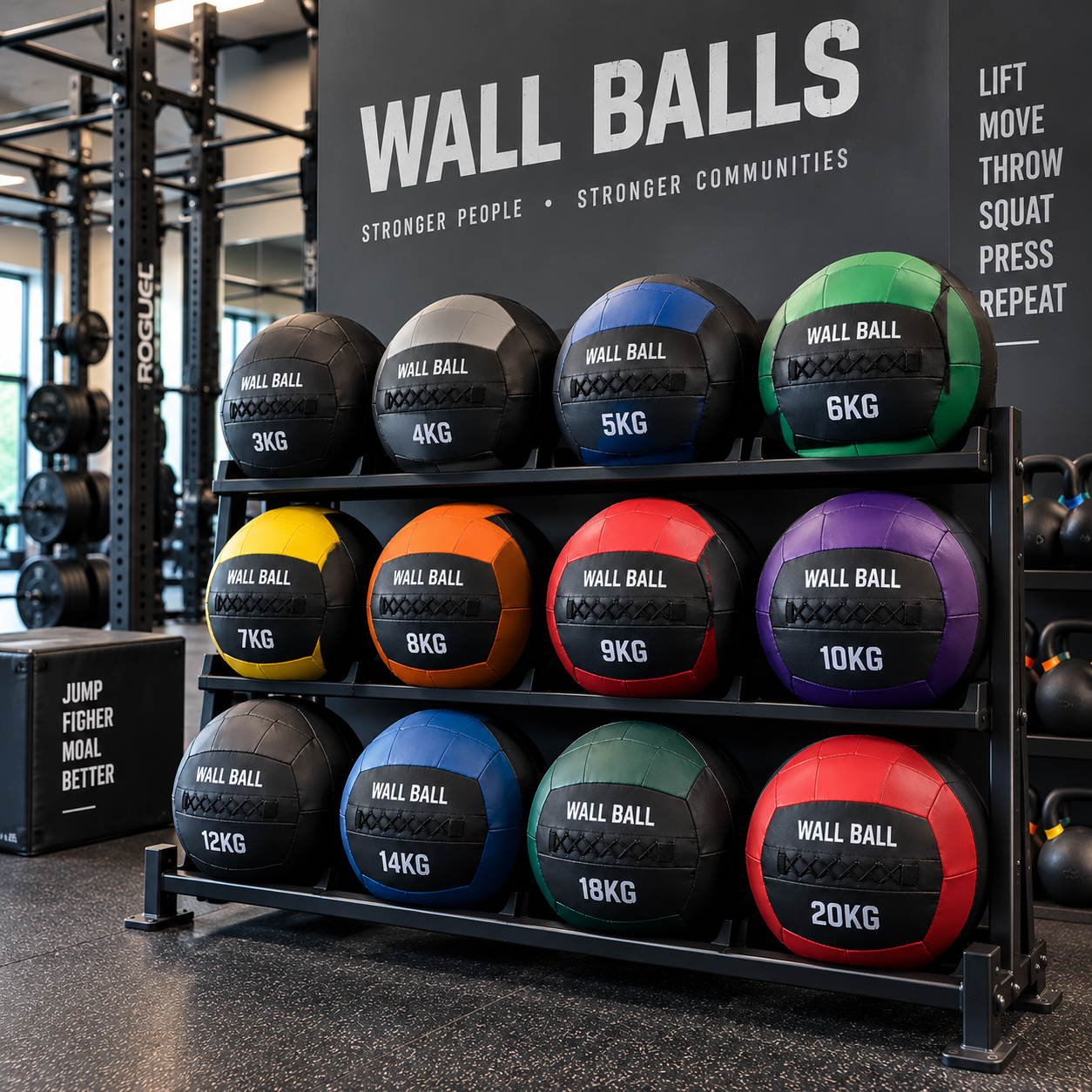
How to choose the weight of the wall ball
The choice of the wall ball weight influences the quality of your training, execution technique, and safety during every repetition. The correct criterion is not choosing the highest weight available, but identifying the one that allows you to complete the expected number of repetitions while maintaining a correct movement pattern from the beginning to the end of the set.
For most users, the ideal weight depends on experience, strength, mobility, training goals, and work volume. A wall ball that is too light reduces the training stimulus, while one that is excessively heavy quickly leads to technical compensations that compromise the effectiveness of the exercise.
This guide provides practical criteria to choose the most suitable weight, clarifies which technical features really matter, and helps avoid the most frequent purchasing mistakes without overlapping with the in-depth guides dedicated to the use of the wall ball or comparisons with other tools.
- Quick answer
- Specifications that matter
- Selection criteria
- Comparison table
- Compatibility with training
- Purchasing mistakes
- Standards and technical references
- How to decide on your purchase
How to quickly choose the correct weight
The correct weight is the one that allows you to perform full squats, precise throws, and controlled catches without interrupting the pace expected by the training. If your technique degrades in the first few repetitions, it means the load is likely excessive.
For general use, many beginners start with reduced weights while more experienced users progressively increase the load only when they can maintain consistent mechanics even in longer sets.
In metabolic workouts, it is preferable to maintain fluidity and continuity rather than using a heavy weight that forces frequent pauses.
Evaluate your level
Experience with squats, throwing exercises, and coordination are more reliable indicators than maximal strength alone.
Define your goal
Cardiovascular training, conditioning, strength endurance, and sports preparation may require different choices.
Which specifications really matter
The weight represents only one of the elements to consider. Diameter, seam quality, coating, and padding distribution also affect usability.
Wall balls normally have a constant outer diameter while the internal density varies to obtain different weights. This allows you to maintain a similar grip regardless of the load.
When evaluating the product, it is also useful to consider the quality of the padding and the resistance of the outer coating to withstand intense use over time.
Diameter
A uniform diameter facilitates the repeatability of the technical gesture during the wall ball shot.
Padding and coating
A homogeneous distribution of the padding improves control and precision during the throw.
Decision criteria for choosing the weight
The first criterion concerns the expected number of repetitions. Long sets generally require lower weights compared to short workouts.
The second criterion is the quality of the technique. Every repetition should maintain squat depth, a regular trajectory, and control of the catch.
Finally, the training context must be considered. If the wall ball is included in circuits with other exercises, the overall fatigue must be part of the evaluation.
Training volume
The more the total volume increases, the more important it becomes to maintain a sustainable weight.
Progression
The weight increase should only happen after consolidating technique and execution continuity.
Orientative comparison table
The following table represents a practical reference and does not replace an individual assessment.
| Profile | Goal | Indication |
|---|---|---|
| Beginner | Technical learning | Choose a weight that allows complete sets without loss of technique. |
| Intermediate | Conditioning | Increase the weight only if the pace remains constant. |
| Advanced | Performance | Adapt the weight to the program and expected volume. |
The choice must always be confirmed with a practical test by performing a few complete sets.
Initial test
Perform a set while maintaining the same quality from the first to the last repetition.
When to modify the weight
Reduce the weight if you lose precision or gradually increase it when the work is too simple.
Compatibility with space and equipment
Before purchasing, check that the facility has enough space for the complete movement and that the wall or target is suitable for the intended use.
To complete an area dedicated to functional training, it can also be useful to evaluate other accessories and correct functional training equipment.
An adequate shock-absorbing flooring helps protect the surface and equipment during daily use.
Available space
Check the free height, distance from the wall, and area needed to perform the movement safely.
Environment of use
Commercial gyms, home gyms, and sports centers may require different characteristics.
Most common mistakes in selection
The most frequent mistake is purchasing the weight used by others without considering your own level.
A second mistake is evaluating only the weight while ignoring building quality, coating, and product durability.
It is also ineffective to choose a wall ball exclusively based on price without checking the intended use and training frequency.
Excessive weight
A load that is too high easily alters the squat and throw technique.
Build quality
Seams and materials affect durability, especially in intensive uses.
Standards and technical references
When available, it is appropriate to refer to the manufacturer's indications regarding nominal weight, materials, usage methods, and maintenance.
Training programs may also provide different weights depending on the athletes' level and the goals of the session. It is therefore advisable to follow the instructions of your coach or the methodology used.
For sports facilities, it is useful to maintain a range of different weights to adapt the equipment to the users' characteristics.
Manufacturer's manuals
Consulting the manual allows you to know the usage limits and storage methods.
Programming
The chosen weight must be coherent with the training program and not just with maximal capacities.
How to make a conscious purchasing decision
For those purchasing a single wall ball, the priority is to choose a versatile weight that allows them to properly develop technique before thinking about higher loads.
For gyms and boxes dedicated to functional training, it is instead advisable to build a set consisting of multiple weights in order to satisfy users with different characteristics and make training progression easier.
A choice based on build quality, durability, usage goals, and correct weight selection offers a more effective investment over time compared to a decision guided exclusively by price.
Comments (0)