
Trolley
You have no items in your shopping cart

 Budgets
 Dumbers
 Discs
Discs
 Benches
 Racks and Rigs
 Weights Holders
 Isotonic machines
 Calisthenics
 Cardio
 Kettlebells
 Flooring
 Gym Set
 Accessories
 Combat
 ARTI MARZIALI
 CONTAINER GYM
 Tug-Of-War
 Used Gym Equipment
 PILATES MACCHINARI
 GINNASTICA ARTISTICA
 CAMPI DA PADEL
 Prodotti in Pronta Consegna
 Informazioni
 IRONMAN
 Gift Card
- Donatif
- General information
- 0 I like it
- 9 Views
- 0 comments
- gym flooring, safety flooring, gym safety, shock-absorbing materials
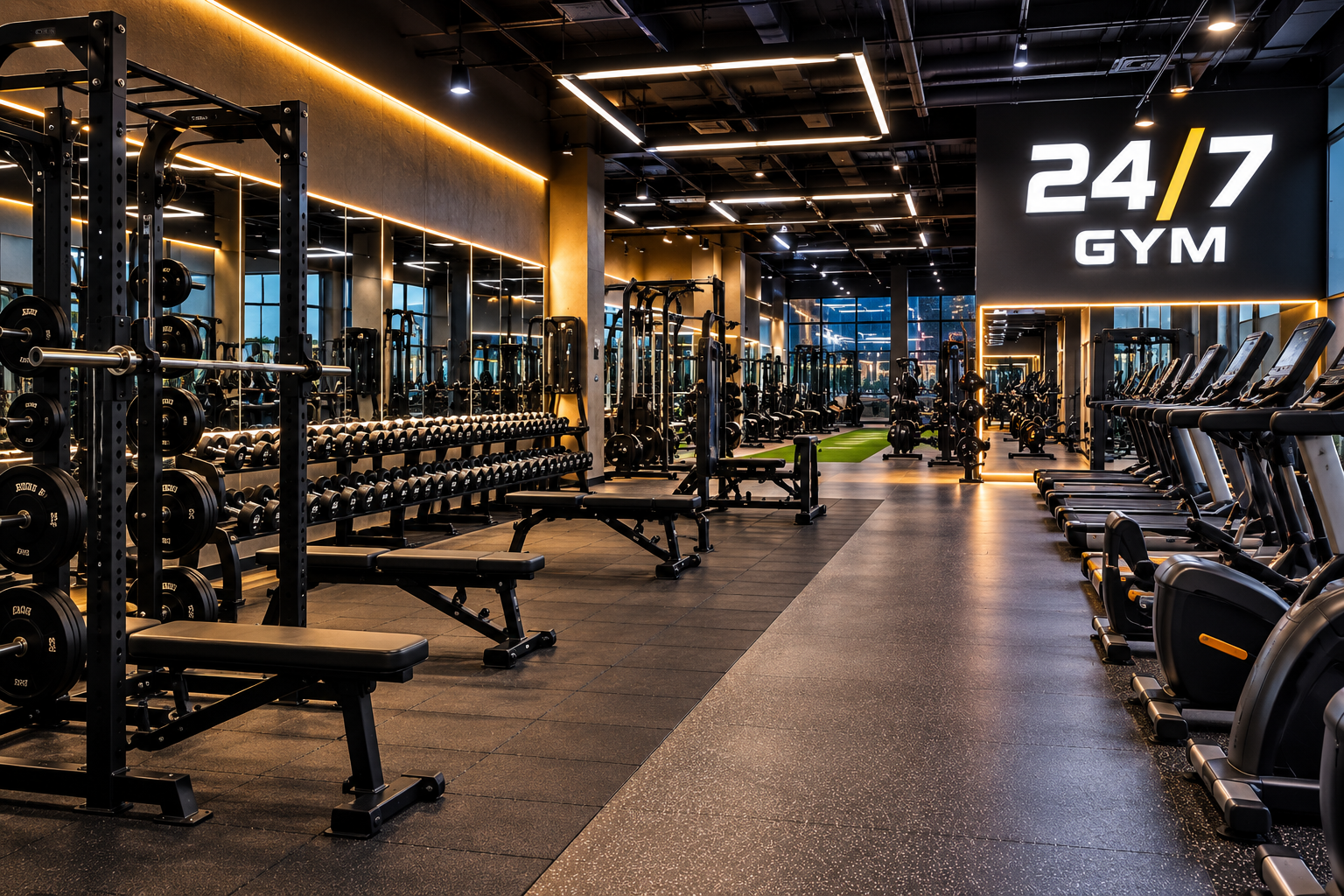
How to design a 24/7 gym: practical guide for layout, safety, and management
24/7 Gym means designing a facility capable of operating continuously, even during unstaffed time slots, through an organization of spaces, equipment, and control systems that ensure safety, operational efficiency, and management simplicity. The design must integrate layout, access control, video surveillance, maintenance, and operational procedures.
A gym open twenty-four hours a day presents different needs compared to a traditional facility. The absence of staff during certain time slots makes it essential to plan every detail, from user access to equipment arrangement, up to monitoring systems and scheduled maintenance interventions.
For managers, the design represents the most important phase of the entire investment. A correct configuration allows for improving the member experience, facilitating daily management, and reducing operational issues that may emerge during the continuous operation of the facility.
- Quick answer
- What requirements must a 24/7 gym have
- How to design space and layout
- How to choose equipment
- Safety, access control, and maintenance
- Design errors to avoid
- FAQ
- How to plan the project
How to design a 24/7 gym?
A 24/7 gym should integrate simple pathways, reliable equipment, access control systems, video surveillance when applicable, emergency procedures, scheduled maintenance, and a rational arrangement of training areas. Each element must contribute to ensuring operational continuity and ease of management even during unstaffed hours.
The design should be developed considering the expected number of users, the adopted management model, and the methods of use of the facility.
Preventive planning also allows for reducing subsequent modifications that could affect the organization of the gym.
Design objective
The objective consists in creating a safe, functional, and easily manageable environment during all opening hours.
Design approach
Layout, equipment, technological systems, and operational procedures must be designed as a single integrated system.
What requirements must a 24/7 gym have?
A facility open twenty-four hours a day requires controlled access, clearly identifiable pathways, adequate lighting, easily readable signage, and areas organized in such a way as to allow the use of equipment without interference.
The environments should facilitate both user movements and control, cleaning, and maintenance operations.
When applicable, design aspects must be verified against current building regulations, plant safety requirements, fire prevention provisions, and any local prescriptions applicable to sports facilities.
Internal pathways
The connections between entrance, locker rooms, fitness areas, and exits should be continuous and easily recognizable.
Complementary services
Automated reception, lockers, restrooms, and common areas should be designed for simple use even during unstaffed time slots.
How to organize space and layout?
A functional subdivision of the environments facilitates gym management and improves the user experience. Areas dedicated to cardio, strength, functional training, and stretching should be clearly separated while maintaining fluid pathways.
Equipment must be distributed avoiding congestion points and allowing effective supervision through any installed control systems.
Sports flooring should be chosen based on the intended use of the various areas, ensuring resistance to continuous use and simplicity of maintenance.
Subdivision of areas
A clear organization of spaces facilitates user orientation and optimizes flows during peak hours.
Flow management
Main pathways should remain free of permanent or temporary obstacles and allow easy access to all stations.
What equipment to choose for a 24/7 gym?
Equipment should be robust, simple to use, easily adjustable, and accompanied by complete technical documentation regarding installation, use, and maintenance.
It is advisable to favor modular configurations that allow future expansions without radically modifying the organization of the facility.
To explore solutions dedicated to professional facilities, you can consult professional gym equipment.
Selection criteria
Construction robustness, simplicity of adjustments, availability of spare parts, and ease of maintenance represent fundamental criteria in evaluating equipment.
Modular configuration
A modular arrangement makes it easier to update the gym based on the evolution of operational needs.
How to manage safety, access control, and maintenance?
Access control systems represent one of the central elements in managing a 24/7 gym. User identification methods must be consistent with the organizational model of the facility and integrated with entrance management procedures.
Scheduled maintenance should include equipment checks, verification of technological systems, environment cleaning, and monitoring of the state of the anti-shock flooring.
When video surveillance systems or electronic access control are used, it is necessary to comply with applicable legislation on personal data protection and provisions in force in the country where the facility operates.
Access control
Access procedures should be simple for users and easily manageable by the gym manager.
Scheduled maintenance
Periodic checks allow keeping equipment and systems in the conditions provided by manufacturers and reducing operational interruptions.
What design errors to avoid?
One of the most frequent errors consists in designing a 24/7 gym like a traditional gym without considering the operational needs of unstaffed time slots.
Another error concerns the arrangement of equipment without a prior evaluation of pathways and maintenance operations.
It is also advisable to avoid configurations that make technical assistance interventions or equipment replacement over time complex.
Dysfunctional layout
An uncoordinated distribution of spaces can slow down daily management and reduce the quality of the user experience.
Non-integrated technology
Control systems should be planned together with the gym project and not added only in the final phases.
FAQ
Is it necessary to provide access control systems?
In 24/7 gyms, they normally represent an important element of operational management, to be chosen based on the organizational model of the facility.
Does equipment need to be different compared to a traditional gym?
Not necessarily, but it is appropriate to favor robust models, easily adjustable and simple to maintain during continuous use.
How much does maintenance matter?
Scheduled maintenance is fundamental to maintain operational continuity, safety, and service quality throughout the entire year.
How to plan the 24/7 gym project?
The design should start with the analysis of the catchment area, the management model, the available surface, and the services the facility intends to offer. Subsequently, it is possible to define layout, equipment, technological systems, and operational procedures in a coordinated manner.
When applicable, the main references include current building regulations, provisions relating to plant safety, fire prevention regulations, rules applicable to personal data protection for access control and video surveillance systems, as well as manufacturer manuals concerning equipment installation, use, and maintenance. Each project should be verified against the intended use of the facility and the requirements provided by local regulations.
A modular approach allows developing the gym in phases, progressively adapting spaces and services to the evolution of the activity. Planning the project based on verifiable criteria allows optimizing investments, improving operational management, and offering users a reliable environment during all twenty-four hours of opening.
Comments (0)