
Trolley
You have no items in your shopping cart

 Budgets
 Dumbers
 Discs
 Benches
 Racks and Rigs
 Weights Holders
 Isotonic machines
 Calisthenics
 Cardio
 Kettlebells
 Flooring
 Gym Set
 Accessories
 Combat
 ARTI MARZIALI
 CONTAINER GYM
 Tug-Of-War
 Used Gym Equipment
 PILATES MACCHINARI
 GINNASTICA ARTISTICA
 CAMPI DA PADEL
 Prodotti in Pronta Consegna
 Informazioni
 IRONMAN
 Gift Card
- Donatif
- General information
- 0 I like it
- 157 Views
- 0 comments
- gym flooring, safety flooring, gym safety, shock-absorbing materials
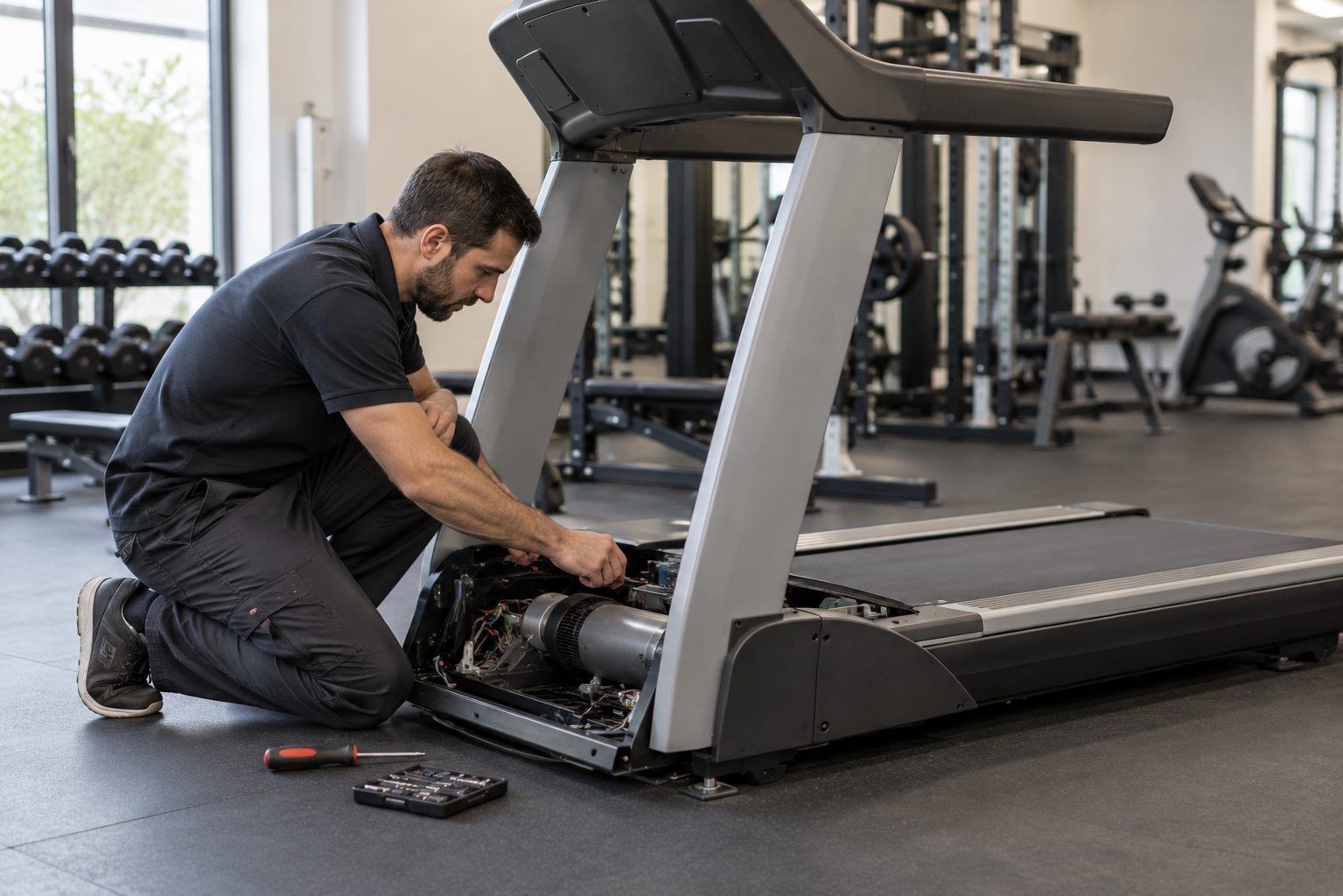
High Power fitness spare parts: identifying the part and preparing the request
When a High Power machine has a problem, immediately looking for a component with the same appearance can lead to an incorrect order. The most useful path starts from identifying the equipment and accurately describing the symptom, before attributing the failure to a part.
Understanding how to find spare parts for High Power fitness equipment means organizing a verifiable request: model, serial number, documentation, and confirmation of compatibility. The availability of a part and the associated services must be ascertained directly with the competent interlocutors.
This guide is neither an updated spare parts catalog nor a promise of availability. It proposes a method for managers and maintenance staff who need to collect data, compare responses, and coordinate the intervention without ordering components based on similarity.
The brand name is not enough to identify every configuration. Two machines in the same category may have different components or revisions. Keeping the specific information of each unit reduces the time needed to prepare a complete request when an anomaly arises.
A frequent case is a machine purchased used, with an incomplete manual and a previous undescribed replacement. In this situation, it is advisable to declare the missing information and have the actual configuration identified. Searching for the part using only the model name risks ignoring a relevant modification.
Another case involves two units present in the same gym. Staff may think of transferring an accessory from the working machine to the stationary one. However, prior to any operation, appropriate compatibility and procedure are required: visual comparison does not authorize an exchange or an autonomous test.
These examples can become a brief internal sheet to prepare the request. The sheet is not used for diagnostics, but to collect what support will need to verify and to keep the machine correctly identified throughout the process.
- Identify the machine before the part
- Describe the observed problem
- Track down the correct code
- Contact the interlocutors
- Evaluate the order
- Prepare the intervention
- Close the request and update the data
Identify the machine before the part
Label and documents
Collect brand, model, and serial number from the label or available documents. Transcribe the data legibly and link the request to the machine's position in the room. If part of the label is illegible, indicate the gap instead of completing it with a guess.
Check the invoice, manual, and previous service reports to look for consistent information. A photograph can facilitate identification, but it must show the relevant data without requiring unauthorized disassembly. Do not remove guards just to find a code you do not know the location of.
Model and revision
Ask the interlocutor if the serial number is used to distinguish revisions or configurations. A commercial name may have been used for different units; compatibility must be confirmed on the actual machine. Do not assume that the component of a second unit is identical just because it looks similar externally.
If the machine has received modifications or previous replacements, report what is documented. The currently installed part may not represent the initial configuration. The history helps the technician understand the situation without turning a past repair into an automatically valid reference.
Describe the observed problem
Symptoms and conditions
Indicate what happens, when it appears, and which function is involved. Noise, irregular sliding, a console message, or an adjustment that does not stay set are useful observations. A phrase like broken machine does not make it clear what further data is needed.
Distinguish observation from diagnosis. A noise alone does not prove that a belt needs to be replaced, just as a dark display does not automatically identify the faulty component. A competent person must evaluate the causes before defining the intervention.
Securing the workstation
If the anomaly can compromise use, apply the suspension procedure and make the machine's status clear to users and shifts. Do not ask different people to repeatedly retry a potentially risky defect to gather further examples.
Photographs or videos can be useful only if they can be obtained without exposing people to inappropriate conditions. Do not open electrical components or bypass devices to record the problem. Follow the instructions and involve qualified personnel for operations that require it.
Track down the correct code
Manuals and exploded views
Check if the available documentation includes a component list or an identifying drawing. Link the position to the reported code, verifying that the document refers to the appropriate model and revision. A generic drawing may be insufficient for ordering.
If you cannot find the code, prepare the machine data and ask for assistance with identification. Measurements and images can supplement the request, but they do not replace confirmation of the part. The goal is to obtain a verified reference, not to choose the first result that seems compatible.
Updated codes and kits
When a different code is proposed, ask if it replaces the previous one and for which machines it is applicable. The confirmation should indicate the relevant model or identifying data. Keep the response along with the unit's order and documentation.
Clarify whether the component is sold alone or as part of an assembly and what other elements the intervention requires. The technician can indicate what is needed to complete the work. Ordering a part without knowing this dependency can leave the machine out of service even after delivery.
Contact the interlocutors
Preparing a complete request
Send an orderly description with identifying data, symptom, and relevant documentation. Ask for spare part identification, compatibility, availability, and installation methods. A structured request makes it easier to distinguish a technical response from commercial availability that still needs to be verified.
You can start from the references present in the purchase or service documents and verify the role of the contacted operator. Do not automatically assign the qualification of authorized brand dealer to a seller. Role, services, and coverage must be confirmed directly.
Comparing responses and limits
If you receive different proposals, ask what data was used to identify them. Do not choose solely based on the price or time indicated without resolving a compatibility difference. An incomplete response must be clarified before ordering.
To navigate between categories and commercial requests, you can consult Donatif; this does not confirm the availability of High Power spare parts or a service relationship with the brand. The specific supply must be verified with the competent operator.
Evaluate the order
Availability and delivery
Distinguish a catalog component from one actually available for your request. Ask for times, shipping conditions, and methods of communicating any delays. A delivery estimate must remain recognizable as such if it depends on further confirmations.
Verify what the price includes and whether transport, materials, or separate interventions are required. The cost of the part does not equal the cost of the machine put back into service. A complete evaluation considers what is needed to install it and verify its operation.
Conditions and alternatives
Ask what conditions apply to the warranty, assistance, and return of the specific component. Do not assume that a part ordered based on technical identification can be returned under the same conditions as another purchase. For relevant contractual matters, involve the competent professional.
If an alternative is proposed, its compatibility must be verified prior to use. An identical measurement or a similar connector does not prove functional, mechanical, or electrical equivalence. Avoid improvised adjustments to use a received but unconfirmed spare part.
Prepare the intervention
Materials and person in charge
Before scheduling the downtime, verify that the received part matches the order and that the person performing the work has the necessary information. Identify tools and additional components with the technician, without creating a bill of materials based on gym staff assumptions.
The intervention must follow the relevant instructions and required competencies. Electrical operations, disassembly, and adjustments do not become routine activities just because the part is available. The manager coordinates space and access, keeping their own role distinct from the technical one.
Schedule and communication
Organize an appropriate workspace and inform the shifts about the machine involved and the status of the service. The window must allow the intervention under the expected conditions, not just reduce user wait times. If power isolation is needed, the person with the necessary competencies intervenes.
Indicate a contact person for organizational decisions if unforeseen conditions arise. Do not ask the technician to complete the work anyway with a different part to meet a date. A modification must be evaluated and documented before it is put back into use.
Close the request and update the data
Final check
The reopening of the workstation follows the checks planned for the machine and the intervention. The installation of the spare part does not automatically prove that the symptom has been resolved. The competent person confirms the conditions and communicates any activities still required.
Record the date, installed code, operations, and instructions received. If the problem returns, link the new report to the previous one without assuming the same cause. A readable history helps avoid duplicate requests and keeps information consistent across shifts.
An archive useful for the next request
Update the inventory with the verified codes and the sources of confirmation. Do not turn a single machine's code into a universal reference for the entire brand. The data remains linked to the model, revision, and configuration actually checked.
Periodically review contacts, documents, and supplies when equipment or operators change. The organizational advantage stems from reliable and accessible information: the next request can start from an already verified base, while still always requiring compatibility control in the specific case.
Comments (0)