
Trolley
You have no items in your shopping cart

 Budgets
 Dumbers
 Discs
 Benches
 Racks and Rigs
 Weights Holders
 Isotonic machines
 Calisthenics
 Cardio
 Kettlebells
 Flooring
 Gym Set
 Accessories
 Combat
 ARTI MARZIALI
 CONTAINER GYM
 Tug-Of-War
 Used Gym Equipment
 PILATES MACCHINARI
 GINNASTICA ARTISTICA
 CAMPI DA PADEL
 Prodotti in Pronta Consegna
 Informazioni
 IRONMAN
 Gift Card
- Donatif
- General information
- 0 I like it
- 185 Views
- 0 comments
- gym flooring, safety flooring, gym safety, shock-absorbing materials
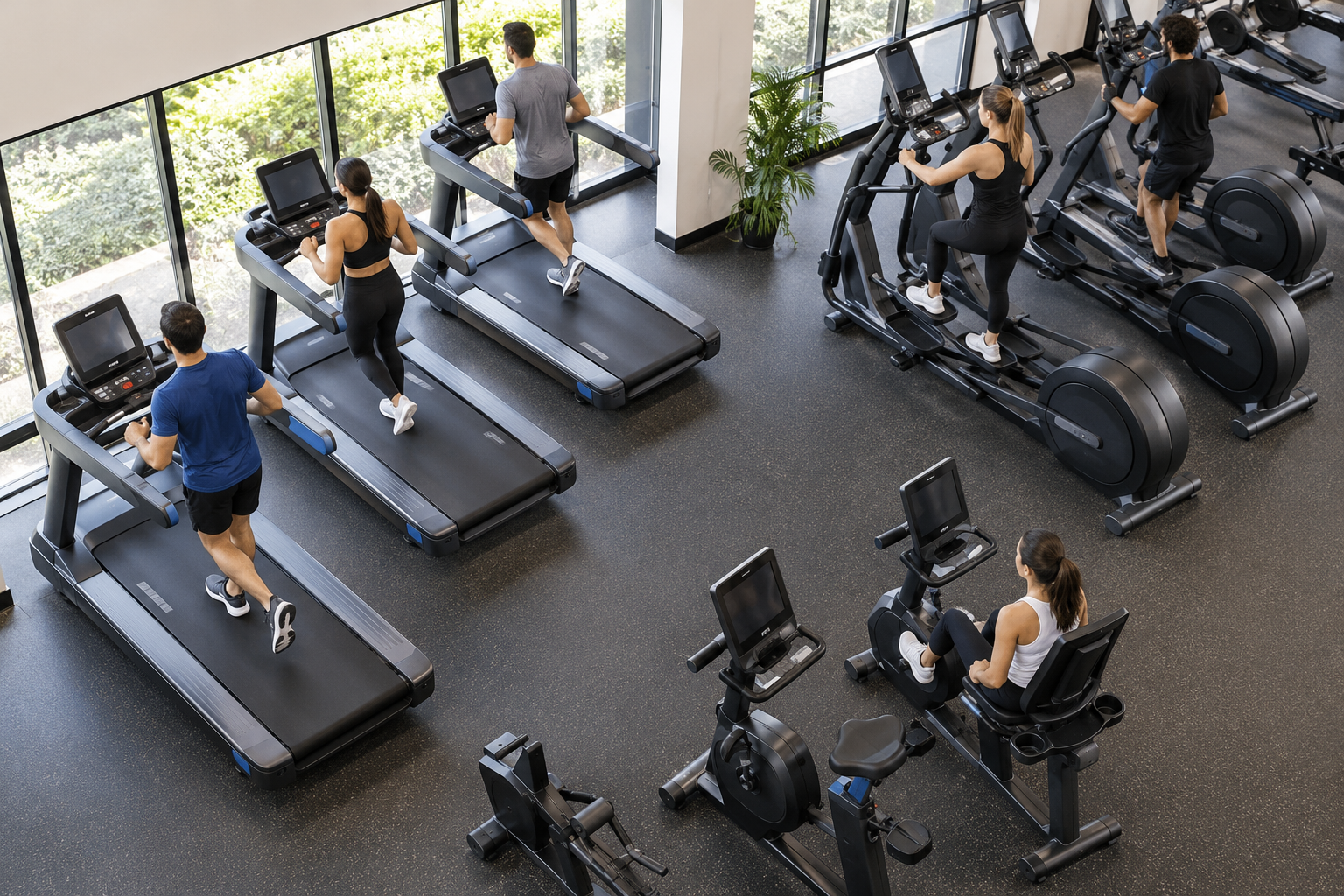
Organizing a cardio room: workflows, service and daily management
A well-organized cardio room allows users to start their activity, find alternatives when a machine is occupied and know who to turn to. The result depends on the equipment, but also on pathways, instructions, maintenance and staff presence.
Understanding how to organize a cardio room in a gym means designing a service that functions during the different hours of the day. The layout must support actual usage, including cleaning, assistance and potential technical downtime.
This guide covers the overall organization of a dedicated room. It starts from user habits and reaches operational procedures, while keeping checks on machines, systems and the building entrusted to manufacturer indications and competent figures.
Before modifying the area, observe at least the main phases of the day: opening, busy moments, rotation between users and closing. Note down where queues form and where the staff encounters difficulties. Observations become more useful requirements than an abstract preference for an arrangement.
A useful example is a room that registers many requests for treadmills during the lunch break, while some bikes remain available. Before increasing the equipment, the manager can observe whether people choose the treadmill for a specific goal, out of familiarity or because they do not know how to adjust the alternatives. The answers lead to different interventions.
The same observation must include the work of the staff. If a machine is difficult to clean without interrupting the neighboring one, the problem concerns the layout; if reports do not reach the technician, it concerns the process. Separating these causes makes the intervention plan more precise and prevents using a purchase as an automatic response.
Also prepare a handover between opening and closing. The next shift should know which machines are available, which require checking and which supplies are missing. A brief and updated note is more usable than scattered messages that force reconstructing the situation every time.
When the room hosts events or extraordinary activities, check beforehand how accesses and cleaning will change. Ordinary service must resume only after the stations have returned to the expected configuration and the relevant checks have been completed.
- Describing the day in the room
- Distributing categories and stations
- Designing pathways and operational areas
- Preparing the environment and systems
- Instructions and staff presence
- Cleaning and fault management
- Reviewing the organization
Describing the day in the room
Accesses and stay
Divide accesses by time slots and observe how many people use the machines simultaneously. Also record the indicative duration of sessions and the most requested categories. The number of members alone does not allow predicting how many stations are needed at a given time.
Information can come from aggregated observations and staff comments, without collecting unnecessary personal data. Highlight the periods you have not yet observed and any seasonal variations. An initial sample is a baseline to be updated, not a definitive forecast.
Warm-up and long sessions
Distinguish those who use cardio for a few minutes before other activities from those who perform a complete session. These behaviors can produce different requests and occupy the same machines. Understanding the differences helps explain waiting times and evaluate alternatives.
Do not automatically attribute a queue problem to poor machine availability. Poorly visible instructions, preferences for a position or difficulties with some consoles could have an impact. Before buying new units, verify what concretely happens and what organizational changes are feasible.
Distributing categories and stations
A coherent offering
Compare treadmills, bikes, ellipticals and rowers against the requested activities. Each category offers different characteristics for access, movement and adjustments. The distribution does not necessarily have to be uniform: it must respond to the observed demand and the facility's program.
Evaluate the intended use and conditions of the models, including expected frequency and user limits. The word professional does not describe every condition of use on its own. Ask for data and instructions of the model actually offered before including it in the project.
Understandable alternatives
If a machine is occupied, the user should be able to ask the staff for a coherent alternative. The instructor evaluates the proposal based on the person and the program, without presenting different categories as perfectly equivalent. Simple communication can reduce uncertainty without promising identical results.
The cardio machines allow comparing categories and configurations; specific sheets and supply conditions are needed to decide. Availability, installation and maintenance must be confirmed directly for the selected products.
Designing pathways and operational areas
Entrance and circulation
The entrance should allow reading the room without immediately crossing movement areas. Mark doors, pillars and pathways on the floor plan and consider where a person can stop to ask for help. Do not use the spaces required for machine use as waiting areas.
For each model, add the footprint and spaces indicated by the manufacturer for access, activity and maintenance. The external dimensions of the stopped machine do not describe the entire station. Verify that the layout continues to function when multiple people get on, get off or modify the adjustments.
Staff access
Those who clean or assist must be able to reach the machine without interfering with other sessions. Check how to access components and how to move any cleaning products. The ability to keep a pathway clear should not depend on occasional user collaboration.
If room modifications are needed, involve the relevant professionals for accessibility and applicable building conditions. Do not derive mandatory distances from generic examples. The final layout must combine model specifications and the requirements of the place where they are installed.
Preparing the environment and systems
Power supply and connections
Electrically powered machines must be connected according to the specifications and conditions of the system. Define sockets and pathways with a qualified professional when necessary. Do not leave cables or extension cords along walkways to adapt an already decided layout.
A model change can modify power supply, dimensions or access requirements. Before approving a replacement, verify its effect on the project. Keep the sheet used for each position, so the staff knows which configuration was evaluated.
Air, light and noise
Ventilation and lighting must be adequate for the environment and activity, with the necessary checks by competent figures. Avoid reflections that make it difficult to read the consoles and consider comfort in the different positions of the room.
Noise and vibrations require an evaluation of the context, especially near sensitive environments. Do not attribute to a flooring the automatic capacity to solve the problem. When necessary, involve a competent technician and consider machines, building and usage methods as a whole.
Instructions and staff presence
Reception and first use
Organize a brief introduction for those unfamiliar with the machines: startup, essential adjustments, stop and problem reporting. The instruction must refer to the model present, not just the category. Similar consoles may have different controls and procedures.
Verify that information is readable and that the user knows where to find assistance. A sheet near the machine can remind of the steps, but does not replace the instructor's observation when necessary. People with special needs may require personalized indications from competent professionals.
Rules for busy moments
If usage rules are needed, build them on observed behaviors and communicate them clearly. Occupation times, any reservations and management of waiting times must be understandable to the staff before being requested of users.
Evaluate the effect of the rules after a trial period. A limit equal for every situation may not respond to real demand. The manager can modify the organization while keeping communication consistent and ensuring that the technical instructions of the machines remain respected.
Cleaning and fault management
Tasks and materials
Define who cleans the different surfaces, when and with which products approved by the manufacturer. If you ask users to clean contact points, make materials and methods recognizable. The staff nevertheless maintains responsibility for the activities provided by the facility.
Do not spray products on consoles or mechanisms without appropriate instructions. A cleaning activity can offer the opportunity to observe damage or loose components, but does not replace technical maintenance. Every anomaly must have a precise reporting channel.
Downtime and reopening
Identify each machine with a simple reference and record the symptom, time and conditions of the problem. If use must be suspended, apply the expected procedure and make the station's status clear. Prevent a user from restarting it because they did not see the notice.
Returning to service follows checks by the technician or competent person according to applicable procedures. Communicate the outcome to subsequent shifts and keep the documentation. Occasional operation does not prove that an intermittent defect has been resolved.
Reviewing the organization
Useful indicators
Choose a few observable elements: occupation by category, waiting times, reports and downtime. Read them together with staff comments. An isolated datum does not necessarily explain the cause of a problem, but can indicate where to investigate further.
Compare equivalent periods and record changes such as new classes or machine movements. If usage increases after better explanation of the controls, the experience can guide other modifications. Do not automatically attribute every variation to the layout or equipment.
Deciding interventions
Before adding a machine, evaluate whether training, maintenance or a different pathway is needed. If a purchase is needed, update the drawing and check spaces and systems again. An additional station must not make access and assistance difficult.
Document the decision, hypotheses and what you will need to observe after the modification. The manager will thus be able to understand whether the intervention answered the question and whether further corrections are necessary. Organization remains an operational process, connected to the actual use of the room.
Comments (0)