
Trolley
You have no items in your shopping cart

 Budgets
 Dumbers
 Discs
Discs
 Benches
 Racks and Rigs
 Weights Holders
 Isotonic machines
 Calisthenics
 Cardio
 Kettlebells
 Flooring
 Gym Set
 Accessories
 Combat
 ARTI MARZIALI
 CONTAINER GYM
 Tug-Of-War
 Used Gym Equipment
 PILATES MACCHINARI
 GINNASTICA ARTISTICA
 CAMPI DA PADEL
 Prodotti in Pronta Consegna
 Informazioni
 IRONMAN
 Gift Card
- Donatif
- General information
- 0 I like it
- 9 Views
- 0 comments
- gym flooring, safety flooring, gym safety, shock-absorbing materials
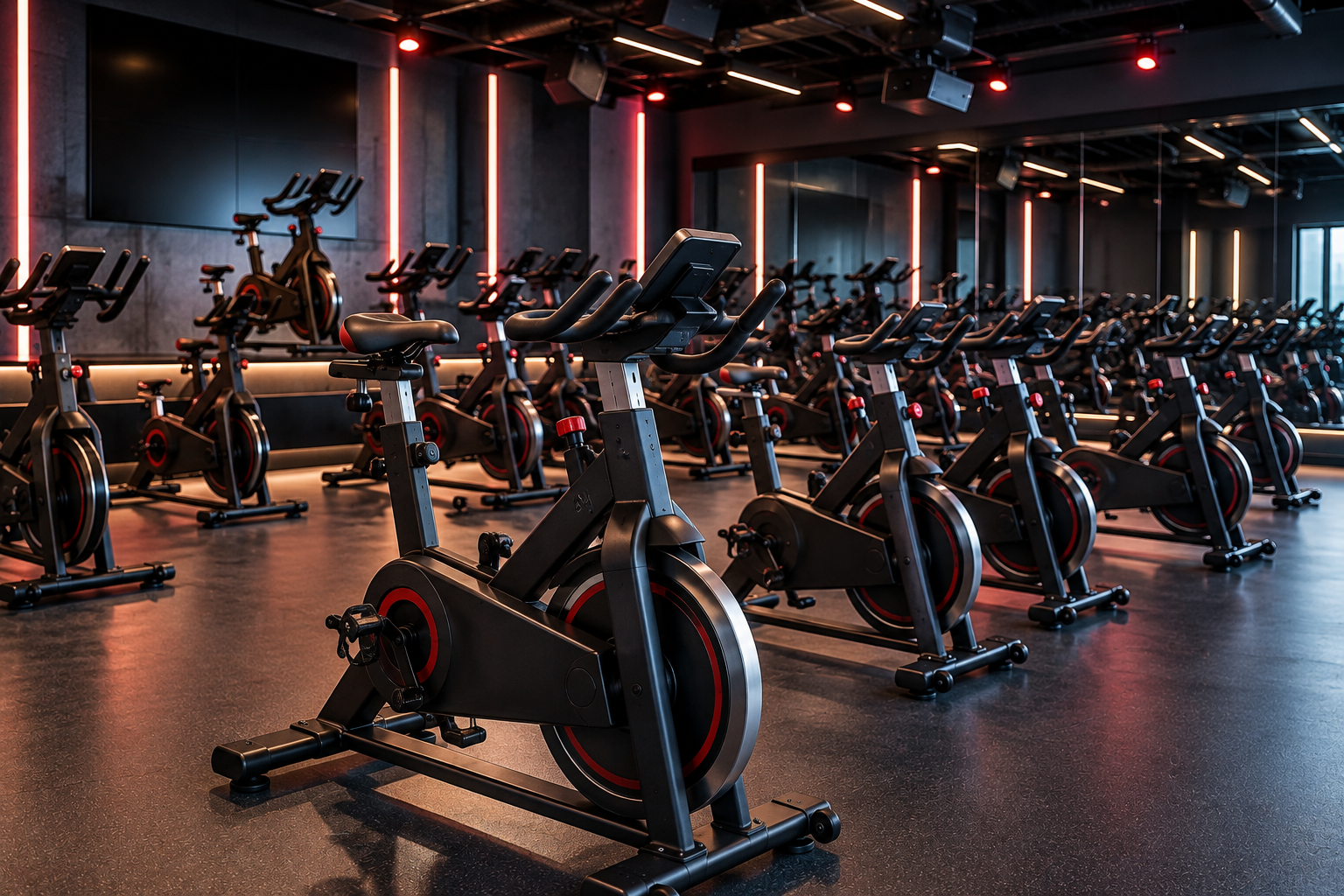
Indoor cycling for cycling studios: selection and configuration criteria
Indoor cycling is a discipline performed on stationary bikes designed for individual workouts or group classes. To create an efficient cycling studio, it is necessary to properly design the layout, workstation configuration, access paths, systems, and operational organization. Planning based on verifiable criteria improves comfort, safety, and continuity of activities without turning the room into a simple space with rows of bikes.
The quality of an indoor cycling room actually depends on the integration between equipment, available space, and usage methods. Bike placement, flow management, ventilation, acoustics, and ease of maintenance directly affect user experience and staff efficiency.
This guide analyzes how to configure a professional cycling studio, illustrating space requirements, equipment selection criteria, organizational aspects, safety, and maintenance. When applicable, it is advisable to consult installation manuals, manufacturer technical documentation, and system specifications, which represent the primary sources for dimensions, configuration, and usage.
- What is an indoor cycling studio
- What requirements it must have
- How to design space and layout
- How to configure the bikes
- How to organize the activity
- Safety and maintenance
- Design errors to avoid
- How to evaluate the investment
What is an indoor cycling studio?
A room dedicated to indoor cycling is a space specifically designed to host stationary bikes intended for group classes or individual workouts. The room's configuration must allow for orderly management of workstations and ensure visibility, accessibility, and ease of use.
Effective design simultaneously considers bike ergonomics, space distribution, technical systems, and the facility's operational model.
Each element should be consistent with the expected number of users and the gym's operational model.
Group class
A room primarily intended for group classes requires special attention to bike arrangement, instructor visibility, and internal pathway management.
Individual workout
When the room is also used for individual sessions, it is useful to provide a configuration that keeps all workstations easily accessible.
What requirements must a cycling studio have?
Before choosing equipment, it is necessary to define the facility's goals, number of participants, class frequency, and usage methods.
The truly important features include the build quality of the bikes, simplicity of adjustments, space organization, ease of maintenance, and system integration.
Design should be developed considering the future operational management of the room and not just the initial installation.
Bike selection
Bikes should offer simple adjustments, a robust structure, and easily maintainable components as provided by the manufacturer.
Supporting systems
Lighting, ventilation, and the sound system must be designed as an integral part of the environment rather than as separate elements.
How to design space and layout?
The layout represents one of the main factors influencing the quality of the experience. Bikes must be distributed in a way that allows access, adjustments, cleaning, and maintenance.
Operating distances depend on the installed model and must always be verified in the manufacturer's instructions.
An orderly arrangement facilitates instructor control and reduces interference between users during mounting, dismounting, and adjustments.
Space management
The available space must include both the footprint of the bikes and the areas necessary for people to pass through and for technical interventions.
Flooring
The flooring must be stable, compatible with the weight of the equipment, and suitable for intensive use according to the manufacturers' indications.
How to correctly configure the bikes?
Every user should be able to quickly adjust the saddle and handlebars before the session begins. Adjustments must be intuitive and easily verifiable.
A uniform configuration facilitates class management and reduces the time needed to prepare workstations.
Before each use, it is advisable to check the correct locking of the adjustment systems.
Initial adjustments
Adjustments must be made following exclusively the instructions given in the bike manufacturer's manual.
Workstation accessories
Bottle cages, holders, and other accessories must be installed without limiting the user's freedom of movement.
How to organize studio management?
The configuration should facilitate both the conducting of classes and the daily operations of the staff.
It is useful to define entrance and exit paths, workstation assignment methods, and control procedures before activities begin.
Orderly management reduces downtime between one class and the next.
Flow management
Pathways should avoid unnecessary crossings between users and allow the instructor to quickly reach every bike.
Instructor position
The area dedicated to the instructor should ensure good visibility of the entire room and allow effective communication with all participants.
What safety and maintenance aspects to consider?
An indoor cycling room requires periodic checks of the bikes, adjustments, and systems present in the environment.
Maintenance operations must follow what is indicated in the manufacturer's technical documentation and include checks of parts subject to wear.
Regular cleaning of the workstations also contributes to maintaining the efficiency and durability of the equipment.
Periodic checks
Before classes, it is advisable to check bike stability, adjustment systems, moving components, and the general condition of the equipment.
Technical documentation
Manuals and official instructions constitute the main reference for maintenance, configuration, and proper use of the bikes.
What design errors to avoid?
One of the most frequent errors consists of installing an excessive number of bikes, sacrificing operating space and access paths.
Another critical issue concerns the separate design of equipment and systems, without coordinating lighting, ventilation, and sound distribution.
It is also advisable to avoid configurations that make bike adjustment or instructor supervision difficult.
Workstations too close together
Excessive density can limit freedom of movement and make cleaning, maintenance, and class management more complex.
Non-functional pathways
Disorderly access and insufficient corridors can slow down user entry and complicate staff work.
How to evaluate the investment in an indoor cycling studio?
The choice should consider bike quality, simplicity of adjustments, space organization, maintenance, potential for future expansion, and system integration. A truly effective investment stems from comprehensive design rather than just equipment selection.
To learn more about solutions dedicated to cardiovascular training, you can consult the cardio machines category, which is useful for comparing different types of equipment intended for fitness areas.
Before creating the studio, it is advisable to consult manuals, technical datasheets, assembly instructions, and official documentation from the bike and system manufacturers, which represent the primary sources for configuration, installation, maintenance, and use. Design based on verifiable criteria makes it possible to create an efficient cycling studio that is easily manageable and consistent with the operational goals of the facility.
FAQ: can a cycling studio also be used outside of class hours?
Yes, as long as the facility's organizational configuration allows it and usage procedures are compatible with individual training.
FAQ: which documents should you start from during design?
It is advisable to consult manufacturer manuals, bike technical datasheets, installation instructions, and system documentation to verify dimensional requirements and usage methods.
Comments (0)