
Trolley
You have no items in your shopping cart

 Budgets
 Dumbers
 Discs
Discs
 Benches
 Racks and Rigs
 Weights Holders
 Isotonic machines
 Calisthenics
 Cardio
 Kettlebells
 Flooring
 Gym Set
 Accessories
 Combat
 ARTI MARZIALI
 CONTAINER GYM
 Tug-Of-War
 Used Gym Equipment
 PILATES MACCHINARI
 GINNASTICA ARTISTICA
 CAMPI DA PADEL
 Prodotti in Pronta Consegna
 Informazioni
 IRONMAN
 Gift Card
- Donatif
- General information
- 0 I like it
- 9 Views
- 0 comments
- gym flooring, safety flooring, gym safety, shock-absorbing materials
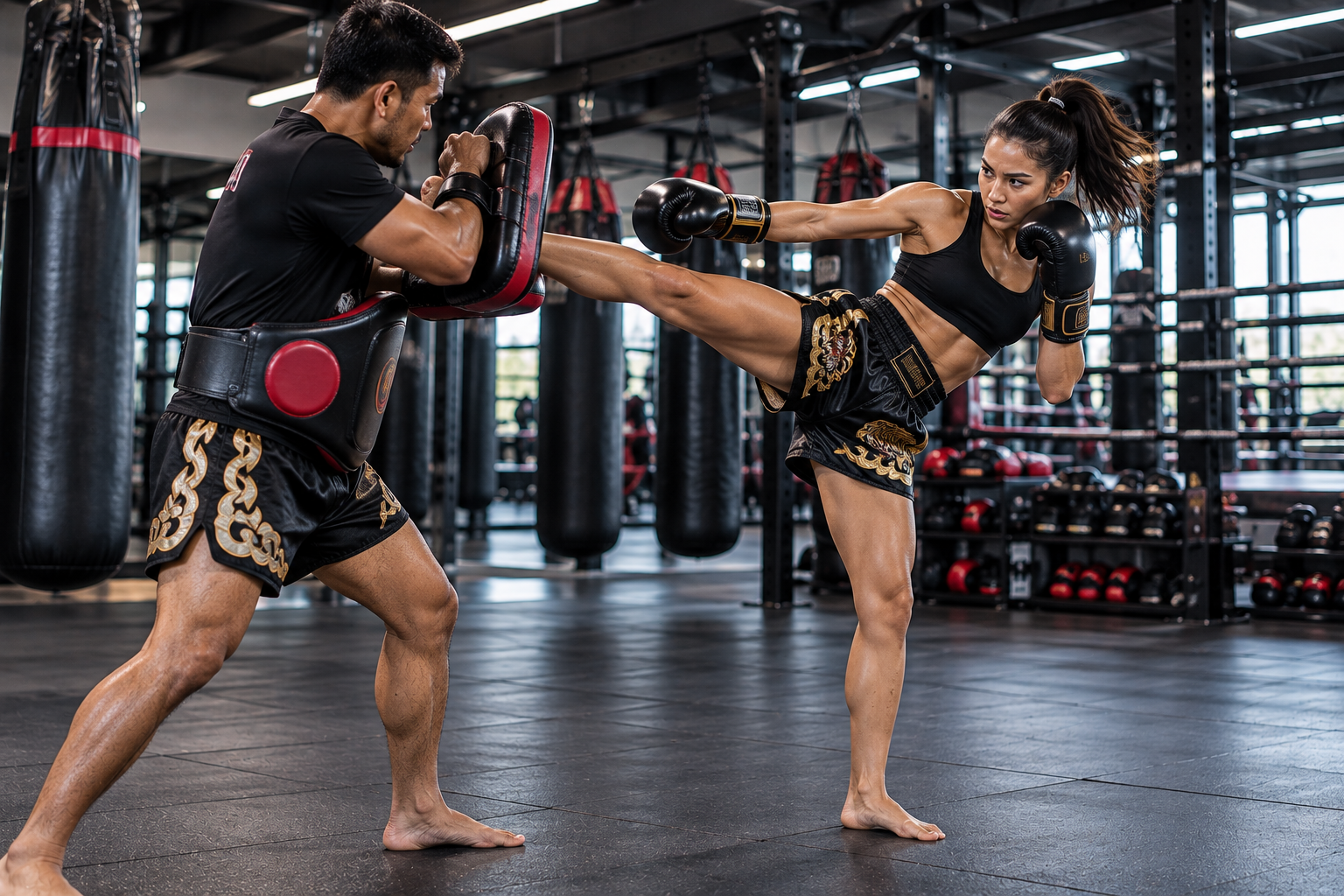
Muay Thai Equipment: Personal Equipment vs Gym Equipment
Muay Thai Equipment means distinguishing what every practitioner should personally own from what a gym should provide for its members. A correct choice improves safety, hygiene, equipment durability, and training quality, avoiding unnecessary purchases and shortcomings in the facility's equipment.
Those who start Muay Thai often face the same doubt: is it better to immediately buy all the equipment or rely on what is present in the gym? The answer depends on the type of material, training frequency, hygienic needs, and technical level reached. Some accessories are strictly personal, while others represent shared equipment that a well-organized gym should offer.
For sports center managers too, the distinction is fundamental. Complete equipment allows for organizing effective lessons, reducing downtime, and ensuring workouts suitable for both beginners and more experienced athletes. The goal is not to accumulate equipment, but to choose tools suited to the available space, the number of users, and the proposed technical program.
- Quick Answer
- Decision Criteria
- Comparison Table
- What Personal Equipment is Needed
- What Equipment a Gym Must Have
- When to Choose One Solution or Another
- Errors to Avoid
- Evaluating the Investment
Personal equipment or gym equipment?
The most practical answer is simple. Elements that come into direct contact with the body and must adapt to the user's characteristics are normally personal. Bulky, expensive equipment or equipment intended for collective training falls instead under the gym's provision.
This distinction allows for improved hygiene, limited wear and tear of shared material, and a more consistent training experience over time.
A well-equipped gym integrates both components by offering quality common tools and inviting practitioners to progressively purchase their own personal gear.
What to purchase personally
Gloves, mouthguards, handwraps, a cup when necessary, ankle supports if used in technical preparation, and dedicated clothing are generally personal items because they affect comfort, fit, and hygiene.
What the gym must provide
Heavy bags, striking pads, pao pads, shields, training area, stopwatches, timers, jump ropes, material for athletic preparation exercises, and suitable flooring normally represent the shared equipment of the facility.
Which criteria to use for choosing
The first criterion concerns safety. The equipment must be suitable for the intended use, maintained in good condition, and periodically checked. Damaged or excessively worn components should be replaced.
The second criterion concerns hygiene. All items that absorb sweat or are worn directly by the practitioner generally prove more suitable for personal use.
The third criterion concerns frequency of use. The more an athlete trains, the greater the advantage in using their own equipment, selected based on individual preferences and always available.
Available space
For a gym, it is important to evaluate the usable surface area, safety distance between stations, and the possibility of simultaneously organizing bag work, partner technique, and athletic preparation.
Maintenance
Maintenance planning includes regular cleaning, checking of seams, control of fastening systems, inspection of impact surfaces, and replacement of deteriorated material.
Comparison table
The following summary helps to quickly distinguish the responsibilities of the practitioner and the facility.
| Element | Personal | Gym |
|---|---|---|
| Gloves | Yes | Only for trial or beginners |
| Handwraps | Yes | No |
| Mouthguard | Yes | No |
| Shorts | Yes | No |
| Heavy bags | No | Yes |
| Pao pads | No | Yes |
| Striking pads | No | Yes |
| Jump ropes | Optional | Yes |
| Flooring | No | Yes |
What personal equipment is needed for Muay Thai
For beginners, it is advisable to build one's equipment gradually. The initial purchase should focus on items used in every training session that directly impact comfort.
Gloves must be chosen considering body weight, intended use, and type of training. Correct wrist support contributes to stability during strikes and comfort during prolonged sessions.
Handwraps help support the hand and wrist and should be kept clean through regular washing according to the manufacturer's instructions.
How to choose gloves
Materials, padding, seam quality, closure system, and intended use represent more useful criteria than just aesthetics. For those wishing to learn more about product selection, the combat equipment category is available.
Other personal accessories
Towel, water bottle, protections possibly required by gym regulations, and a dedicated bag allow keeping the gear organized and in better condition.
How to set up a Muay Thai area in the gym
A dedicated facility should provide a rational distribution of work stations, avoiding interference between different groups. The space intended for heavy bags should allow complete movements without obstacles.
Training bags must be chosen considering height, weight, outer material, and suspension system. Proper installation contributes to the safety of the entire area.
Pao pads and striking pads should be available in adequate numbers to allow partner exercises without slowing down the lesson.
How to choose Muay Thai bags and striking pads
It is necessary to evaluate construction quality, padding uniformity, seam robustness, ease of maintenance, and compatibility with the users' level. It is preferable to provide different models for technical training and high-intensity work.
Flooring and technical space
Adequate sports flooring facilitates movement, improves comfort during exercises, and contributes to subfloor protection. The area should remain tidy and free of unused equipment.
In which scenarios to choose one solution or the other
Those trying Muay Thai for a few lessons can initially use part of the material provided by the gym, if available and correctly sanitized.
A practitioner who attends regularly instead benefits from owning their own complete equipment, always available and suited to their preferences.
For a gym oriented towards both the amateur and competitive public, it is advisable to maintain a large stock of collective equipment and require members to use personal protections.
Beginners
The investment can be gradual, starting from the essential accessories and expanding the kit with increasing experience.
Structured gyms
Careful equipment planning allows managing numerous classes while maintaining high training quality and reducing material wear.
Most common errors
One of the most frequent errors consists in purchasing exclusively based on price without evaluating intended use, construction quality, and durability.
Another error is neglecting maintenance. Even good quality products require cleaning, seam checks, and replacement when deteriorated.
Finally, many facilities purchase numerous secondary accessories without first ensuring a complete provision of the tools actually used during each lesson.
Space management
An overly crowded area limits the technical quality of the training and increases the risk of interference between practitioners.
Unplanned purchases
Establishing priorities based on the number of members and the educational program allows better distribution of the available budget.
How to evaluate the investment in Muay Thai equipment
For the practitioner, the priority consists in purchasing personal equipment that will be used at every training session. For the gym, however, the investment should focus on shared tools that allow carrying out complete and progressive programs.
Before purchasing new equipment, it is useful to verify the average number of participants per lesson, station rotation, the space actually available, and the expected maintenance frequency. These elements allow choosing equipment consistent with operational needs, avoiding waste and under-sizing.
When applicable, it is appropriate to refer to the manufacturer's instructions for installation, use, and maintenance, in addition to technical equipment manuals and general safety standards provided for sports environments. An approach based on verifiable criteria allows maintaining high standards of functionality over time without turning the choice of equipment into a simple catalog comparison.
Comments (0)