
Trolley
You have no items in your shopping cart

 Budgets
 Dumbers
 Discs
Discs
 Benches
 Racks and Rigs
 Weights Holders
 Isotonic machines
 Calisthenics
 Cardio
 Kettlebells
 Flooring
 Gym Set
 Accessories
 Combat
 ARTI MARZIALI
 CONTAINER GYM
 Tug-Of-War
 Used Gym Equipment
 PILATES MACCHINARI
 GINNASTICA ARTISTICA
 CAMPI DA PADEL
 Prodotti in Pronta Consegna
 Informazioni
 IRONMAN
 Gift Card
- Donatif
- General information
- 0 I like it
- 674 Views
- 0 comments
- gym flooring, safety flooring, gym safety, shock-absorbing materials
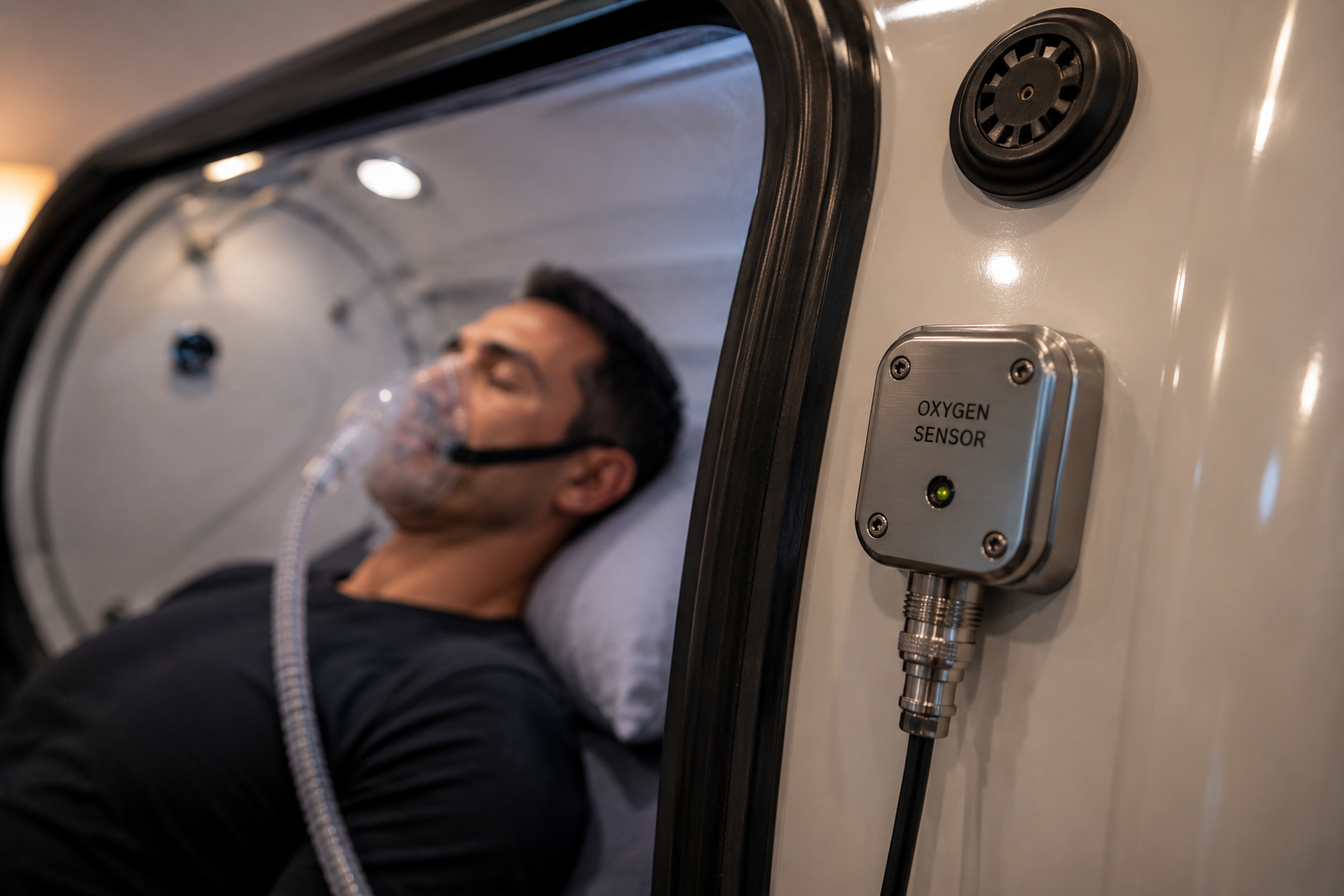
Hypoxic Chamber Oxygen Sensors: why precision is the only metric that matters
In a professional hypoxic training system, the quality of the result depends on the ability to precisely control the environment in which the athlete trains. Reducing oxygen concentration does not simply mean changing a parameter, but creating a controlled condition in which every variation can influence the user's physiological response. For this reason, sensors represent one of the most important elements of the entire infrastructure.
A modern hypoxic chamber integrates several technological components that work together: generator, air distribution systems, control software, and monitoring devices. Among these, hypoxic chamber oxygen sensors have the fundamental task of detecting environmental conditions and providing usable data to keep the system within the set parameters.
Relying on cheap or incorrectly calibrated sensors can compromise the quality of the service offered and increase the margin of error in training management. In a professional context, precision is not a secondary technical detail, but an essential requirement to ensure safety, reliability, and measurable results.
Importance of sensors in the hypoxic chamber
A hypoxic chamber is an environment in which atmospheric parameters are intentionally modified to simulate altitude conditions. The goal is to create a controlled stimulus that can be used within sports protocols, athletic preparation programs, or paths dedicated to performance improvement.
For this process to be effective, the system must constantly know the conditions present inside the chamber. Sensors therefore perform a continuous control function, collecting fundamental information for the correct operation of the facility.
The precision of the detection directly influences the system's ability to react to variations. Inaccurate data can lead the generator to modify its operation based on incorrect information, creating a discrepancy between the desired value and the one actually present in the environment.
Role of the sensor in system control
The sensor represents the connection point between the physical environment and the electronic management system. It detects the parameters present in the chamber and allows the control unit to make operational decisions.
In a professional facility, this process must be rapid, stable, and reliable. The quality of the sensor therefore determines the ability of the entire system to maintain consistent conditions during prolonged sessions.
Precision as a performance factor
Precision is not only about safety, but also about the quality of training. An athlete who follows a protocol based on specific data needs repeatable conditions to correctly evaluate their response.
The ability to compare different sessions depends on the stability of environmental parameters. Reliable sensors allow for the construction of more scientific and improvement-oriented paths.
Oxygen measurement and environmental control
Controlling oxygen concentration is the first element of managing a hypoxic chamber. The system must be able to detect the level present in the environment and compare it with the value set by the protocol.
Hypoxic chamber oxygen sensors must ensure constant measurement even during normal usage variations, such as people entering, movements inside the chamber, or changes in airflow.
The quality of the collected data allows the generator to intervene more precisely, keeping the environment in the expected conditions and reducing unwanted oscillations.
Stability of the oxygen level
During hypoxic training, even small variations can have an impact on the athlete's perception of the stimulus. For this reason, maintaining the set value is a fundamental objective.
A system equipped with precise sensors can compensate for variations more effectively and ensures a more uniform experience.
Difference between set value and real value
One of the most important aspects in professional management concerns the distance between the programmed parameter and the one actually present in the chamber. This difference must be monitored continuously.
An imprecise reading can create a false perception of the hypoxic level reached, making the protocol followed by the athlete or coach less reliable.
CO2 monitoring in hypoxia and safety
In addition to oxygen concentration, a professional system must also consider the level of carbon dioxide present in the environment. Air exchange and the presence of people inside the chamber can influence this parameter.
Hypoxia CO2 monitoring therefore represents a fundamental element for maintaining controlled environmental conditions. Proper CO2 management contributes to the overall safety of the system and the quality of the user experience.
A well-designed hypoxic chamber does not just reduce oxygen, but controls the entire balance of the internal environment through a series of integrated measurements.
Why CO2 must be controlled
During a session, the presence of one or more people naturally changes the composition of the air. Without adequate control, the concentration of carbon dioxide can increase and affect the comfort of the environment.
Monitoring this parameter allows the system to better manage ventilation and air changes.
Integration between oxygen and CO2 sensors
The best systems use multiple coordinated sensors to obtain a complete view of internal conditions. Oxygen and CO2 provide complementary information on environmental quality.
This integration allows for more advanced management and greater operational reliability.
Oxygen sensor calibration and reliability
A sensor, even if technically advanced, maintains its effectiveness only through correct calibration. Over time, in fact, every measuring device can undergo variations that affect the precision of the returned data.
Oxygen sensor calibration therefore represents a fundamental procedure in the management of a professional hypoxic chamber. Performing periodic checks allows for maintaining high standards of reliability.
Correct maintenance also allows for identifying any anomalies before they can affect the functioning of the entire system.
Frequency of checks and maintenance
The frequency of calibration depends on the intensity of system usage and the characteristics of the installed sensor. Facilities with daily use must provide for more rigorous management compared to occasional installations.
A scheduled maintenance plan protects the investment and ensures operational continuity.
Importance of data traceability
For professional centers and advanced athletes, recording the collected data allows for analyzing the effectiveness of protocols over time. The quality of the information depends directly on the reliability of the sensors.
Management based on precise data increases the scientific value of the service offered.
Risks of low-quality sensors
Choosing cheap components may seem initially advantageous, but it can generate problems in the medium and long term. An imprecise sensor introduces uncertainty into the most important element: knowledge of the actual environmental conditions.
In a professional context, relying on inadequate tools means increasing operational risk and reducing the perceived quality of the service.
The safety of hypoxic training depends on the system's ability to provide reliable information at all times.
Measurement error and wrong decisions
Incorrect data can lead to unnecessary protocol modifications or suboptimal environment management. When decisions are made based on inaccurate information, even an advanced system can lose effectiveness.
Sensor precision reduces this margin of error.
Impact on the center's reputation
For a sports center, offering a hypoxic service means taking responsibility towards users. The quality of the technology used contributes directly to the perception of professionalism.
Investing in reliable components therefore also represents a strategic choice to build trust.
Criteria for choosing professional sensors
The selection of sensors must consider several technical elements. Precision, stability, calibration capability, and compatibility with the existing system are fundamental aspects to evaluate.
Not all sensors are designed for the same level of use. A facility intended for professional athletes or a commercial structure requires components with superior characteristics.
The correct choice allows for creating a system that is more reliable and easier to manage over time.
Sensor build quality
Materials, internal technology, and design influence the durability and precision of the device. A quality component maintains its performance better even after intensive use.
Build quality therefore represents an investment in system continuity.
Compatibility with the hypoxic system
A sensor must be correctly integrated with the generator, software, and control systems. Compatibility ensures effective communication between the different components.
Coordinated design avoids problems and improves daily management.
Investment in safety and precision
In a professional hypoxic chamber, sensor precision is one of the elements that determine the quality of the entire system. Advanced generators and evolved software can offer high performance only when they receive correct information from the environment.
Choosing reliable components means reducing the risk of errors, improving training control, and offering users an experience based on real data. Monitoring technology thus becomes a central part of the service's value.
For sports facilities, safety managers, and performance-oriented athletes, investing in precise detection systems represents a strategic choice. The difference between effective training and unnecessary risk can depend precisely on the quality of the available information.
Technical excellence and repeatability
A professional system must ensure repeatable conditions session after session. Only through reliable measurements is it possible to compare results and progressively optimize protocols.
Precision thus becomes a tool for continuously improving training quality.
Safety as a distinctive element
Safety is not an accessory, but a fundamental component in the design of any hypoxic environment. Reliable sensors allow for maintaining the control necessary to offer a professional service.
Investing in the quality of monitoring systems means building solid foundations for effective and responsible use of hypoxia.
Comments (0)