
Trolley
You have no items in your shopping cart

 Budgets
 Dumbers
 Discs
Discs
 Benches
 Racks and Rigs
 Weights Holders
 Isotonic machines
 Calisthenics
 Cardio
 Kettlebells
 Flooring
 Gym Set
 Accessories
 Combat
 ARTI MARZIALI
 CONTAINER GYM
 Tug-Of-War
 Used Gym Equipment
 PILATES MACCHINARI
 GINNASTICA ARTISTICA
 CAMPI DA PADEL
 Prodotti in Pronta Consegna
 Informazioni
 IRONMAN
 Gift Card
- Donatif
- General information
- 0 I like it
- 9 Views
- 0 comments
- gym flooring, safety flooring, gym safety, shock-absorbing materials
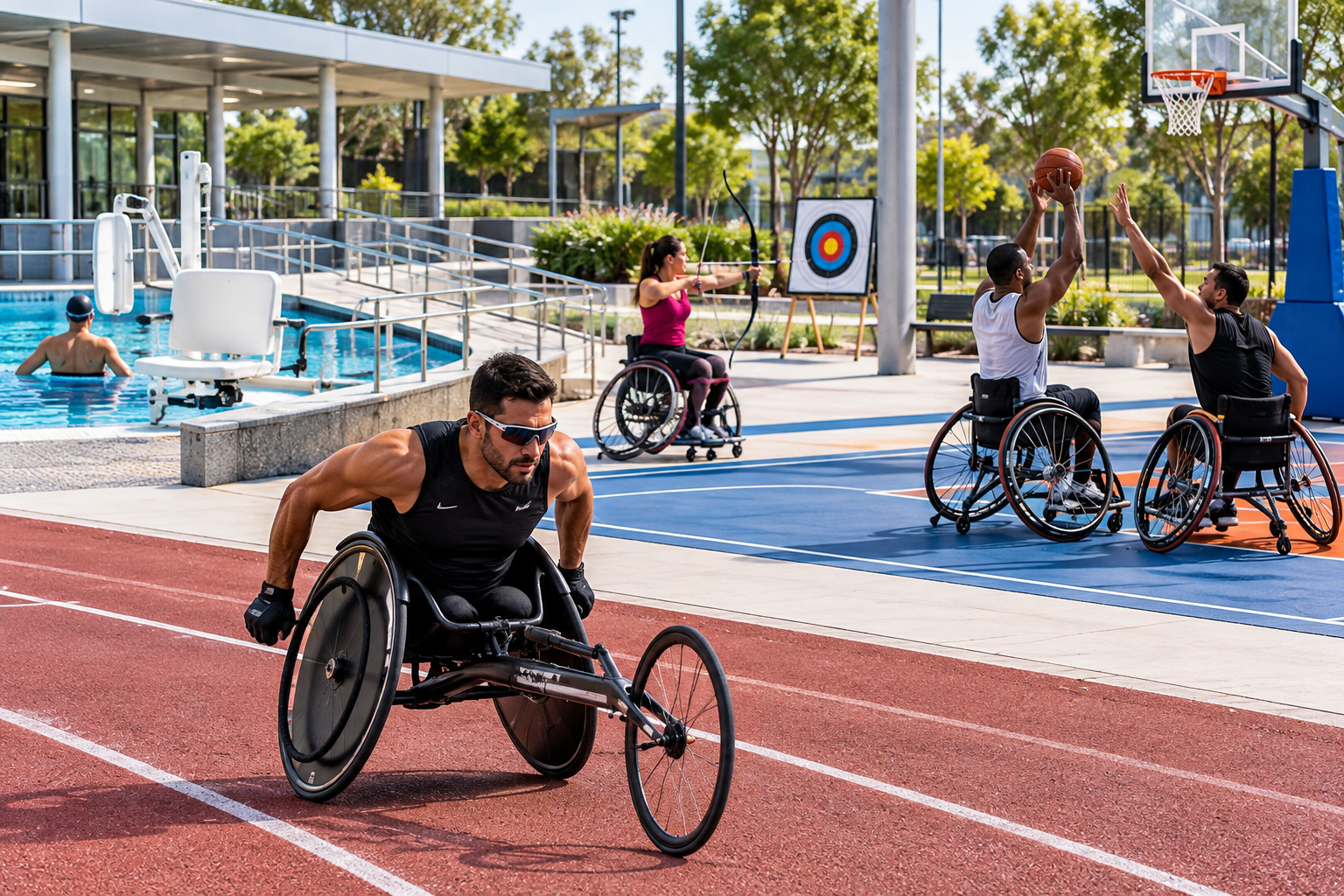
Paralympic sport for public facilities: selection criteria and configuration of accessible equipment
Paralympic sport in a public facility requires a design that promotes accessibility, safety, and use by users with different needs. The spatial configuration must integrate accessible pathways, suitable equipment, maneuvering areas, operating procedures, and scheduled maintenance to ensure continuous use of the facility.
Public facilities must meet very diverse needs. They host school activities, sports associations, training sessions, events, and programs dedicated to inclusive sport. For this reason, the design must prioritize flexible solutions that allow effective management without compromising the safety or functionality of the environments.
A well-developed project is not limited to the purchase of equipment but considers the entire user journey, from entering the facility to using the sports areas, providing easily accessible spaces, rational organization of pathways, and staff prepared to assist users when necessary.
- Quick answer
- What requirements must an accessible public facility meet
- How to design space and layout
- How to configure sports equipment
- Operational management of the facility
- Safety and maintenance
- Design errors to avoid
- How to plan investments
How to configure a public facility for paralympic sport?
A public facility should guarantee continuous pathways, adequate maneuvering areas, easily accessible equipment, understandable signage, and shared operating procedures. The configuration must allow sports activities to take place under safe conditions, facilitating user autonomy and simplifying the daily management of the structure.
Design should be approached by considering both current needs and the future evolution of the facility, providing easily upgradeable solutions.
Each choice should also promote maximum flexibility in the organization of sports and recreational activities.
Design objectives
An inclusive facility must allow use by people with different motor skills, ensuring continuity between access, training, and complementary services.
Design approach
Layout, equipment, pathways, and operational organization must be developed as parts of a single coordinated project.
What requirements must the space meet?
Accessibility begins at the entrance and continues along all interior pathways. Reception, locker rooms, restrooms, sports areas, and emergency exits should be connected through easily usable routes.
Pathways must constantly remain free from temporary obstacles, deposited materials, or mobile equipment that could limit circulation.
When applicable, dimensional characteristics must be verified against current national regulations on the accessibility of public buildings, the elimination of architectural barriers, and safety requirements for sports facilities.
Accessible pathways
Connections between different areas must be intuitive and easily recognizable, limiting complex changes in direction and congestion points.
Maneuvering areas
Each training zone should allow smooth movements without interfering with the passage of other users.
How to organize the layout of a public facility?
Space distribution should provide areas dedicated to cardiovascular activities, strength training, functional exercises, recovery, and assisted activities, maintaining logical pathways between the various zones.
An orderly arrangement of equipment facilitates supervision by staff and improves the organization of individual and group classes.
The shock-absorbing flooring must be chosen based on the intended use, ease of maintenance, and surface continuity, avoiding level changes or elements that could hinder movement.
Functional subdivision
Separating areas dedicated to different activities helps reduce operational interference and makes the simultaneous management of multiple groups simpler.
Flow management
Main pathways should be distinct from operational areas to maintain orderly circulation even during peak hours.
How to choose inclusive sports equipment?
Selection should favor robust, easily adjustable equipment with accessible controls and configurations that allow simple use by users with different needs.
It is useful to organize stations in a way that allows adjustments without having to continually modify the general layout of the gym.
To learn more about solutions dedicated to sports facilities, you can consult professional gym equipment.
Selection criteria
Ease of use, simplicity of maintenance, availability of technical documentation, and build quality represent important elements in evaluating equipment.
Modular configuration
Modular design allows for the progressive upgrading of the facility, adapting it to the evolution of sports activities without complex structural interventions.
How to organize operational management?
Shared operating procedures facilitate staff work and improve the user experience during all sports activities.
Operator training should include the correct use of equipment, assistance procedures, communication with users, and emergency management.
Simple and easily legible signage helps improve orientation and autonomy within the structure.
Operator training
Continuous staff updating promotes consistent facility management and correct use of available equipment.
Organizational procedures
Internal manuals and operating instructions make it possible to standardize checks and assistance methods during activities.
How to manage safety and maintenance?
Periodic equipment checks represent an essential component of public facility management.
Checks should include adjustment systems, fastenings, support surfaces, mobile elements, and the condition of the sports flooring, following the instructions provided in the manufacturers' technical documentation.
Recording maintenance work facilitates the scheduling of subsequent checks and contributes to the operational continuity of the structure.
Scheduled checks
Regular planning makes it possible to promptly identify any anomalies before they affect the use of the equipment.
Technical documentation
Installation, use, and maintenance manuals constitute the primary reference for managing the entire lifecycle of the equipment.
What design errors should be avoided?
One of the most frequent errors consists of designing spaces without considering the user's complete journey from the entrance to the training area.
Another error concerns the choice of uncoordinated equipment, which makes the organization of sports activities difficult.
Even a lack of maintenance planning can progressively reduce functionality, safety, and the quality of the service offered.
Non-integrated layout
A poorly rationalized distribution of equipment limits facility flexibility and makes daily management more complex.
Absence of planning
Foreseeing progressive facility upgrades allows the structure to be adapted to the evolution of activities without sudden interventions.
How to plan investments in a public facility?
Design should start with an analysis of planned activities, the number of users, building characteristics, and the operational needs of the managing entity. Subsequently, it is possible to define layout, equipment, and management methods in a coordinated manner.
When applicable, main references include national regulations on the elimination of architectural barriers, current building provisions, technical guidelines from the Italian Paralympic Committee for facilities and related activities, manufacturer manuals concerning equipment installation, use, and maintenance, and applicable sports facility safety standards. Each project should be verified against the facility's intended use and obligations required by current regulations.
Modular investment planning allows for the progressive upgrading of the facility while maintaining operational continuity, improving space accessibility, and favoring more efficient management of sports activities over the long term.
Comments (0)