
Trolley
You have no items in your shopping cart

 Budgets
 Dumbers
 Discs
Discs
 Benches
 Racks and Rigs
 Weights Holders
 Isotonic machines
 Calisthenics
 Cardio
 Kettlebells
 Flooring
 Gym Set
 Accessories
 Combat
 ARTI MARZIALI
 CONTAINER GYM
 Tug-Of-War
 Used Gym Equipment
 PILATES MACCHINARI
 GINNASTICA ARTISTICA
 CAMPI DA PADEL
 Prodotti in Pronta Consegna
 Informazioni
 IRONMAN
 Gift Card
- Donatif
- General information
- 0 I like it
- 0 Views
- 0 comments
- gym flooring, safety flooring, gym safety, shock-absorbing materials
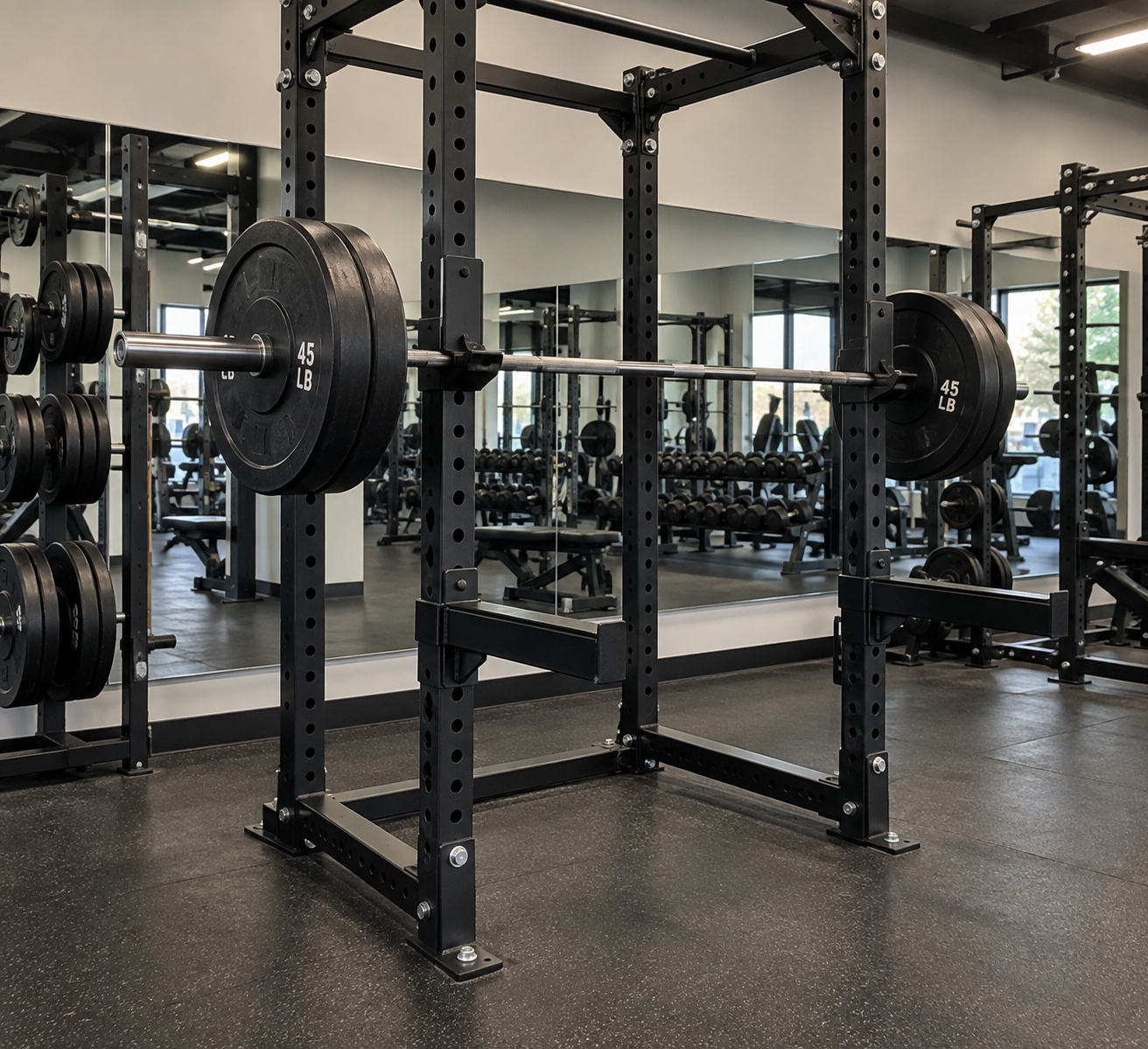
Power rack vs squat rack: differences, usage, and selection criteria
Choosing between a power rack and a squat rack depends on the available space, the type of training, the necessary accessories, and the required technical features. Both pieces of equipment allow you to perform barbell exercises, but they differ in structure, configuration, adjustment options, and safety systems.
Understanding these differences allows you to evaluate which solution best meets your needs without relying solely on price or dimensions. The choice should be made by comparing the technical specifications provided by the manufacturer and considering the usage context.
This guide analyzes the main elements for comparing power racks and squat racks, proposing practical criteria for an objective and verifiable assessment.
- What are the main differences?
- How usage modes change
- Space and layout
- Accessory compatibility
- Safety systems
- Errors to avoid
- Comparison table
- How to choose the most suitable solution
What are the main differences between a power rack and a squat rack?
The main difference concerns the structure of the equipment.
A power rack consists of a complete cage with four uprights and integrated safety systems, while a squat rack generally uses a more open structure designed to support the barbell during exercises.
Both solutions can be used for barbell training, but they present different characteristics in terms of configuration and customization options.
How does the structure change?
The power rack features a closed structure that allows for the installation of numerous accessories, while the squat rack normally adopts a more essential configuration.
Are the adjustments the same?
No. Adjustment possibilities depend on the design of the individual model and the specifications indicated by the manufacturer.
How does usage change?
Both pieces of equipment can be used for barbell exercises, but the configuration influences operational methods.
The power rack generally allows for the integration of more accessories and safety systems, while the squat rack is often chosen for more essential setups.
Usage methods must always follow the instructions provided in the manufacturer's technical documentation.
Which exercises can be performed?
Exercises like squat and bench press can be performed according to the configuration provided by the manufacturer and with compatible accessories.
When to consider a power rack?
It can be an interesting solution when greater modularity, numerous adjustments, and compatibility with various accessories are required.
How much space do they require?
The space needed depends not only on the dimensions of the structure but also on the operating area required during training.
Before purchasing, it is necessary to evaluate the room height, traffic paths, barbell usage, and flooring characteristics.
The final dimensions must be verified in the technical data sheet of the chosen model.
Does only the footprint matter?
No. You must also consider the space necessary to use the barbell and any installed accessories.
Why plan the layout?
A correct arrangement of the equipment facilitates usage and reduces interference with other areas of the gym.
How important are accessories?
Compatibility with accessories represents one of the elements that most differentiates the various models.
Before purchasing, it is useful to check for adjustment holes, the availability of compatible components, and the expansion possibilities provided by the manufacturer.
To learn more about the different available configurations, you can consult the professional power racks category.
Why consider expandability?
A structure compatible with additional accessories can offer greater flexibility over time.
Are accessories universal?
No. Compatibility varies according to the design features of the model and the manufacturer's instructions.
Which safety aspects should be compared?
Barbell supports, safety systems, adjustments, and installation methods represent fundamental elements in the evaluation of both pieces of equipment.
It is important to also check the load capacity declared by the manufacturer and always respect the assembly and usage instructions.
Before every workout, it is advisable to check the proper fastening of components and the general condition of the structure.
Why check the supports?
The supports must be adjusted according to the manufacturer's instructions and checked periodically.
What is the reference document?
The manufacturer's manual represents the main source for installation, usage, and maintenance.
What errors should be avoided?
One of the most frequent errors consists of comparing power racks and squat racks based solely on price.
It is important to also evaluate available space, accessory compatibility, usage methods, maintenance, and technical documentation.
Neglecting these aspects can lead to choosing a configuration that is poorly suited to your actual training needs.
Why is price not enough?
The initial cost represents only part of the overall investment, which includes installation, maintenance, and the possibility of expansion.
Why check the availability of spare parts?
The availability of compatible components facilitates maintenance and ensures the continued use of the equipment.
Comparison table
| Criterion | Power rack | Squat rack |
|---|---|---|
| Structure | Full cage | Open structure |
| Accessories | Broad compatibility depending on the model | Depends on configuration |
| Adjustments | Generally numerous | Variable according to the model |
| Space | To be verified in the technical data sheet | To be verified in the technical data sheet |
| Safety | According to manufacturer configuration | According to manufacturer configuration |
This table allows you to compare the two types using technical criteria without attributing an absolute advantage to either solution.
Final characteristics must always be confirmed by consulting the manufacturer's official technical documentation.
Which documents should be consulted?
Installation manuals, technical data sheets, and official manufacturer documentation represent the primary sources for verifying characteristics, configuration, installation, and maintenance.
Which aspects should be compared before purchase?
Dimensions, load capacity, safety systems, hole configuration, accessory compatibility, availability of spare parts, and completeness of technical documentation constitute the main evaluation criteria.
How to choose between a power rack and a squat rack?
The choice between a power rack and a squat rack should be based on training needs, available space, and the technical characteristics of the models under consideration. Analyzing structure, accessories, safety systems, and expansion possibilities allows for an objective evaluation without limiting yourself to commercial features alone.
Before purchasing, it is advisable to prepare a checklist including dimensions, operating area, accessory compatibility, technical documentation, maintenance, and installation methods. This approach facilitates a choice that is consistent with the usage context.
FAQ
Is the power rack always more versatile? Versatility depends on the model configuration and the compatible accessories provided by the manufacturer.
Does a squat rack always take up less space? Dimensions must be verified in the technical data sheet of the specific model.
Do both allow for barbell exercises? Yes, according to the methods provided by the manufacturer and with the installed configuration.
What is the most reliable source for comparing two models? Manuals, technical data sheets, and official manufacturer documentation represent the main reference for verifying characteristics, installation, and usage.
Comments (0)