
Trolley
You have no items in your shopping cart

 Budgets
 Dumbers
 Discs
 Benches
 Racks and Rigs
 Weights Holders
 Isotonic machines
 Calisthenics
 Cardio
 Kettlebells
 Flooring
 Gym Set
 Accessories
 Combat
 ARTI MARZIALI
 CONTAINER GYM
 Tug-Of-War
 Used Gym Equipment
 PILATES MACCHINARI
 GINNASTICA ARTISTICA
 CAMPI DA PADEL
 Prodotti in Pronta Consegna
 Informazioni
 IRONMAN
 Gift Card
- Donatif
- General information
- 0 I like it
- 170 Views
- 0 comments
- gym flooring, safety flooring, gym safety, shock-absorbing materials
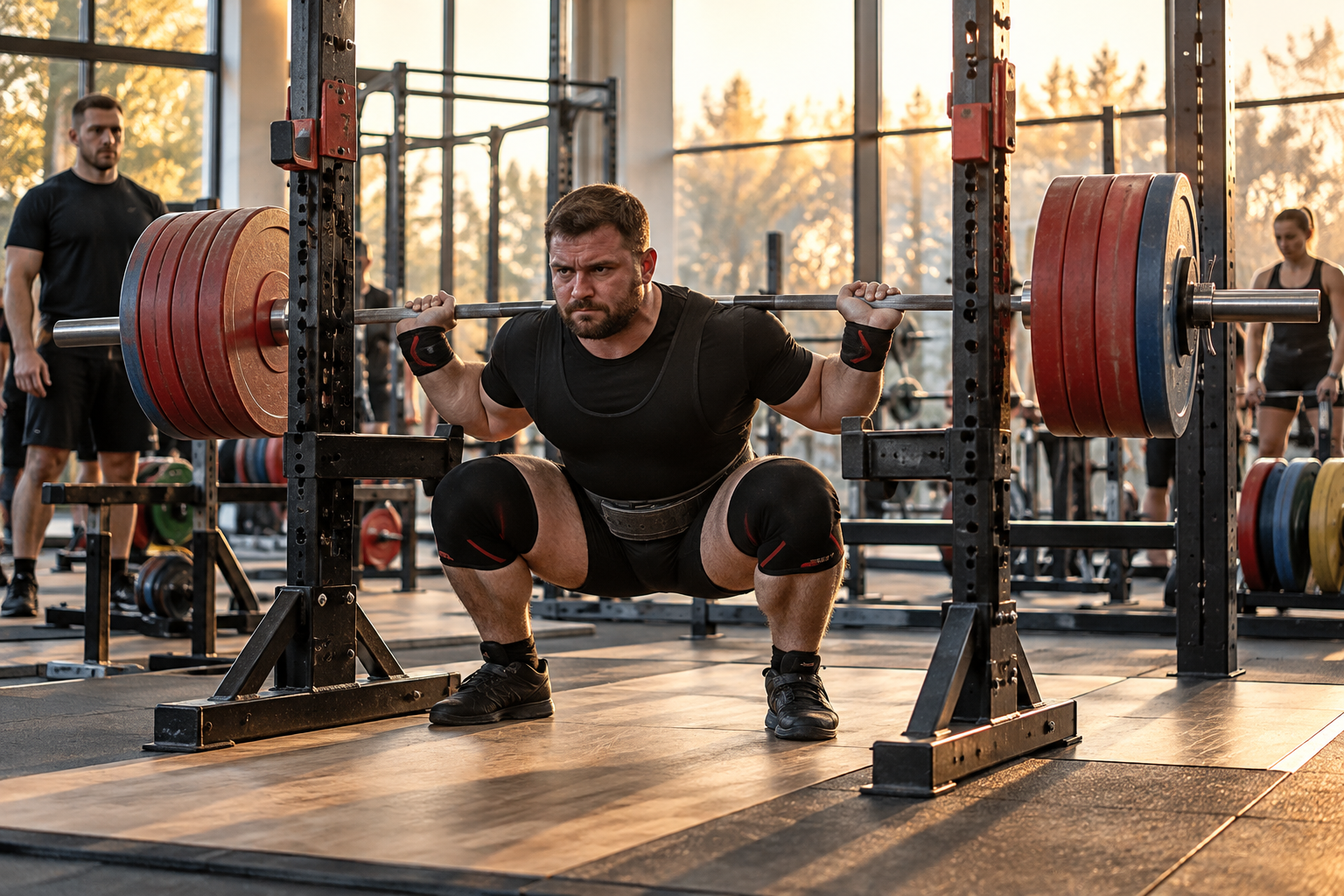
Powerlifting competition equipment: organizing the platform and warm-up area
A powerlifting competition requires much more than a barbell and some plates. The platform, supports, bench, loading systems, and warm-up area must work together, allowing athletes, referees, and staff to perform their duties without hindrance.
The choice of powerlifting competition equipment starts with the regulations of the federation and the specific event. Measurements, homologations, material conditions, and procedures may change: the fact that a product is suitable for training does not automatically prove it is permitted in competition.
This guide helps organizers and floor technicians prepare a checklist, coordinate stations, and document what remains to be confirmed. Final specifications must be requested from the organizing body and compared with the applicable regulations before the event.
The project must also consider assembly times and venue availability before the competition. Delivering material at the last minute reduces time to check adjustments, identify missing components, and coordinate those working on the platform. A shared schedule makes it possible to distinguish what has already been checked from what still requires confirmation.
If equipment is rented, agree in advance on delivery conditions, assembly responsibilities, and the contact person for any issues. Verify that the delivered configuration matches the one approved for the event and that staff have the relevant instructions.
- Start with the competition regulations
- Platform and competition space
- Racks, supports, and bench
- Barbells, plates, and collars
- Warm-up area
- Platform crew and checks
- From checklist to competition day
Start with the competition regulations
Federation, category, and discipline
Identify the federation, the event, and the version of the regulations that applies to the competition. Squat, bench press, and deadlift may have requirements regarding the platform, barbells, and supports; the actual prescriptions must be read in the relevant document. Do not automatically transfer the rules of one event to another.
If the event requires approved equipment, verify the brand, model, configuration, and validity of the approval with the organizer. Keep the confirmation together with the product documentation. A commercial definition such as professional or competition-grade does not in itself equal admission to the specific competition.
Assigning responsibilities
Establish who checks the sports requirements, who procures and assembles the equipment, and who authorizes the opening of the platform. The technical manager should be able to report an issue before the warm-up begins. The organizer maintains a contact list for assistance and agreed-upon replacements.
The event procedures must also clarify who checks the athletes' personal gear. Belts, clothing, and accessories may be subject to their own rules, distinct from those of the machines. Do not let an athlete discover an incompatibility only when called to the platform.
Platform and competition space
Surface and stability
The platform must meet the characteristics required by the regulations and the manufacturer, be stable, and offer an appropriate surface for the lifts. Check joints, edges, flatness, and the condition of the surface covering. A raised element or damaged area can interfere with footing or movement.
The performance of a surface covering cannot be deduced from thickness alone. Consider the complete system and installation instructions; when building or load verifications are needed, involve competent professionals. Do not promise that a material will automatically eliminate noise or vibrations.
Paths and visibility
In addition to the lifting area, plan space for loaders, spotters, referees, and athlete access. People must be able to reach the platform and exit without crossing paths occupied by plates. Position equipment and furnishings so they do not obstruct visibility and communication.
A rehearsal before the event can simulate calling, load changes, and exiting. Observe where bottlenecks form and correct the layout according to the organizer's instructions. Distances and mandatory equipment are those established by the applicable rules, not generic values.
Racks, supports, and bench
Squat adjustments
The supports must allow setting the required heights and maintaining the configuration planned by the manufacturer and the competition. Check that the adjustment devices are intact, correctly inserted, and recognizable by the staff. Verify how to record and communicate the height requested by each athlete.
Protections and the role of spotters must follow the regulations and event procedures. An adjustable support does not replace trained staff, just as the presence of spotters does not make damaged equipment acceptable. Avoid improvised adjustments or incompatible components.
Bench press setup
For the bench press event, verify the characteristics, stability, and position of the supports provided by the organization. If the structure changes configuration between the squat and bench press, plan the assembly sequence and identify who checks each lock before authorizing the next attempt.
During the check, consider athlete access, spotter positioning, and space for loading operations. An empty run, performed according to the manual, helps identify practical interference but does not replace verification of the required specifications. Record any anomalies and suspend use if necessary.
Barbells, plates, and collars
Identification and compatibility
Check that barbells and plates match the competition requirements and are compatible with each other. Identify the materials intended for the platform and those for the warm-up area, avoiding accidental mix-ups. If the event includes mass checks or approved equipment, agree on methods and responsibilities with the judges.
Check the condition of sleeves, knurling, plates, and collar systems according to the instructions. Damaged parts or parts that do not function correctly must be reported and handled before use. Do not assume that components from different systems are interchangeable just because they seem to fit.
Preparing correct loads
Organize the plates in a recognizable and accessible order for the loaders, keeping paths clear. Define a procedure for confirming the load and collars consistent with the competition rules. Communication between the table, referees, and platform staff must be clear even during rapid changes.
The selection of barbells can help identify relevant categories, but the proposed model must be verified against the event's requirements. Ask for written confirmation of specifications, availability, and conditions before basing the organization on a particular supply.
Warm-up area
Sizing the stations
The warm-up area must be planned in relation to the number of athletes, groups, and the call schedule. Counting platforms is not enough: observe how much space each station needs to load, adjust, and wait. Equipment must be arranged without overlapping trajectories and passageways.
If stations are shared, define how to communicate heights and load changes. A clear distribution of materials and informed staff can reduce confusion, but they do not turn a capacity estimate into a guarantee. Review the organization when the number of entries changes.
Equipment and flow toward the competition
Verify that warm-up equipment is suitable for the intended use and that any differences compared to the competition platform are communicated to the athletes. Check conditions and adjustments before opening, following the individual product instructions and event procedures.
The path to the platform must allow responding to calls without crossing loading areas. Signage and reference staff help athletes and coaches orient themselves. Nonetheless, keep required passageways accessible and coordinate the layout with the venue manager.
Platform crew and checks
Preparing loaders and spotters
Before opening, outline tasks, communication, and limits of responsibility to the staff. Spotters must know the event procedures and equipment instructions. A simulation of transitions between lifts helps recognize interference, but it does not replace adequate training and experience.
Define who checks the load, who checks the locks after an adjustment, and who stops the operation when an issue arises. Shift changes and replacements must include a handoff. Role clarity reduces the risk of a check being taken for granted.
Recording anomalies
Prepare a sheet to note equipment, symptom, time of appearance, and action taken. A halt must be recognizable and communicated to the people involved. If an item requires assistance, follow the manufacturer's instructions and the organizer's procedures without attempting improvised repairs.
The availability of a replacement component must be checked in advance, and its replacement must be permitted by the regulations. After the intervention, a competent person checks the configuration before reopening. Keep the information for event management and subsequent checks.
From checklist to competition day
Before the athletes arrive
Compare inventory and regulations: identify platform, supports, bench, barbells, plates, collars, and warm-up materials. Check that necessary manuals and confirmations are accessible to managers and that area conditions match the agreed plan. Mark anything missing as an open item with an assigned person and a deadline.
Verify assembly, adjustments, and paths following specific procedures. Involve the organizer in decisions concerning sports requirements or schedule changes. A signed or recorded list can help with handoffs, but it does not replace actual checks and required authorizations.
During and after the event
During the competition, monitor the status of the stations and keep the reporting channel clear. Configuration changes must be performed by designated personnel and checked before use. If conditions change, stopping and clarifying a situation is preferable to proceeding with an unresolved doubt.
At the end, inventory components, record any damage, and follow instructions for disassembly and storage. Collect observations from referees and the platform crew on flows, communication, and equipment. This information makes preparing for the next event more concrete.
Comments (0)