
Trolley
You have no items in your shopping cart

 Budgets
 Dumbers
 Discs
 Benches
 Racks and Rigs
 Weights Holders
 Isotonic machines
 Calisthenics
 Cardio
 Kettlebells
 Flooring
 Gym Set
 Accessories
 Combat
 ARTI MARZIALI
 CONTAINER GYM
 Tug-Of-War
 Used Gym Equipment
 PILATES MACCHINARI
 GINNASTICA ARTISTICA
 CAMPI DA PADEL
 Prodotti in Pronta Consegna
 Informazioni
 IRONMAN
 Gift Card
- Donatif
- General information
- 0 I like it
- 124 Views
- 0 comments
- gym flooring, safety flooring, gym safety, shock-absorbing materials
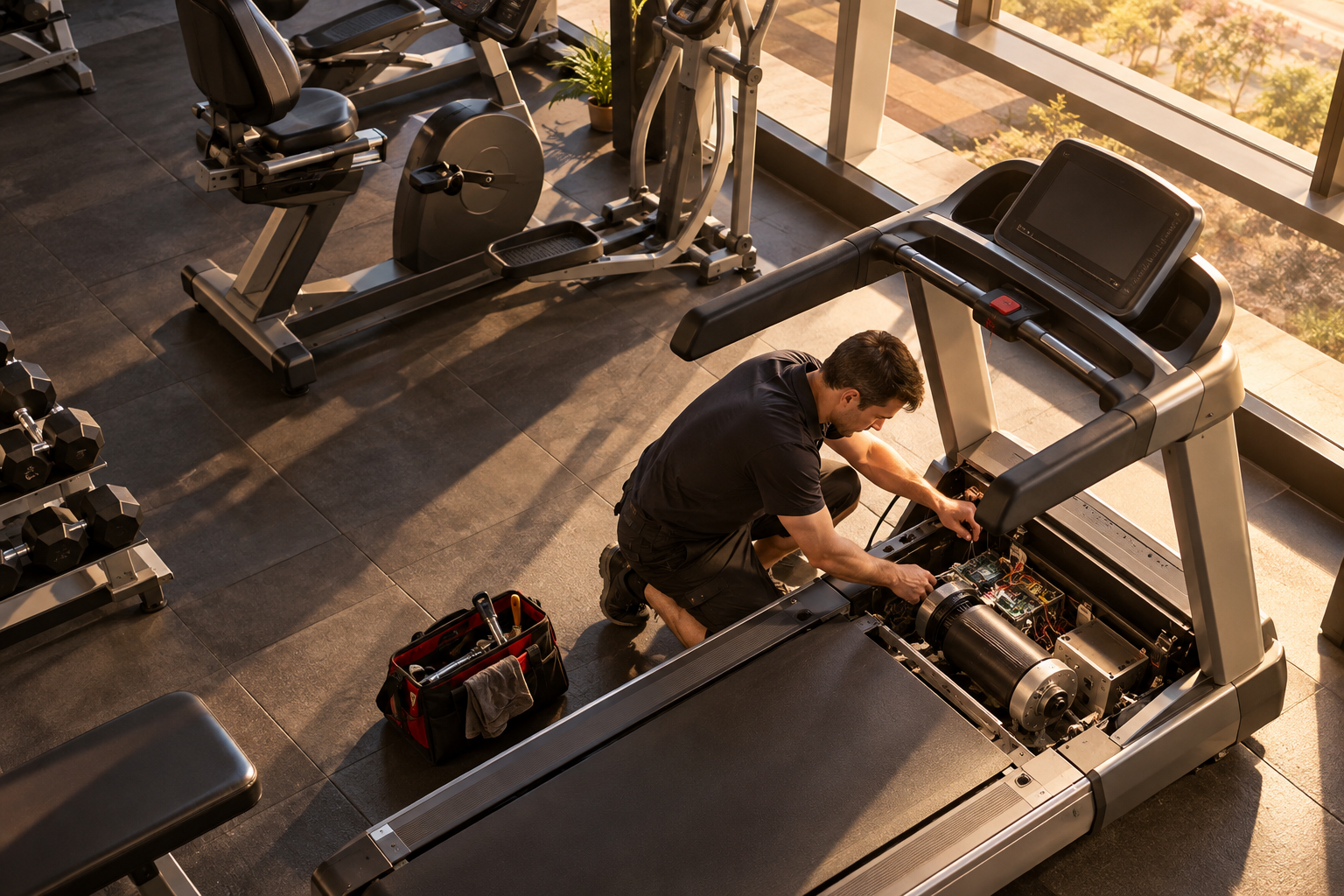
Professional cardio spare parts: management and checks for the gym
A stopped cardio machine does not just interrupt a session: it can increase wait times, change user distribution and take up staff time. Spare parts management therefore begins before a breakdown, with the identification of the machines and knowledge of the procedures established by their respective manufacturers.
When talking about professional cardio spare parts it is important to distinguish between consumable components, parts subject to checks and interventions that require a qualified technician. Treadmills, bikes, ellipticals and rowers do not necessarily have the same components or the same needs.
This guide helps the fitness room manager organize inventory, reports and procurement. Frequencies, compatibility and procedures must be confirmed in the manuals of individual models and with competent support.
The primary goal is not to accumulate spare parts, but to know what information is needed when a machine requires attention. An updated inventory, a reporting channel and a recognizable contact person make it possible to prepare a request without confusing models or purchasing unverified components.
In a room with multiple shifts, the same anomaly can be described in different ways. A shared log should report date, machine, symptom and actions already taken, clearly indicating whether the equipment is available. The manager can thus prevent different users from repeatedly encountering the problem while waiting for assistance.
Warehouse choices must be reviewed when present models or service conditions change. A part purchased for previous equipment must not be assigned to a new machine without compatibility confirmation. It is also useful to keep the return conditions and storage instructions received with the order.
- Identify the room's machines
- Recognize component categories
- Schedule checks and replacements
- Verify compatibility before ordering
- Stock and procurement times
- Manage breakdowns and interventions
- Evaluate the plan over time
Identify the room's machines
Model and serial number
Prepare a list of equipment with brand, model, serial number and location in the room. Also record installation date, available manual and support contact. Externally similar machines may have different revisions and require different components.
Information must be accessible to anyone opening a service request. A photograph of the identification label can help, provided the data is legible and managed according to facility procedures. Check inventory when a machine is moved, replaced or modified.
Documents and history
Keep manuals, sheets, warranty conditions and intervention records. A history showing symptom, date and replaced component helps the technician understand if a problem is recurring. Distinguish staff observations from diagnoses made by those with the necessary skills.
If model information is missing, ask the manufacturer or supplier for assistance before ordering. A generic description like treadmill belt is not enough to prove compatibility. The correct code must be confirmed on the machine and applicable documentation.
Recognize component categories
Treadmills and running surface
Belt, deck and other components of the running system may require checks and interventions depending on the model. Unusual noises, irregular movement or display alerts must be recorded without immediately attributing the cause to a single part. Similar conditions may have different origins.
Cleaning, any lubrication and adjustments must follow the manual. Do not apply a product just because it was used on another machine: materials and procedures can change. If an anomaly could compromise use, take the treadmill out of service and activate the designated channel.
Bikes, ellipticals and rowers
Pedals, belts, moving parts, adjustments and resistance systems vary between models and categories. Staff can observe play, noise or adjustment difficulties and report them, but should not dismantle parts or intervene on components for which they are not trained.
A rower may use different resistance systems, each with its own instructions. Consoles and power supplies also require specific checks. The category name does not automatically determine the spare part: exact identification and compatibility confirmation are needed.
Schedule checks and replacements
Follow the manufacturer's instructions
The maintenance plan must distinguish pre-use checks, routine activities and specialized interventions. Use the frequencies and criteria indicated for each model, taking into account the actual conditions of the room. A generic deadline that is the same for all machines can overlook important differences.
Assign each activity to a competent person and record when it was performed. If the manual provides for usage-based checks, verify how to detect the relevant data. Do not bring forward or postpone a critical replacement based on a commercial hypothesis without consulting support.
Observe the signals
Staff can collect useful information: when the noise appears, what message appears, what adjustment was used and whether the symptom repeats. These elements help prepare the intervention and prevent the request from being limited to the formula broken machine.
Do not invite users to reproduce a potentially dangerous defect. If the machine must be isolated or taken out of service, follow facility and manufacturer procedures. Verification and any repairs are the responsibility of authorized and qualified persons.
Verify compatibility before ordering
Codes and revisions
Compare the requested spare part code with brand, model and serial number, including any revisions indicated by the manufacturer. If a part has been replaced by an updated code, ask for written confirmation that the new component is applicable to the specific machine.
Measurements or photographs can facilitate communication, but alone they do not guarantee mechanical, electrical or functional compatibility. Avoid purchases based solely on appearance. Record the source of confirmation and keep documents together with the order and machine history.
Warranty and alternative components
Before choosing an alternative component, check if it is authorized and what conditions apply to warranty and safety. The lowest price alone does not describe quality, compatibility or support availability. Also ask if special accessories or installation procedures are required.
Cardio machines constitute different categories for use and maintenance. For each request, contact the appropriate person with the model data: the presence of a machine in a category does not confirm the availability of a specific spare part.
Stock and procurement times
Decide what to keep available
Stock can be useful for components identified as necessary and compatible with the machines present. Consider number of models, frequency of use, times communicated by the supplier and storage conditions. Avoid purchasing large quantities without knowing shelf life and probability of use.
Compare the plan with those who perform maintenance. Some components may require specialized installation or be subject to revisions: keeping them in stock does not mean you can install them independently. Record quantity, code, intended destination and purchase date to avoid confusion.
Store and reorder
Follow manufacturer instructions for environment, packaging and handling. Protect components from conditions that could damage them and keep identification labels. Similar parts for different models should be clearly distinguishable, without relying solely on staff memory.
Establish a reasonable reorder level and periodically verify that it matches the machines still present. If a machine is decommissioned, review the associated stock according to internal procedures. Delivery times and commercial conditions must be confirmed upon ordering.
Manage breakdowns and interventions
Reporting and taking out of service
When a problem arises, identify the machine and collect observable symptoms. Apply the out-of-service procedure if necessary, making it clear to users that it must not be used. Do not let occasional restarts be interpreted as a definitive solution.
Communicate model, serial number, any codes and circumstances of the failure to support. Follow instructions received without bypassing protections or opening electrical components. Operations that require power isolation or technical skills are the responsibility of qualified personnel.
Intervention and reopening
Record the work performed, replaced parts and technician instructions. Function verification and return to service must follow the procedures established for the machine and facility. A new part alone does not prove that the entire problem has been resolved.
Inform staff when the machine is available again and keep intervention documents. If the anomaly recurs, link the new report to the previous one without assuming it has the same cause. This continuity makes dialogue with support more useful.
Evaluate the plan over time
Measure interruptions and recurrences
A log can help observe how many machines are unavailable, for how long and what information is often missing from requests. Use the data to improve organization, not to automatically attribute a failure to a single component or supplier.
Compare observations with the maintenance schedule and actual conditions of use. If a category shows repeated interruptions, ask the technician what checks are appropriate. Decisions on replacements must remain based on diagnosis and documentation, not on isolated statistics.
Responsibility and continuity
Define who updates the inventory, who orders and who communicates with the technician. Shift handovers prevent duplicate requests and machines left without indications. Keep contacts and procedures easily accessible for staff working across different time slots.
Periodically review stock, documents and machines present. Orderly spare parts management helps prepare for interventions and ask more precise questions, even without guaranteeing the absence of breakdowns. Room availability also depends on proper use, checks and appropriate support.
Comments (0)