
Trolley
You have no items in your shopping cart

 Budgets
 Dumbers
 Discs
Discs
 Benches
 Racks and Rigs
 Weights Holders
 Isotonic machines
 Calisthenics
 Cardio
 Kettlebells
 Flooring
 Gym Set
 Accessories
 Combat
 ARTI MARZIALI
 CONTAINER GYM
 Tug-Of-War
 Used Gym Equipment
 PILATES MACCHINARI
 GINNASTICA ARTISTICA
 CAMPI DA PADEL
 Prodotti in Pronta Consegna
 Informazioni
 IRONMAN
 Gift Card
- Donatif
- General information
- 0 I like it
- 461 Views
- 0 comments
- gym flooring, safety flooring, gym safety, shock-absorbing materials
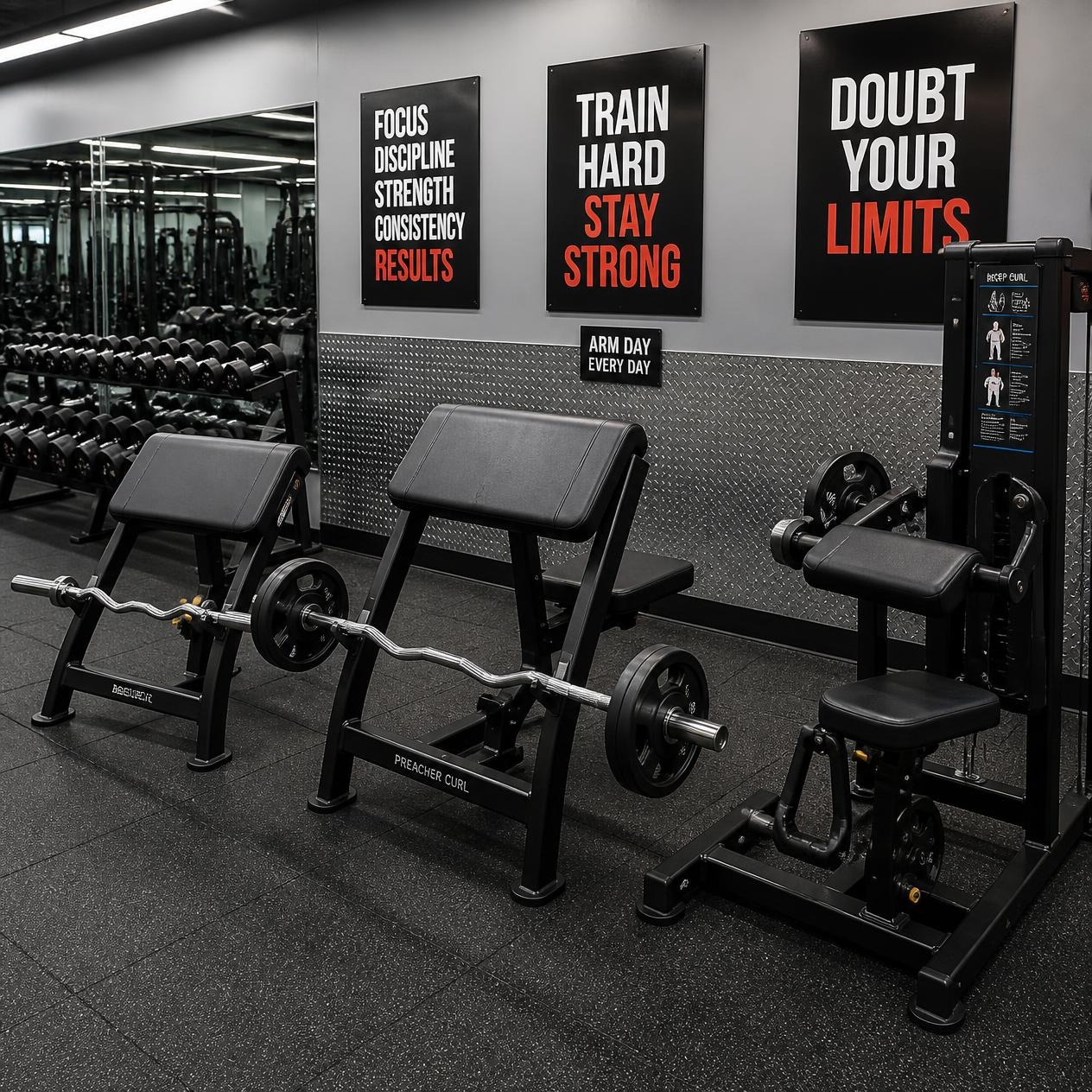
Professional Scott bench: bicep isolation without joint stress
Training biceps effectively does not simply mean lifting heavy loads, but using equipment designed to guide movement according to precise biomechanical principles. The Scott bench is one of the most appreciated tools in bodybuilding because it allows for reduced compensation, increased control of technical execution, and focused work on the target muscle without excessively involving the shoulders and back.
For those who wish to develop strength, hypertrophy, and quality of contraction, the choice of the right bench directly affects training comfort and joint protection. Support angle, padding density, structural stability, and movement fluidity determine the quality of the exercise much more than the simple weight used.
In this guide, we analyze why a professional Scott bench represents an ideal solution for achieving optimal bicep isolation, reducing stress on tendons, and improving safety during every training session, with an approach designed for both enthusiasts and those looking to set up a professional-level gym.
- What is a professional Scott bench
- Biomechanics of movement
- Importance of the inclination angle
- Role of the padding
- Execution technique
- How to choose the ideal model
- Why it represents a smart investment
What is a professional Scott bench
The Scott bench was created with the goal of eliminating the compensatory movements that often occur during traditional curls. Thanks to the inclined support, the arm remains stable and the elbow maintains a constant position throughout the entire trajectory, favoring more precise work.
This configuration allows for limiting the contribution of the back, deltoids, and torso momentum, transforming every repetition into an exercise truly focused on the bicep. The result is higher quality contraction and better perception of muscle work.
In professional facilities, construction quality plays a fundamental role because stability, ergonomics, and adjustments allow the machine to be adapted to athletes with different physical characteristics without compromising comfort or safety.
Benefits of isolation
Isolation reduces force dispersion and makes it easier to maintain correct technique even with heavy loads. This allows for improving the mind-muscle connection and obtaining a more effective training stimulus.
Who should use it
It is indicated for beginners who want to learn the correct movement, bodybuilders who seek maximum bicep development, and personal trainers who wish to offer safe exercises to their clients.
Biomechanics of movement
The biomechanics of the Scott bench are designed to keep the elbow stable and reduce variations in the joint angle that could increase stress on the tendons. This makes the movement more predictable and controlled.
When the arm remains well supported, the force is transferred more directly toward the bicep, decreasing the risk of using inertia or oscillations that could compromise the effectiveness of the exercise.
Correct alignment between the shoulder, elbow, and wrist also improves load distribution and makes it possible to perform longer sets while maintaining high technical quality.
Protection of tendons
Stabilization of the limb limits sudden stress on the bicep tendons, which is particularly important during the initial phase of the ascent and the controlled descent of the load.
Peak contraction
A guided trajectory allows for maintaining constant tension throughout the entire range of motion, favoring intense and uniform contraction without losing control.
Importance of the inclination angle
The angle of the front backrest is one of the most underestimated aspects in the design of the Scott bench. Correct geometry allows the arm to be kept in the ideal position to work the bicep while minimizing unwanted tension.
If the inclination is too vertical, the movement becomes less natural; if it is too horizontal, the difficulty in maintaining the position increases, and the risk of compensation grows. The balance between these elements allows for fluid and repeatable execution.
Professional benches are designed specifically to offer an angle capable of favoring maximum biomechanical efficiency during every repetition.
Trajectory control
Optimal inclination helps keep the elbow steady and makes it easier to follow a constant trajectory from the beginning to the end of the exercise.
Superior performance
The correct position improves the quality of the muscle stimulus and allows for training with greater continuity over time without overloading the joints.
Role of the padding
The density of the padding directly affects comfort and stability. Material that is too soft disperses support, while material that is excessively rigid can create unpleasant pressure points during sets.
The best benches use high-density foams capable of maintaining shape and support even after years of intense use, always ensuring a uniform surface.
Good padding also improves the precision of the support and makes it easier to maintain the correct position throughout the duration of the exercise.
Comfort during sets
Correct support reduces fatigue due to pressure on the forearm and allows one to focus exclusively on the quality of the contraction.
Professional durability
Wear-resistant materials maintain aesthetic and functional performance even in gyms with high frequency of use.
Execution technique
To obtain the maximum benefit, it is fundamental to adjust the seat height so that the armpits adhere comfortably to the support without lifting the shoulders. The torso must remain stable and the movement must start exclusively from the flexion of the elbow.
During the concentric phase, it is advisable to avoid sudden accelerations, while during the descent, the weight must be accompanied slowly to maintain continuous muscle tension.
Regular breathing, an adequate grip, and the choice of a load consistent with one's level complete an effective and safe technique.
Most common errors
Among the most frequent errors are the detachment of the elbows from the support, the use of momentum, and the use of excessive weights that compromise control of the exercise.
Inclusion in the program
The bicep bench can be used both at the beginning of the workout to emphasize specific work and at the end of the session to increase time under tension with moderate loads.
How to choose the ideal model
A professional Scott bench should offer a robust frame, precise welds, resistant paint, intuitive adjustments, and absolute stability during use. These elements affect safety and the duration of the investment.
It is important to verify the quality of the finishes, the maximum capacity, compatibility with barbells and EZ bars, and ease of maintenance, especially in gyms with intensive use.
A professional product maintains high performance over time and contributes to improving the qualitative perception of the entire weight area.
Construction materials
High-thickness steel, non-slip bases, and technical padding ensure reliability even in the most demanding conditions of use.
Adjustments and accessories
The ability to adapt the seat to different heights makes the equipment more versatile and improves the training experience of every user. Exercises like the Scott bench curl thus become more precise and comfortable.
Why it represents a smart investment
For an athlete, it means being able to train biceps with greater precision and continuity, while for a gym, it represents equipment capable of enhancing the technical offering and satisfying expert users who seek construction quality and concrete results.
Investing in professional bodybuilding equipment means reducing wear, maintenance, and frequent replacements, while simultaneously improving the image of the facility and customer satisfaction. A stable and well-designed machine immediately conveys reliability and attention to detail, characteristics that contribute to member retention.
The choice of a Scott bench should therefore not be based solely on price, but on the ability to offer ergonomics, safety, durability, and constant performance over time. Equipment built according to advanced biomechanical criteria allows for training biceps more effectively, protecting joints and tendons, and transforming every session into a concrete investment in training quality.
Comments (0)