
Trolley
You have no items in your shopping cart

 Budgets
 Dumbers
 Discs
Discs
 Benches
 Racks and Rigs
 Weights Holders
 Isotonic machines
 Calisthenics
 Cardio
 Kettlebells
 Flooring
 Gym Set
 Accessories
 Combat
 ARTI MARZIALI
 CONTAINER GYM
 Tug-Of-War
 Used Gym Equipment
 PILATES MACCHINARI
 GINNASTICA ARTISTICA
 CAMPI DA PADEL
 Prodotti in Pronta Consegna
 Informazioni
 IRONMAN
 Gift Card
- Donatif
- General information
- 0 I like it
- 11 Views
- 0 comments
- gym flooring, safety flooring, gym safety, shock-absorbing materials
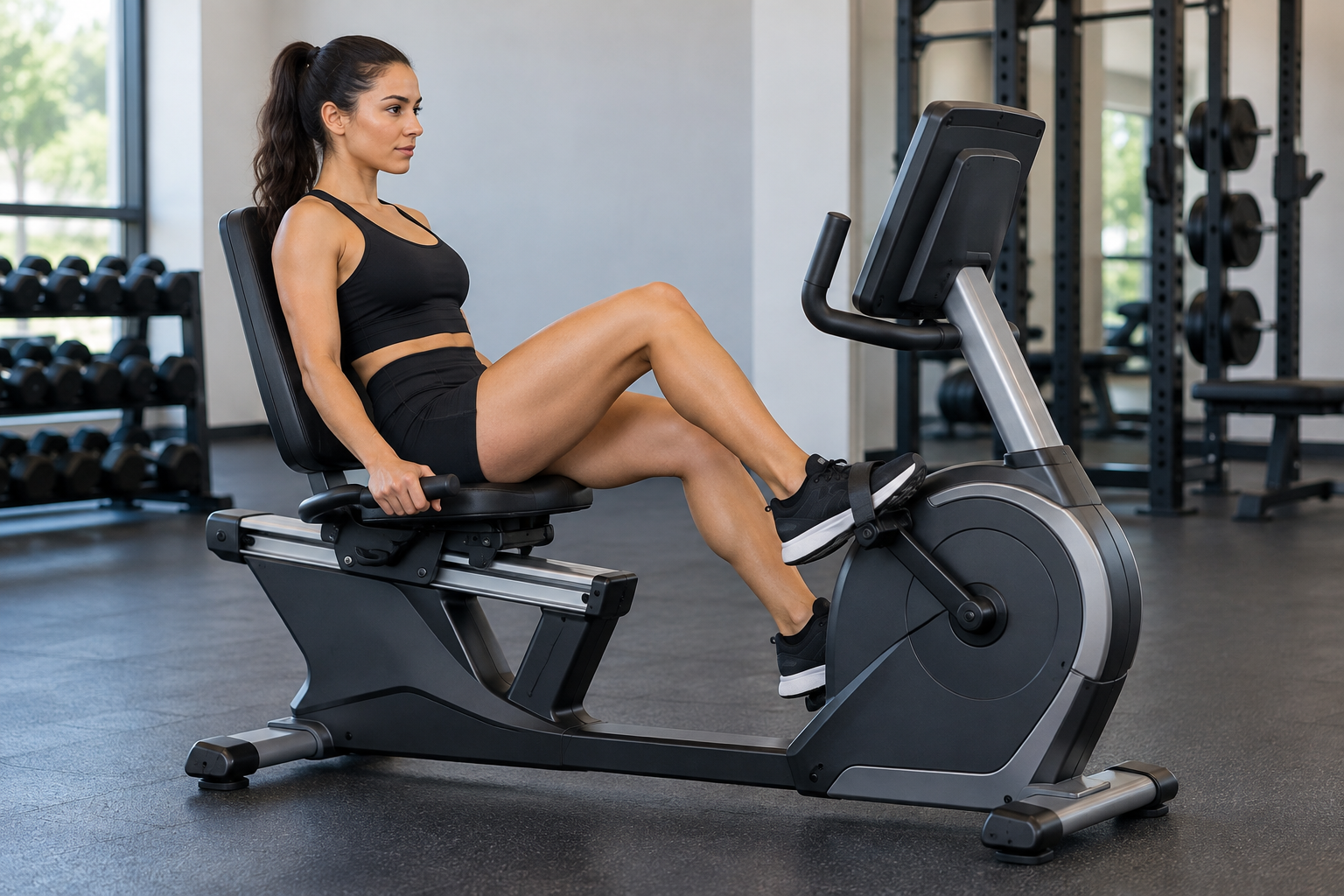
Recumbent bike safety: seat adjustment and passage clearance
The recumbent bike is a reclining exercise bike designed to offer a cardiovascular workout with a backrest-equipped seat and ergonomic leg position. To use it safely, it is essential to correctly adjust the seat, keep passages clear, and follow the manufacturer's instructions regarding installation, operating space, and maintenance. An appropriate setup reduces the risk of difficulty accessing the machine and facilitates use in shared environments.
In a gym, fitness center, or senior fitness facility, safety does not depend exclusively on the quality of the equipment but also on how it is installed, adjusted, and integrated into the cardio area layout. A correctly positioned machine improves accessibility, flow management, and operational continuity.
This guide analyzes the main risks, pre-use checks, seat adjustment criteria, and passage space verifications. When applicable, it is always advisable to consult manuals, installation instructions, and the manufacturer's technical documentation, which represent the primary sources for dimensional requirements, adjustments, and maintenance.
- Why safety matters
- What the main risks are
- How to adjust the seat correctly
- How to manage clearance and passages
- Pre-use checks
- Safety and maintenance
- Errors to avoid
- How to design a safe cardio area
Why is recumbent bike safety fundamental?
The recumbent bike is often chosen for low-impact cardio programs, activities dedicated to senior fitness, and contexts where comfort and accessibility are priority elements.
Incorrect seat adjustment or inadequate placement of the machine can make access more difficult and limit the freedom of movement of the user and operators.
Safety must therefore be considered as early as the space design phase and not only during daily use.
Configuration objective
A correctly configured workstation facilitates getting on, getting off, adjustments, and assistance without introducing obstacles along internal pathways.
Who it is particularly important for
Attention to safety plays an even more relevant role in facilities frequented by senior users or people with reduced mobility.
What are the main risks?
The most frequent risks stem from inadequate seat adjustment, insufficient passages, or installing the machine in congested areas.
Failure to check adjustment systems or structural stability can also compromise the correct use of the equipment.
A periodic check schedule helps promptly identify any anomalies before use.
Difficulty of access
An inappropriately adjusted seat can make getting on or off the machine less convenient, especially for users with functional limitations.
Obstacles in passages
Objects, accessories, or other machines placed too close to the recumbent bike can limit the movements of the user and staff.
How to adjust the seat correctly?
Seat adjustment represents the first check to perform before each use. The objective is to allow smooth pedaling while maintaining a stable and comfortable posture.
Adjustment methods vary across different models and must always follow the manufacturer's instructions.
Distance from pedals
The position must allow reaching the pedals without assuming forced postures. The correct adjustment is the one indicated in the technical documentation of the installed model.
Final check
Before starting the workout, it is advisable to check again that the seat is properly secured and that the adjustments are functioning.
How to manage clearance and passages?
The space around the machine must allow access, exit, assistance, and maintenance without interference with other equipment.
Operating distances are not the same for all models and must be obtained from the manufacturer's installation instructions.
An orderly layout improves safety, accessibility, and flow management within the cardio area.
Space organization
Main pathways should always remain free of permanent or temporary obstacles. It is advisable to avoid storing accessories along passage routes.
Role of flooring
The flooring must provide stability to the machine and be suitable for the weight of the equipment according to the manufacturer's indications.
What checks to perform before use?
A simple pre-workout verification procedure makes it possible to identify any issues without interrupting the session.
Checks must include adjustments, machine stability, pedal condition, surface cleanliness, and the absence of obstacles in passages.
It is advisable to always use a standardized procedure, especially in professional facilities.
Safety checklist
1. Check seat locking.
2. Check machine stability.
3. Ensure passages are clear.
4. Check that adjustments function correctly.
5. Check the general condition of the equipment.
Role of staff
In professional facilities, staff can verify the correct configuration of the machine before user access.
Which maintenance aspects affect safety?
Scheduled maintenance helps keep the machine efficient and reduces the risk of breakdowns during use.
Verifications must be carried out following the frequency scheduled by the manufacturer and include adjustment systems, fasteners, electronic components, and wear parts.
Contact surfaces must be cleaned using products compatible with the materials indicated in the technical documentation.
Scheduled checks
Periodic verifications allow early detection of wear or anomalies that could compromise machine safety.
Technical documentation
Manufacturer manuals represent the main reference for maintenance, adjustments, and correct use of the equipment.
What errors should be avoided?
One of the most frequent errors consists of quickly modifying the seat without verifying the correct locking of the adjustment system.
Another critical issue concerns positioning the recumbent bike too close to other equipment, reducing available space for access and assistance.
It is also advisable to avoid accumulations of accessories along passage routes or unauthorized modifications to the machine.
Improvised adjustments
Adjustments must be made exclusively using the systems provided by the manufacturer and following official instructions.
Non-functional layout
Space organization that obstructs user movement can reduce the overall safety of the cardio area.
How to design a safe cardio area with a recumbent bike?
Effective design simultaneously considers accessibility, machine build quality, simplicity of adjustments, scheduled maintenance, and organization of internal pathways. Safety stems from the integration between equipment, space, and operating procedures.
To explore different solutions dedicated to cardiovascular training, you can consult the cardio machines category, which is useful for comparing different types of equipment based on the facility project.
Before installation, it is advisable to consult data sheets, manuals, assembly instructions, and manufacturer documentation, which represent the primary sources for dimensional requirements, adjustments, maintenance, and conditions of use. A preventive check of spaces, seat configuration, and passages makes it possible to reduce operational criticalities and create a cardio area organized according to verifiable criteria without relying exclusively on the commercial characteristics of the equipment.
FAQ: does every recumbent bike require the same free space?
No. Operating clearance varies between models. It is always necessary to check the minimum distances reported in the manufacturer's installation manual.
FAQ: when is it necessary to adjust the seat?
The seat should be checked and adjusted before each use or whenever the user changes, following the manufacturer's official instructions.
Comments (0)