
Trolley
You have no items in your shopping cart

 Budgets
 Dumbers
 Discs
 Benches
 Racks and Rigs
 Weights Holders
 Isotonic machines
 Calisthenics
 Cardio
 Kettlebells
 Flooring
 Gym Set
 Accessories
 Combat
 ARTI MARZIALI
 CONTAINER GYM
 Tug-Of-War
 Used Gym Equipment
 PILATES MACCHINARI
 GINNASTICA ARTISTICA
 CAMPI DA PADEL
 Prodotti in Pronta Consegna
 Informazioni
 IRONMAN
 Gift Card
- Donatif
- General information
- 0 I like it
- 203 Views
- 0 comments
- gym flooring, safety flooring, gym safety, shock-absorbing materials
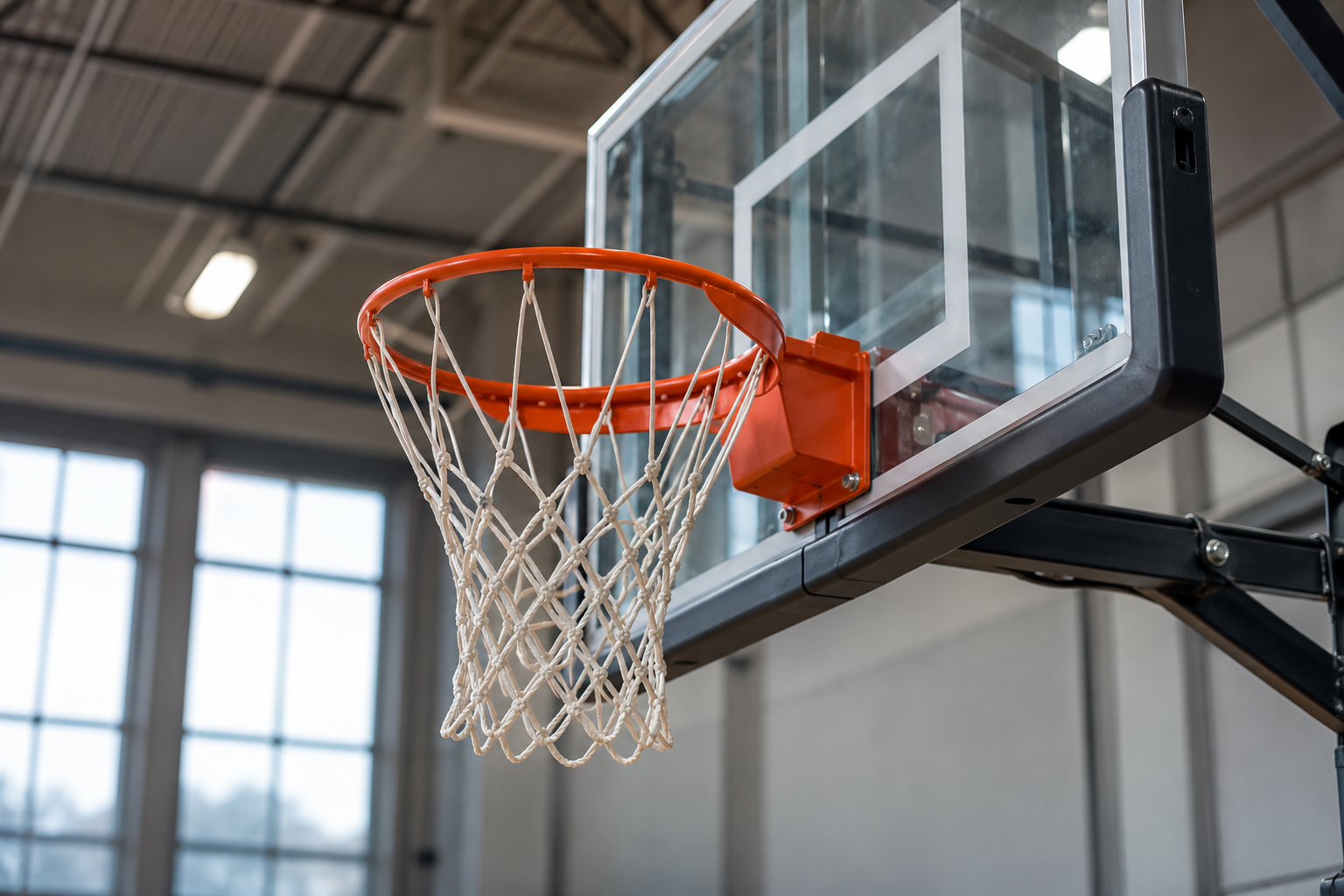
Basketball Hoop Dimensions: Reading Specifications and Verifying Installation
The height of the ring is the best-known fact about a basketball hoop, but it does not describe the entire equipment. Backboard, ring, support, and installation must be evaluated together, distinguishing between sports requirements and the technical conditions of the location.
The regulation dimensions of basketball hoops must be referred to the correct context. This article uses the FIBA Basketball Equipment 2026 document, in force since October 1, 2026, as a dimensional reference; for a competition, the regulations of the competent organization must also be verified.
The guide is designed for facility managers and purchasing managers who need to read a datasheet or prepare an inspection. It does not constitute an installation project or a certification: compliance with certain measurements alone does not prove the overall suitability of the system.
Before comparing products, specify the destination, venue, and planned activities. An adjustable solution for educational activities must be evaluated for its functions, while a system intended for a competition requires the verification of all applicable requirements.
Imagine a hoop installed before replacing the floor. After the work, the manager should not simply retrieve the old report: the height reference may have changed. It is necessary to ask which check is relevant and have it performed in the final configuration, keeping the result documented.
A second example is an adjustable product shared among different activities. The position left by the previous group may not be the one requested by the next session. A short procedure, with an identified manager and a scheduled check, makes the transition clearer without leaving it to the users' memory.
Source for the figures shown: FIBA, Official Basketball Rules 2026, Basketball Equipment. Before a purchase intended for competitions, verify the edition and applicable regulations with the competent organization.
- Start from the sports reference
- Ring height and diameter
- Backboard and visual references
- Structure and installation
- Adjustable models and shared spaces
- Compare offers and documents
- Keep inspections understandable
Start from the sports reference
Which use must be covered
Describe whether the hoop will be used for training, recreational activities, or events, and identify the categories involved. Do not automatically transfer a configuration seen in a different gym to every activity. The manager must know which requirement they want to satisfy before looking for the measurement in the catalog.
Keep the adopted reference together with the project and the confirmations received. If the program includes different activities, check how to manage any adjustments and who will perform them. The mechanical ability to change height does not establish which position should be used in a specific activity.
Dimensions and complete system
A measurement only makes sense when the starting point and ending point are clear. Ask drawings and datasheets to distinguish product measurements from finished installation measurements. A value read without this context may refer to a different element than the one you want to check.
The purchase request should identify the complete unit and the expected accessories. A ring with appropriate dimensions does not guarantee that the backboard, structure, and fasteners are compatible. Technical confirmations must concern the configuration actually delivered, without being extended to undocumented combinations.
Ring height and diameter
The figures of the FIBA reference
In the FIBA 2026 document, the top edge of the ring is 3,050 millimeters from the floor, with a maximum tolerance of plus or minus 6 millimeters; the ring is horizontal. The internal diameter provided ranges from 450 to 459 millimeters. These are distinct references, not to be confused with support height or external diameter.
When preparing a request, explicitly state which measurement you want to check and the document adopted. Ask the supplier to show the measurement references on the drawing. This precision helps avoid answers based on the commercial name of the product or an approximate dimension.
Measuring without improvising
Organize the inspection with appropriate tools and personnel, without using a ladder or climbing on equipment in an improvised manner. The procedure must be compatible with the site and the system instructions. If height adjustment is necessary, the safety of the operation must be managed by competent persons.
Do not measure relative to a temporary element that does not represent the finished playing surface. A change to the floor can change the height reference. The check must be performed in the expected configuration and documented so that whoever reads it understands what has been verified.
Backboard and visual references
Dimensions to be interpreted
The FIBA backboard of the mentioned reference measures 1,800 millimeters horizontally and 1,050 vertically, frame included, with maximum increases of 30 and 20 millimeters respectively. These measurements alone do not describe materials, fasteners, or all other conditions of the equipment.
In the product datasheet, look for a drawing that shows external dimensions, structure, and relation to the ring. If the description indicates only a commercial format, ask for the necessary data. A photograph does not allow measurements or tolerances to be reliably derived.
Marks and configuration
The mentioned FIBA reference provides for a rectangle on the backboard with external dimensions of 590 by 450 millimeters, with maximum increases of 20 and 8 millimeters. For position and other markings, consult the complete document, avoiding reconstructing them by sight.
If the backboard is replaced, verify the entire configuration and compatibility with the system with the supplier. Do not consider it sufficient that the external dimensions appear the same. A replacement may require checks on connections and components that do not emerge from the front measurement alone.
Structure and installation
Support and site
The solution must be chosen with respect to the building, space, and conditions of use. A mobile, wall-mounted, or other type of support introduces different requirements. The competent professional must identify the necessary checks, while the supplier communicates the requirements of their system.
Do not deduce the capacity of a support from its mass or robust appearance. Request documentation, instructions, and installation conditions. Dimensional verification does not replace that of the structure and does not authorize fasteners or adaptations other than those provided.
Fasteners and assembly
Clarify who prepares the site and who performs assembly and checks. An intervention that requires building works or evaluations must involve the appropriate figures. Avoid using generic components because they are apparently suitable for the hole or available surface.
Before welcoming users, complete the checks and procedures required by the configuration and location. An informal test with the ball does not prove that the installation was correctly performed. Keep the results and identify the contact person for any anomalies.
Adjustable models and shared spaces
Height adjustment
For an adjustable model, check the range, control method, and locking devices in the manual. Define who can make the change and under what conditions. Adjustment must not be performed while users interfere with the movement of the structure.
If the activity requires a specific measurement, do not rely solely on poorly legible markings or a position remembered by staff. Use the relevant control procedure and record the configuration when necessary. The ease of the control does not eliminate the need for instructions.
Dimensions and storage
Evaluate the movement space and the position of the unit when not in use. Any moving operations must follow the manufacturer's instructions and not obstruct pathways. A poorly stored hoop can create problems even outside activity hours.
To navigate sports categories, you can consult Donatif; availability of hoops, configurations, and specific services must be confirmed directly. Consulting the catalog does not prove compliance with the requirements of your event or venue.
Compare offers and documents
Readable technical request
Prepare a grid with intended use, model, stated measurements, adjustments, installation system, and available documents. Ask that the answers refer to the product offered. A general description of a range may not be sufficient to identify the chosen configuration.
Distinguish confirmed requirements from still open checks. If data is not available, ask who will be able to provide it and when. A numerical evaluation of the offer should not hide an essential condition that no interlocutor has yet verified.
Services and responsibilities
Compare transport, handling, assembly, and checks, in addition to the product price. An offer for the material alone does not equal an installed solution. Specify access and site conditions before assigning a definitive meaning to the total.
Examine how model replacements or configuration changes are handled. Any relevant variation must be evaluated against the project and adopted requirements. Keep confirmations to connect the initial decision to the system actually delivered.
Keep inspections understandable
Checks and reports
Include in the facility plan the activities required by the manufacturer for components, adjustments, and conditions of use. Assign tasks and make the reporting channel known. Staff must know how to describe abnormal movement or a damaged part without attempting autonomous repairs.
If suitability is doubtful, suspend use according to procedures and involve the competent person. The presence of correct measurements does not make a damaged system acceptable. After an intervention, returning to service requires appropriate checks.
Updating the file
Keep the model, instructions, sports reference, and check results together with the history of interventions. When floor, venue, or components change, ask which checks must be repeated. Data measured in the past does not necessarily describe a modified configuration.
Review requirements when the hosted activity changes. Comparison with the competent organization and professionals allows understanding what information is needed, keeping the measurement of an element distinct from the overall suitability of the facility.
Comments (0)