
Trolley
You have no items in your shopping cart

 Budgets
 Dumbers
 Discs
Discs
 Benches
 Racks and Rigs
 Weights Holders
 Isotonic machines
 Calisthenics
 Cardio
 Kettlebells
 Flooring
 Gym Set
 Accessories
 Combat
 ARTI MARZIALI
 CONTAINER GYM
 Tug-Of-War
 Used Gym Equipment
 PILATES MACCHINARI
 GINNASTICA ARTISTICA
 CAMPI DA PADEL
 Prodotti in Pronta Consegna
 Informazioni
 IRONMAN
 Gift Card
- Donatif
- General information
- 0 I like it
- 12 Views
- 0 comments
- gym flooring, safety flooring, gym safety, shock-absorbing materials
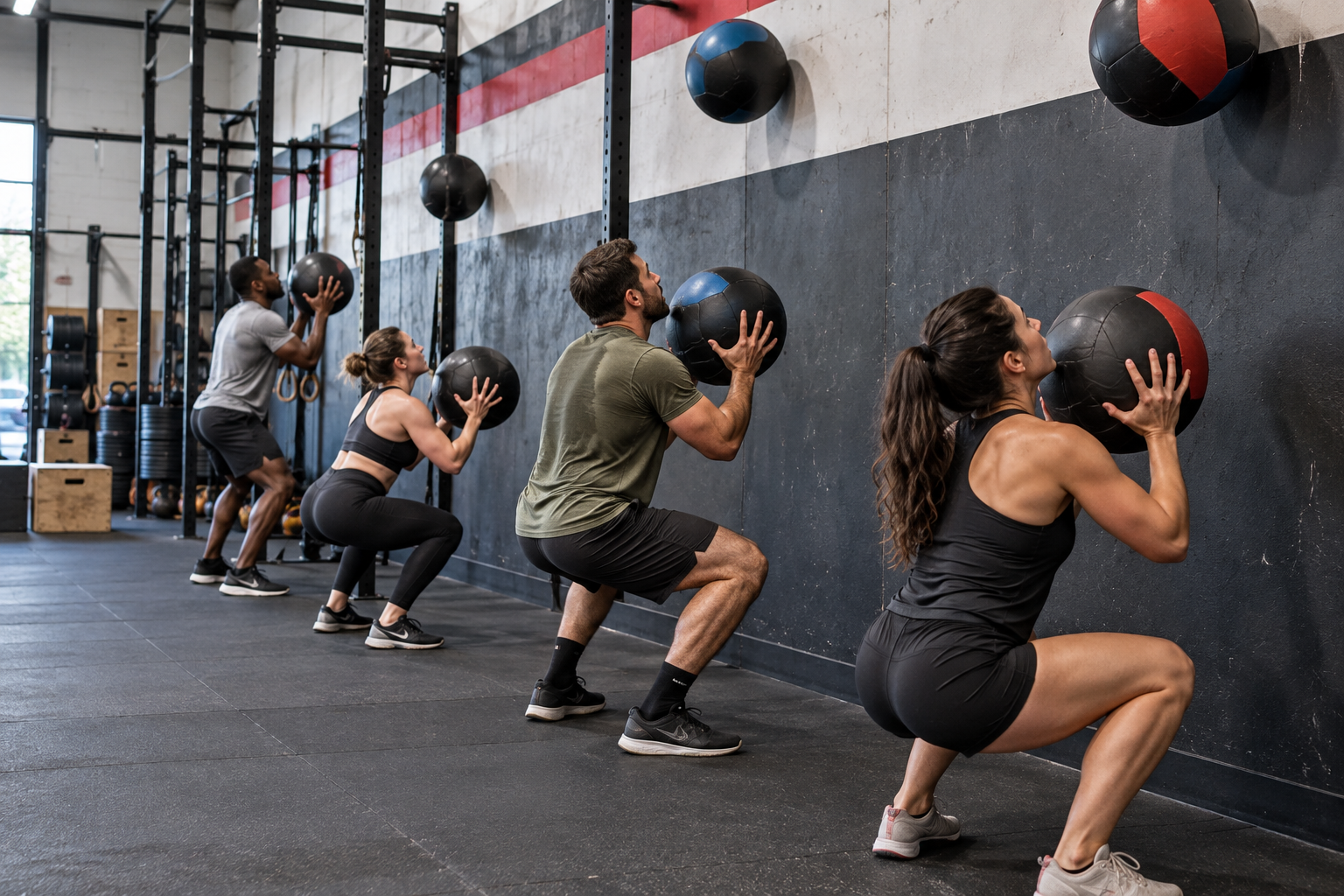
Wall ball safety: trajectory and wall distance
Training with the wall ball safely means controlling not only the weight of the equipment but also the throwing trajectory, the distance from the wall, and the available space around the working area. Proper organization reduces the risk of impacts, unpredictable bounces, and loss of control during movement.
Most issues do not stem from the wall ball itself, but from positioning errors, technical fatigue, or use in unsuitable environments. For this reason, it is important to check the training area before starting each session.
This guide offers practical criteria for setting up a safe workout, highlighting aspects to check before use without going into the detailed technique of the wall ball shot or weight selection.
- Quick answer
- What are the main risks
- Safety requirements
- Pre-use checks
- Verification table
- Most common mistakes
- Standards and references
- How to organize a safe area
How to use the wall ball safely
Safety depends on the ability to perform each repetition while maintaining control of the ball during the squat, throw, and catch. The trajectory must be predictable, and the training area must allow complete movements without obstacles.
Before starting, verify that the wall or target is stable, that the floor provides good grip, and that no people are within the throwing range.
When technical fatigue appears, it is preferable to stop the set rather than continuing with imprecise movements.
Trajectory control
A vertical and regular trajectory facilitates a controlled catch and limits unexpected deviations.
Space management
Always maintain sufficient free space in front, laterally, and behind the work area to avoid interference with other people or equipment.
What are the main risks
The most common risks involve losing control of the ball during the catch, off-target throws, and execution with technique compromised by fatigue.
An inadequate distance from the wall can make it difficult to properly intercept the ball or force a change in posture during movement.
Even a slippery or irregular surface increases the risk of losing balance during the wall ball shot.
Uncontrolled bounces
A catch made out of balance makes it harder to manage any variations in trajectory.
Technical fatigue
As the set progresses, compensations may appear that reduce precision and control.
What requirements must the training area have
The area must allow complete movement without obstacles and with a target fixed stably when required by the training program.
The wall must be suitable for the intended use and kept free of elements that could alter the ball's return.
It is advisable to use an impact-absorbing flooring suitable for functional training exercises to improve stability and surface protection.
Wall and target
Periodically check the condition of the surface and the possible presence of protruding elements.
Flooring
A stable surface with adequate grip helps maintain control during squats and throws.
What checks to perform before the workout
Before each session, check the integrity of the wall ball by inspecting the seams, outer cover, and uniformity of the padding.
Make sure there are no people in the area affected by the ball's trajectory and that the path is completely clear.
Also verify that shoes and flooring offer stable support throughout the movement.
Equipment check
Do not use a wall ball that shows evident damage or deformation.
Environment check
Remove any accessories or equipment that could interfere with the throw or catch.
Quick verification table
This checklist helps check the main elements before training.
| Element | Verification | Action |
|---|---|---|
| Wall | Stable and clear | Check before the session. |
| Work area | Free of obstacles | Keep space clear. |
| Wall ball | Seams and cover intact | Do not use damaged products. |
| Floor | Good grip | Check stability and cleanliness. |
Repeating these checks takes only a few minutes but helps reduce the most common inconveniences.
Initial checklist
Always perform a visual check of the equipment before use.
During the session
Stop the workout if technique worsens or if the environment no longer guarantees safe conditions.
Most common mistakes to avoid
Training too close to the wall limits the ability to catch the ball in balance, while positioning oneself excessively far modifies the trajectory and makes the movement less controllable.
Another mistake is continuing the set when fatigue compromises precision and coordination.
It is also discouraged to share the same training lane with other users during throws.
Wrong positioning
Choose a distance that allows natural movement without forced adaptations.
Crowded environment
Avoid performing the exercise when other people cross the area affected by the throw.
Standards and technical references
For correct use, it is appropriate to follow the manufacturer's instructions regarding the use, maintenance, and storage of the wall ball.
Sports facilities should also apply safety procedures provided for the management of areas dedicated to functional training and periodically check the condition of the equipment.
When targets or dedicated structures are installed, it is necessary to follow the assembly and maintenance instructions provided by the manufacturer.
Manufacturer manuals
Official instructions represent the primary reference for use and maintenance.
Scheduled checks
Periodic inspection of the equipment helps promptly identify any signs of wear.
How to organize a safe training area
Those setting up a home gym or a gym should design the area considering movement space, flooring, access paths, and separation from other training stations.
To complete an area dedicated to functional training, it can be useful to integrate a selection of gym accessories compatible with the planned activity, always maintaining order and ease of use.
Careful environmental planning, along with regular equipment checks and compliance with the manufacturer's instructions, allows for creating a more functional space suitable for continuous use. :contentReference[oaicite:0]{index=0}
Comments (0)