
Trolley
You have no items in your shopping cart

 Budgets
 Dumbers
 Discs
 Benches
 Racks and Rigs
 Weights Holders
 Isotonic machines
 Calisthenics
 Cardio
 Kettlebells
 Flooring
 Gym Set
 Accessories
 Combat
 ARTI MARZIALI
 CONTAINER GYM
 Tug-Of-War
 Used Gym Equipment
 PILATES MACCHINARI
 GINNASTICA ARTISTICA
 CAMPI DA PADEL
 Prodotti in Pronta Consegna
 Informazioni
 IRONMAN
 Gift Card
- Donatif
- General information
- 0 I like it
- 81 Views
- 0 comments
- gym flooring, safety flooring, gym safety, shock-absorbing materials
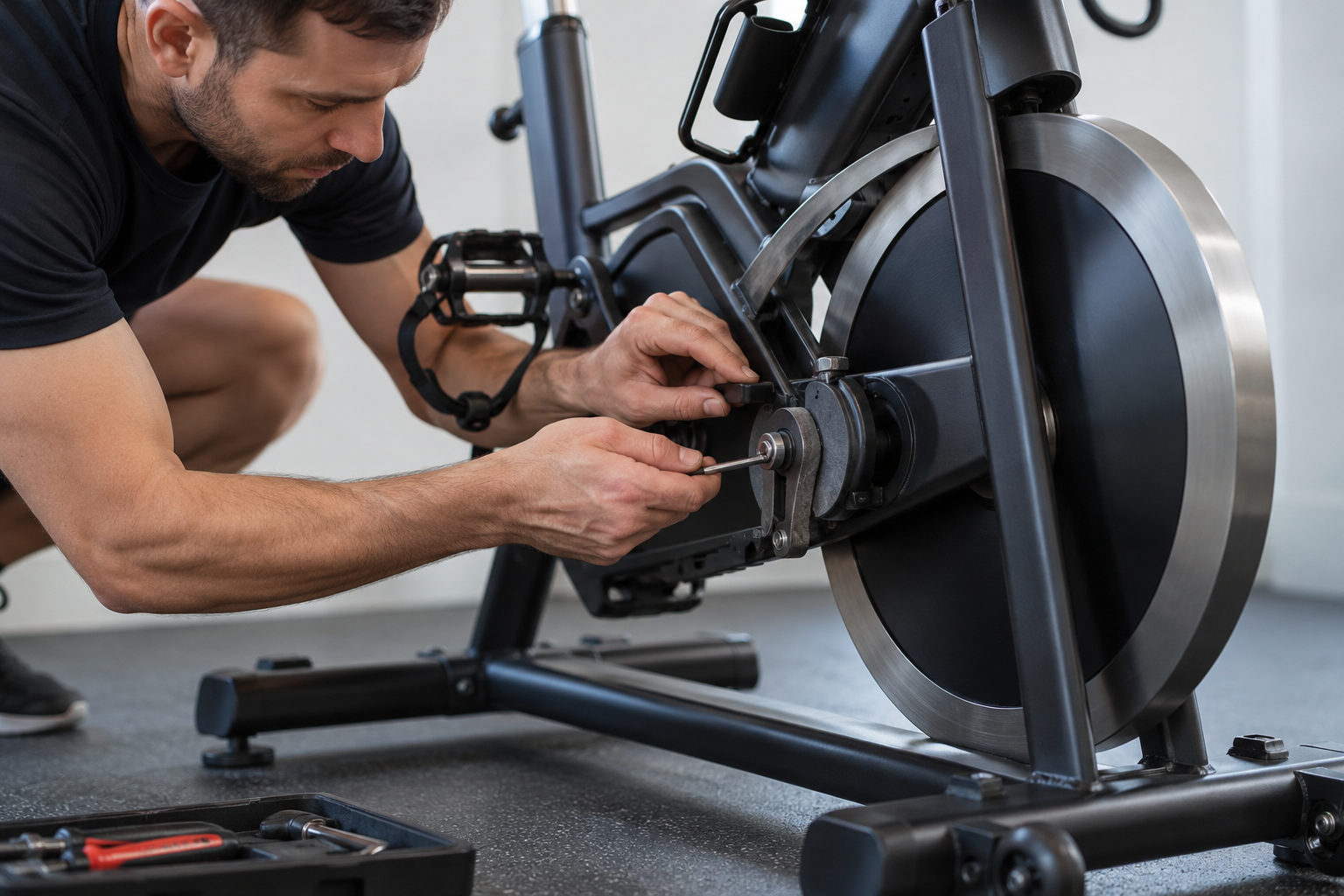
Spinning bike maintenance: checks and best practices for professional gyms
The spinning bike is one of the most widely used pieces of equipment in cardio fitness rooms and indoor cycling studios. During a normal day of activity, it can be used by numerous users, with different intensities, durations, and pedaling methods. This frequency of use subjects the transmission, pedals, adjustment systems, and structural components to repeated stress that requires regular checks.
Proper spinning bike maintenance allows you to promptly identify anomalies, limit premature wear, and reduce the risk of service interruptions. For a gym manager or fitness room supervisor, keeping equipment efficient also means protecting the quality of members' experiences and better organizing scheduled activities.
Maintenance does not just consist of cleaning surfaces after training. It includes mechanical checks, safety system checks, inspections of wear-and-tear components, and interventions carried out according to the manufacturer's instructions. This guide delves into the main operations and proposes practical criteria for building a maintenance program suited to the needs of a professional facility.
- Why spinning bike maintenance is important
- Daily checks before and after use
- Cleaning and component protection
- Transmission and flywheel control
- Maintenance of pedals, crank arms, and bottom bracket
- Checking the resistance and braking system
- Checking adjustments and structure
- How to organize a professional maintenance plan
- Evaluating costs, durability, and operational continuity
Why spinning bike maintenance is important
A professional spinning bike must guarantee smooth operation even when used repeatedly throughout the day. Group indoor cycling classes, in particular, may involve close sessions with limited intervals between one group and the next. In these conditions, minor mechanical problems can quickly turn into discomfort for users and instructors.
Preventive maintenance makes it possible to recognize signs of deterioration before they cause more significant breakdowns. Unusual noises, vibrations, play in the pedals, and difficulty adjusting resistance can indicate the need for a technical check. Ignoring these signs can increase component wear and compromise equipment availability.
For a professional gym, the goal is not only to extend the life of the machine, but to maintain predictable operating conditions. A fleet of spinning bikes with uniform operating characteristics facilitates class organization and allows instructors to focus on leading the workout.
Preventing breakdowns and service interruptions
Periodic checks make it possible to identify looseness, wear, and anomalies that could worsen with use. Intervening promptly on a deteriorated component can prevent the problem from involving other parts of the transmission or structure.
The preventive maintenance of professional bikes must be planned considering actual hours of use, environmental conditions, and the manufacturer's instructions. A machine used for several daily classes may require more frequent checks than a bike used occasionally.
Maintaining safe usage conditions
Pedals, adjustment systems, and stop mechanisms must function correctly throughout the session. A loose or damaged component can compromise pedaling control and requires immediate evaluation.
The presence of a maintenance program does not eliminate all risks, but helps manage them through documented checks. When anomalies affecting safety are detected, the spinning bike must be taken out of service until the problem is resolved.
Daily checks before and after use
Daily checks represent the first level of spinning bike maintenance. These operations are generally quick, but important for identifying visible problems and abnormal behavior. In an indoor cycling room, they can be integrated into opening procedures, class preparation, and station cleanup.
Before use, it is advisable to check that the bike is stable, that the pedals are intact, and that the saddle and handlebars are correctly locked. It is also useful to check the operation of the resistance system and any emergency stop device, following the procedure provided by the manufacturer.
After sessions, staff should pay attention to noises reported by users, adjustment difficulties, and the presence of damaged components. The systematic collection of this information makes it possible to schedule targeted interventions without waiting for a complete breakdown.
Checks before the start of the class
A brief visual inspection should include the frame, stabilizers, pedals, handlebars, and saddle. Staff can verify that there are no loose elements, obvious breakages, or objects interfering with movement.
A low-intensity functional test can help recognize abnormal noises or irregularities in pedaling. If problems arise, the machine must be tagged and not used until properly checked.
Checks at the end of sessions
At the end of the class, it is important to check the condition of the surfaces and collect any user reports. A noisy pedal or a knob that does not lock the adjustment correctly must be checked before the next session.
Daily cleaning also provides an opportunity to observe components that are normally not very visible. Small anomalies spotted during these operations can be recorded and entrusted to competent technical staff.
Cleaning and component protection
Sweat is one of the main environmental factors to consider when managing spinning bikes. During classes, it can accumulate on handlebars, frames, supports, and metal components. If not removed regularly, it can promote corrosion or deterioration of finishes, especially in less accessible areas.
A correct cleaning procedure must be compatible with the materials and the manufacturer's instructions. Aggressive detergents, unauthorized solvents, or excessive amounts of liquid can damage coatings, electronic components, and mechanical parts. It is therefore preferable to use suitable products and apply them according to specific instructions.
The cleaning of professional spinning bikes must distinguish between sanitizing contact surfaces and maintaining mechanical components. The two activities are complementary, but require different procedures. A product intended for disinfection must not be automatically used as a lubricant or protective treatment.
Cleaning handlebars, saddle, and contact points
Handlebars and saddles are frequently touched by users and require regular cleaning. It is important to remove sweat and residue without saturating the padding or allowing liquids to infiltrate the adjustment systems.
Staff should use cloths and detergents compatible with the upholstery. After treatment, surfaces must be left in the conditions prescribed by the product used and ready for the next session.
Protection of the frame and metal parts
Junction areas, supports, and metal elements can retain moisture. Thorough cleaning helps limit the accumulation of residue that could promote corrosion or surface deterioration.
Any protective treatments must be applied only when provided for by the manufacturer. It is necessary to prevent oils or slippery substances from reaching pedals, support surfaces, or braking system components.
Transmission and flywheel control
The transmission transfers the movement of the crank arms to the flywheel and represents one of the fundamental systems of the spinning bike. Depending on the model, it can use a belt or a chain. The two configurations require different maintenance methods, so it is not correct to apply a universal procedure to all machines.
An efficient transmission should guarantee smooth pedaling, without abnormal slipping, vibrations, and persistent noises. Any changes in behavior may depend on wear, incorrect tensioning, or problems in connected components. Diagnosis must be carried out according to the manufacturer's instructions.
The flywheel contributes to the continuity of movement and can be connected to direct transmission systems or other specific mechanisms. During checks, it is important to check that there are no interferences, abnormal oscillations, or noises attributable to the rotating supports.
Belt transmission maintenance
Spinning bikes with belt transmission may require relatively low intervention, but they are not exempt from checks. It is important to check for signs of wear, slipping, and tensioning anomalies.
Lubricants should not be applied to the belt unless specifically directed by the manufacturer. The use of incompatible substances can alter the behavior of the transmission and accelerate material degradation.
Chain transmission maintenance
Chain transmissions may require tension checks, cleaning, and lubrication at intervals defined by the manufacturer. An excessively loose or worn chain can generate noise and compromise pedaling smoothness.
Interventions must be carried out using compatible products and respecting the planned technical procedures. It is important to avoid makeshift adjustments, especially when they require removing guards or accessing moving parts.
Maintenance of pedals, crank arms, and bottom bracket
Pedals and crank arms are subjected to repeated stress during each session. Users can alternate between seated and standing pedaling, modifying load distribution. For this reason, it is important to periodically check the integrity of the components and the correct tightening of connections.
A loose pedal can damage the crank thread and compromise user safety. Localized noises, abnormal lateral movements, and difficulty rotating must be considered signs requiring verification. Simply increasing the tightening force is not always an appropriate solution.
The bottom bracket contains components that allow the crank arms to rotate. Its characteristics depend on the machine's design and may include sealed systems or components subject to specific maintenance. Any intervention must comply with the manufacturer's technical instructions.
Checking pedals and clip-in systems
Pedals must be checked for play, deformation, and damage to bearing surfaces. On models with retention systems for cycling shoes, it is also important to check the state of the retention mechanisms.
Compatibility between pedals and footwear must be clearly communicated to users. Damaged components or non-functioning clip-in systems require suspension of use until replacement or repair.
Checking crank arms and connections
Crank arms must be firmly connected to the bottom bracket and rotate without abnormal play. Any creaks during pedaling may depend on various components and require accurate diagnosis.
Tightening torques must be those specified by the manufacturer. The use of appropriate tools, when required, helps avoid insufficient or excessive tightening that could damage connections.
Checking the resistance and braking system
The resistance system determines pedaling difficulty and is an essential element for indoor cycling training. Spinning bikes can use magnetic systems, mechanical friction systems, or other configurations. Each technology has different maintenance needs and must be managed according to model specifications.
Correct adjustment should allow the user to modify resistance predictably. If the knob has excessive play, the load varies irregularly, or the machine's response changes suddenly, a technical check is necessary.
The emergency stop system, when present, must function according to the methods provided by the manufacturer. This aspect is particularly important in fixed-gear bikes, where pedal movement is connected to flywheel movement. Users must know the correct procedures to slow down and stop the machine.
Magnetic resistance control
Magnetic systems regulate resistance through the interaction between magnets and moving metal components. They generally do not require direct contact between braking elements, but may still present problems in adjustment mechanisms.
During maintenance, it is advisable to check the regularity of the response and the absence of abnormal noises. Any interventions on internal components must be entrusted to competent personnel.
Friction resistance systems control
Bikes with mechanical friction resistance may use pads or other elements that exert pressure on the flywheel. These components are subject to wear and may require periodic adjustments or replacements.
It is important to check the condition of contact surfaces and respect instructions regarding consumable materials. The application of unauthorized lubricants or detergents can compromise the effectiveness of the braking system.
Checking adjustments and structure
Saddles and handlebars must be easily adjustable to accommodate users with different anthropometric characteristics. Professional spinning bikes can provide vertical and horizontal adjustments, managed through pins, knobs, or specific locking systems.
With repeated use, adjustment mechanisms can accumulate dirt or show wear. A latch that does not stably hold its position is a problem to be solved before allowing further workouts. The correct functioning of locking systems is particularly important during classes involving frequent posture changes.
The load-bearing structure must also be checked. Stabilizers, support feet, and frame connections contribute to overall stability. A bike that wobbles while pedaling may have a leveling problem or a structural anomaly that requires investigation.
Saddle and handlebar adjustment maintenance
Guides and sliding systems must be kept clean and functional. Any lubricating treatments must be carried out only when provided for by the manufacturer and using compatible products.
Knobs must allow effective locking without requiring abnormal effort. If a system does not maintain the selected position, the machine must be checked before use.
Frame stability and leveling
The bike must rest stably on the floor, without noticeable wobbling. Adjustable feet, when present, make it possible to compensate for small surface irregularities according to the manufacturer's instructions.
It is also important to check the integrity of stabilizers and structural connections. Metallic noises, deformations, or abnormal movements must not be overlooked, especially in intensively used machines.
How to organize a professional maintenance plan
Effective management requires a documented control program proportional to equipment usage. For a gym with numerous spinning bikes, it is useful to prepare a logbook that identifies each machine and records checks, anomalies, interventions, and replacements carried out. This system facilitates planning and makes it possible to identify recurring problems.
Maintenance frequencies must be defined starting from the manufacturer's manual. In the absence of specific intervals for certain organizational checks, the gym can adopt more frequent internal checks, as long as they do not replace the mandatory or recommended technical procedures of the manufacturer.
The spinning bike maintenance checklist should distinguish between operations that can be performed by floor staff and interventions reserved for qualified technicians. Cleaning, visual inspections, and complaint collection can be integrated into daily activities, while complex mechanical adjustments and component replacements require appropriate skills.
Frequency of checks and intervention recording
A possible organization involves daily visual checks, periodic functional checks, and technical maintenance at intervals indicated by the manufacturer. The actual frequency must be adapted to the number of classes, hours of use, and equipment conditions.
Each intervention should be recorded indicating the date, machine identifier, problem found, and operation performed. This documentation makes it possible to monitor bike reliability and supports decisions regarding component replacement.
Staff responsibilities and technical assistance
The fitness room manager should clearly define who performs daily checks, who records anomalies, and who authorizes the return to service of machines after an intervention. A precise distribution of responsibilities reduces the risk of reported problems remaining unresolved.
Interventions requiring the opening of guards, transmission adjustment, or replacement of structural components must be entrusted to competent personnel, following the manufacturer's instructions. Before any operation, it is necessary to put the equipment in safe conditions.
Evaluating costs, durability, and operational continuity
Spinning bike maintenance must be considered part of the overall management cost of the cardio fitness room. The initial purchase price represents only one component of the investment, while component durability, spare parts availability, technical assistance, and frequency of interventions affect the actual value of the equipment over time.
For a gym manager, it is useful to evaluate the total cost of ownership of the machines, including routine maintenance, any repairs, and periods of unavailability. A bike requiring frequent interventions can generate indirect costs related to class reorganization and reduced station availability.
When planning the expansion or renewal of the room, it is advisable to compare the features of professional cardio machines while also considering ease of maintenance, component accessibility, and after-sales support. The choice should favor solutions consistent with the expected workload and the structural organizational capacity.
Total cost of ownership and spare parts availability
The total cost of ownership includes purchase, installation, scheduled maintenance, consumables, and extraordinary interventions. To compare multiple models, it is useful to consider a homogeneous period of use and estimate expected operating hours.
The availability of original or manufacturer-approved spare parts can help reduce downtime. Before purchase, it is advisable to check which components are replaceable and what assistance conditions are offered.
When to schedule spinning bike replacement
Replacement should be evaluated when interventions become frequent, essential components are no longer available, or the machine no longer meets the operational needs of the gym. There is no universal lifespan valid for all spinning bikes, as useful life depends on manufacturing quality, intensity of use, and maintenance.
A historical record of interventions allows you to compare repair costs with those of new equipment. This evaluation should also include reliability, safety, and service continuity, avoiding decisions based exclusively on the age of the machine.
Investing in proper spinning bike maintenance means building a management system capable of preventing problems, maintaining regular performance, and efficiently utilizing available resources. Programmed checks, staff training, and qualified technical assistance make it possible to enhance existing equipment and plan future purchases based on concrete data, contributing to the quality and operational sustainability of the cardio fitness room.
Comments (0)