
Trolley
You have no items in your shopping cart

 Budgets
 Dumbers
 Discs
Discs
 Benches
 Racks and Rigs
 Weights Holders
 Isotonic machines
 Calisthenics
 Cardio
 Kettlebells
 Flooring
 Gym Set
 Accessories
 Combat
 ARTI MARZIALI
 CONTAINER GYM
 Tug-Of-War
 Used Gym Equipment
 PILATES MACCHINARI
 GINNASTICA ARTISTICA
 CAMPI DA PADEL
 Prodotti in Pronta Consegna
 Informazioni
 IRONMAN
 Gift Card
- Donatif
- General information
- 0 I like it
- 514 Views
- 0 comments
- gym flooring, safety flooring, gym safety, shock-absorbing materials
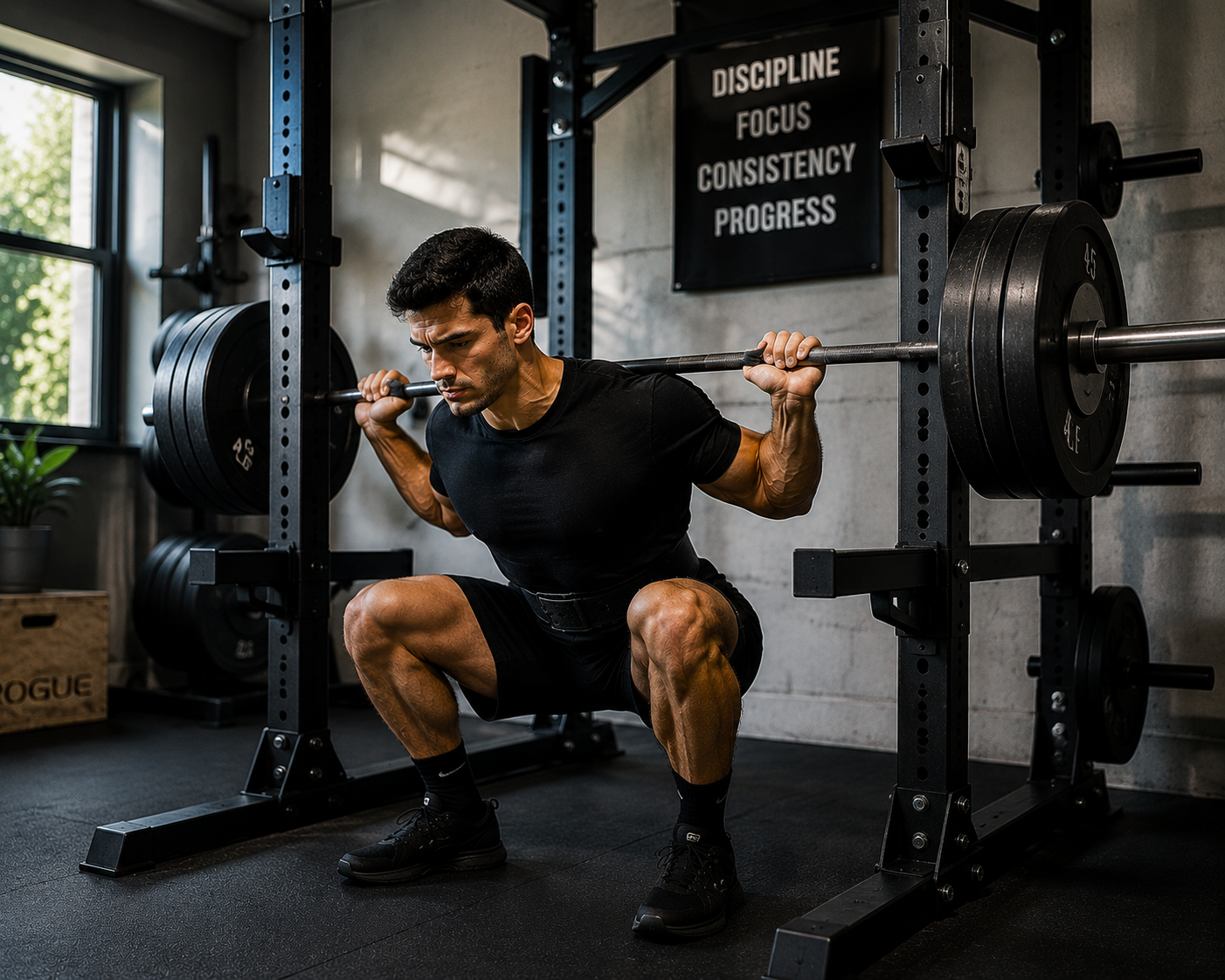
Squat Rack vs Power Rack: Which to Choose for Your Home Gym?
When designing a home gym, one of the most important decisions concerns the choice of the structure that will hold your barbell. The comparison between squat racks and power racks is one of the most frequent dilemmas, especially for those who have limited space but want to train safely with fundamental exercises like squats, bench presses, and military presses.
The answer does not depend exclusively on the size of your garage or the available budget. Each type of rack is designed to meet different needs: some models prioritize compactness and modularity, while others offer the highest level of safety and versatility for intensive training with heavy loads.
In this guide, we analyze in detail the differences, advantages, and disadvantages of the two solutions, helping you understand which represents the best investment for your home gym based on the exercises you perform, the space available, and the possibilities for future expansion.
- What changes between a squat rack and a power rack
- Advantages of the squat rack
- Why choose a power rack
- Space and budget
- Safety during training
- Accessories and modularity
- How to choose the right rack
- An investment for better training
What changes between a squat rack and a power rack
The main difference concerns the structure. The squat rack is generally open and composed of two main uprights on which the barbell supports are positioned. The power rack, on the other hand, is a closed structure with four uprights that creates a real safety cage in which to perform exercises.
This design difference influences safety, footprint, usage possibilities, and compatibility with accessories. There is no universally better solution: everything depends on how you train and which exercises represent the core of your programming.
Those who primarily use basic exercises with moderate loads may find the squat rack a practical and affordable solution. Those who frequently perform heavy training or train completely alone benefit more from the protection offered by the power rack.
Structural differences
The difference between a rack and a power rack consists mainly in the presence of the full cage. The four uprights allow for the installation of internal safety bars that catch the barbell in case of failure during a repetition.
The squat rack can still integrate safety systems, but it normally offers less protection than a completely closed structure.
How daily use changes
During training, the difference is felt especially in the heaviest sets. The power rack allows you to tackle squats and bench presses with greater peace of mind even without a spotter.
The squat rack, on the other hand, guarantees greater freedom of movement and is often faster to use in sessions dedicated to dynamic and functional exercises.
Advantages of the squat rack
The squat rack is one of the preferred solutions for those who want to create an efficient home gym without sacrificing too much space. The open structure generally occupies less surface area and makes the environment look more organized.
The lower cost compared to a power rack also allows you to allocate a larger part of your budget to the purchase of barbells, Olympic plates, and adjustable benches, improving the overall training experience.
For many users, it represents the best compromise between functionality, simplicity, and initial investment.
Ideal for small environments
Those looking for a home gym rack often have to deal with garages, basements, or multi-purpose rooms. In these contexts, every centimeter is precious, and a squat rack can be the smartest choice.
The open structure also facilitates passage and makes it easier to use the surrounding space.
Value for money
With equal build quality, a squat rack generally costs less than a power rack. This allows you to invest in essential accessories while keeping your budget under control.
For beginners, it often represents the ideal starting point.
Why choose a power rack
The power rack is designed to offer the highest level of safety during barbell exercises. The adjustable safety bars allow you to perform deep squats, bench presses, and military presses even without a training partner.
The closed structure also offers superior rigidity that improves stability when using heavy loads and makes it possible to install numerous professional accessories.
For more experienced users, it often represents an investment destined to last for many years.
Training with heavy loads
The safety bars allow you to interrupt a repetition without risk in case of muscle failure.
This aspect becomes fundamental when performing programs oriented toward maximal strength.
A complete gym
Many power racks can integrate pulleys, lat machines, dip stations, pull-up bars, jammer arms, and numerous other accessories.
This evolution allows you to transform a simple structure into a true multi-function station.
Space and budget
The available space is one of the decisive criteria in the choice. A small garage requires careful planning so that the rack does not compromise freedom of movement.
In addition to the footprint of the structure, you must also consider the space needed for loading the barbell, lateral passage, and using accessories.
From an economic point of view, it is important to evaluate not only the initial price but also the possibilities for the future growth of your gym.
Evaluating actual dimensions
Before purchasing, it is advisable to measure ceiling height, available depth, and distance from walls.
Even a few centimeters can make the difference between a functional gym and one that is difficult to use.
Thinking about future developments
Buying a modular rack allows you to add components over time, avoiding the need to completely replace the structure.
A forward-looking choice reduces costs in the long run.
Safety during training
Safety should be an absolute priority, especially when training alone. Protection systems allow you to tackle the most demanding sets with greater peace of mind.
Even the best squat barbell support must be adjusted correctly in height and used following proper technique.
A robust, certified, and stable structure represents an investment that protects both performance and the user's safety.
Spotter arms and safety bars
Both systems perform the function of stopping the barbell, but the internal safety bars of the power rack generally guarantee a higher margin of protection.
The choice depends on the intensity of the workouts and the level of experience.
Materials and construction
Steel thickness, weld quality, and precision of workmanship directly affect the stability of the structure.
It is preferable to turn to specialized manufacturers that guarantee high construction standards.
Accessories and modularity
One of the most interesting aspects of modern racks is the possibility of expanding the structure over time. Modularity allows you to adapt the gym to the evolution of your needs.
Many manufacturers offer compatible accessories that allow you to progressively increase functionality without replacing the main rack.
For this reason, it is worth evaluating the ecosystem available around the chosen product from the beginning.
The most useful accessories
Dip stations, landmines, pulleys, pull-up bars, and plate storage significantly improve the versatility of the setup.
A complete solution allows you to train your whole body without purchasing additional machines.
A choice that grows with you
Investing in an expandable structure means maintaining the high value of the purchase over time.
To explore professional solutions dedicated to home gyms, you can consult home gym racks and evaluate models designed for different space and training needs.
How to choose the right rack
The final choice depends on the balance between available space, training frequency, goals, and budget. Those who have a small garage and primarily use basic exercises might prefer a quality squat rack.
Those who practice powerlifting, strength training, or want the highest level of safety should opt for a complete power rack.
The possibility of integrating future accessories is also an element to consider before purchasing.
For beginners
A squat rack often represents the best starting point thanks to low costs and ease of use.
With proper programming, it still allows you to perform all fundamental exercises.
For advanced users
Those who train frequently with heavy loads will appreciate the greater stability and safety offered by the half rack vs power rack, carefully evaluating which solution best meets their technical needs.
A professional structure also allows you to tackle more advanced programs without limitations.
An investment for better training
Choosing between a squat rack and a power rack means evaluating your way of training more than simply comparing two metal structures. The ideal solution is one that allows you to perform exercises safely, making the most of the available space and leaving room for any future expansions.
Considering build quality, modularity, availability of accessories, and growth possibilities helps you make a more informed and lasting investment.
By carefully analyzing these aspects, it will be possible to create an efficient, safe home gym that is perfectly adapted to your training goals, avoiding purchases that could prove limiting in the medium and long term.
Comments (0)