
Trolley
You have no items in your shopping cart

 Budgets
 Dumbers
 Discs
Discs
 Benches
 Racks and Rigs
 Weights Holders
 Isotonic machines
 Calisthenics
 Cardio
 Kettlebells
 Flooring
 Gym Set
 Accessories
 Combat
 ARTI MARZIALI
 CONTAINER GYM
 Tug-Of-War
 Used Gym Equipment
 PILATES MACCHINARI
 GINNASTICA ARTISTICA
 CAMPI DA PADEL
 Prodotti in Pronta Consegna
 Informazioni
 IRONMAN
 Gift Card
- Donatif
- General information
- 0 I like it
- 294 Views
- 0 comments
- gym flooring, safety flooring, gym safety, shock-absorbing materials
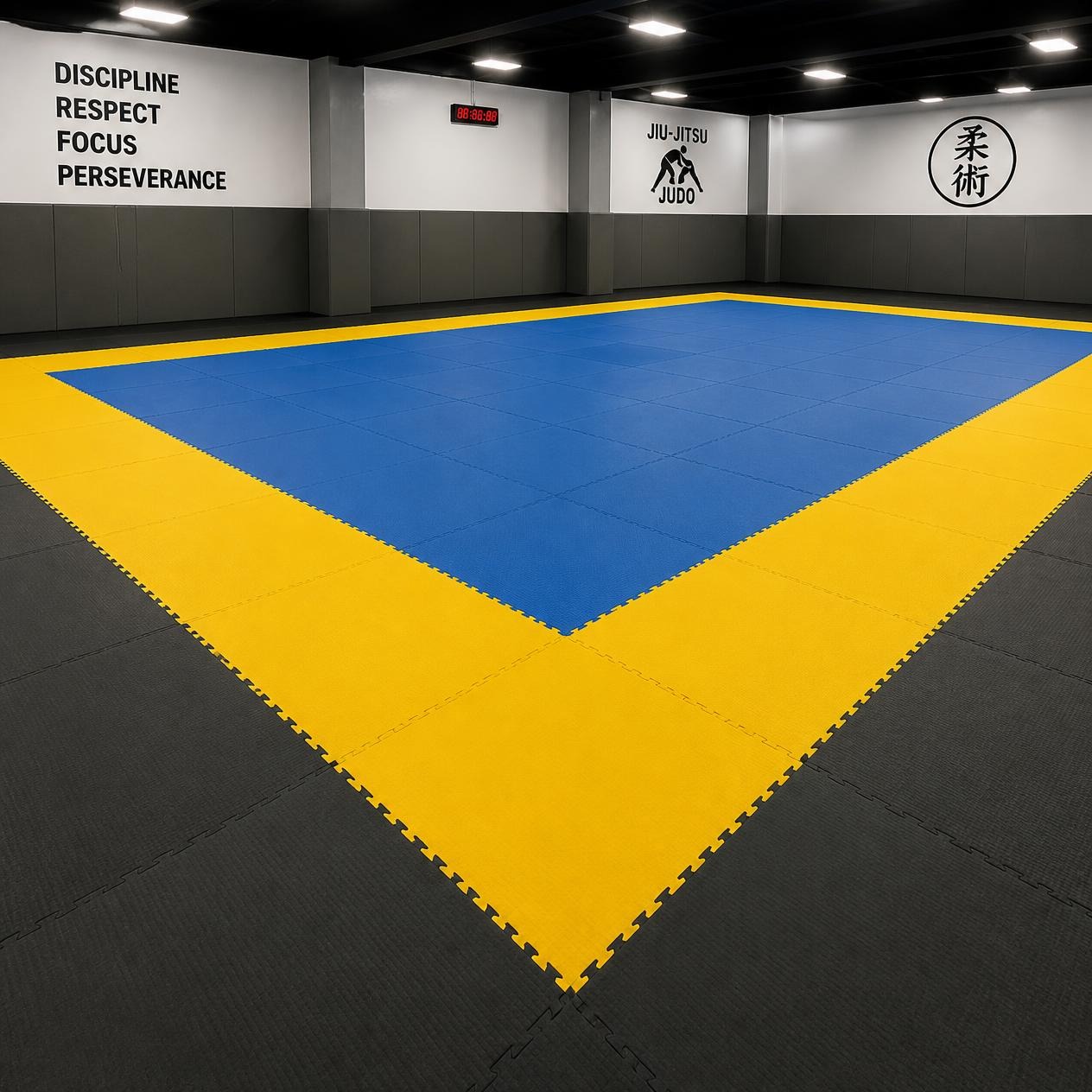
Tatami for Combat Sports: A Guide to Density and Thickness for MMA, Judo, and Karate
Choosing a combat sports tatami is one of the most important investments for a gym, a martial arts school, or a home gym dedicated to combat sports. Although many models may look similar at first glance, there are substantial differences in terms of density, thickness, shock absorption capacity, surface grip, and long-term durability. An inadequate surface can compromise training quality, increase the risk of injury, and deteriorate rapidly when subjected to intensive use.
Every discipline has specific needs. Judo requires a high capacity to absorb falls generated by throws, while Muay Thai and MMA need a stable surface that allows for rapid movements, changes of direction, and work both standing and on the ground. Karate, on the other hand, prioritizes balance, stability, and a surface that promotes explosiveness and precision during techniques.
In this guide, we analyze in detail the technical characteristics of professional tatami mats, comparing thicknesses, densities, materials, and intended uses. The goal is to help athletes, instructors, and gym owners choose a solution that is truly suited to their needs, avoiding poor investments and prioritizing safety, durability, and performance.
- Why the tatami is fundamental in combat sports
- Why density matters more than thickness
- Comparison between 2 cm, 3 cm, and 4 cm tatami
- The ideal tatami for MMA
- Which tatami to choose for Judo
- The ideal flooring for Karate
- Materials, texture, and interlocking systems
- Installation and maintenance
- How to choose the best investment
Why the tatami is fundamental in combat sports
The floor is the only element with which the athlete remains in constant contact during every training session. Every step, throw, roll, fall, and change of direction is influenced by the characteristics of the surface.
A tatami that is too rigid transmits greater stress to the joints of the ankles, knees, and spine. Conversely, an excessively soft surface compromises stability, balance, and precision of movement, increasing energy expenditure and making technical execution more difficult.
Choosing the correct tatami therefore contributes to both safety and training quality, improving athlete confidence and reducing physical wear resulting from thousands of repetitions throughout the season.
Reducing the risk of injury
A surface designed for the practiced discipline absorbs part of the impact energy and limits the stress transmitted to the joints during daily training.
Improving technical performance
Grip, stability, and elastic response directly influence speed, balance, and precision of movement, making training more effective.
Why density matters more than thickness
Many buyers evaluate tatami exclusively based on thickness, but this parameter only tells part of the story regarding product quality. The density of the foam, generally expressed in kilograms per cubic meter, determines the flooring's actual ability to support the athlete's weight and absorb impacts without deforming.
Modern high-density MMA mats ensure better force distribution, greater stability during movements, and significantly longer durability compared to cheaper products with less compact foams.
A very thick tatami made with low-density material will tend to crush quickly, progressively losing its absorption capacity, stability, and comfort.
How to interpret density
The higher the foam density, the greater the resistance to deformation and the tatami's ability to maintain its characteristics even after years of intensive use.
Compression resistance
A quality foam quickly recovers its original shape after every impact, ensuring consistent performance during intensive training.
Comparison between 2 cm, 3 cm, and 4 cm tatami
Thickness must always be evaluated together with density and the discipline practiced. Each configuration offers specific advantages that meet different needs.
2 cm tatami mats are particularly suitable for disciplines characterized by predominantly standing movements and limited throws. They offer excellent stability and allow for rapid changes of direction.
3 cm models are a versatile solution, while 4 cm thickness Judo tatami are generally preferred when falls and throws constitute a predominant part of the training.
2 cm tatami
Ideal for traditional Karate, fitness, technical disciplines, and activities with limited throwing work.
3 and 4 cm tatami
Greater thicknesses increase shock absorption capacity and are particularly suitable for Judo, Brazilian Jiu-Jitsu, and numerous MMA applications.
The ideal tatami for MMA
Mixed Martial Arts combine striking, wrestling, and grappling. The flooring must therefore ensure a perfect balance between shock absorption and stability during rapid movements.
An excessively soft surface makes footing difficult during strikes and can penalize standing mobility. Conversely, a surface that is too rigid increases discomfort during ground work and throws.
For this reason, professional gyms focused on MMA generally choose high-density tatami with anti-slip texture and thicknesses designed to offer an optimal compromise between protection and performance.
Grappling needs
During wrestling and guard passing, the tatami must ensure comfort without creating excessive friction on the skin.
Striking needs
A stable surface response promotes explosiveness, balance, and precision during punches, kicks, and movement.
Which tatami to choose for Judo
In Judo, the number of falls during a single session can be extremely high. For this reason, the level of shock absorption is the priority parameter.
Throws transfer high amounts of energy to the ground and require surfaces designed to limit stress on the back, hips, and joints. A professional tatami allows athletes to perform numerous repetitions while maintaining a high level of safety.
In addition to thickness, it is important to verify surface uniformity, the quality of the interlocking system, and the overall stability of the installation, especially in high-traffic gyms.
Fall absorption
The combination of high density and adequate thickness reduces force transmission during ukemi and throwing techniques.
Resistance to intensive use
Schools with many practitioners need flooring that maintains its characteristics even after thousands of falls.
The ideal flooring for Karate
In Karate, the needs change significantly compared to sports with numerous throws. The stability of footing becomes a priority to allow for the precise execution of techniques, kata, and explosive combinations.
Good Karate flooring offers a balanced grip that prevents slipping without hindering foot rotation during changes of direction.
The surface must also ensure a controlled elastic return that promotes speed, balance, and movement control without being unstable.
Technical training
A stable surface improves the precision of stances and the quality of execution during kata and technical work.
Kumite
In combat training, it is important to find a balance between grip and fluidity of movement.
Materials, texture, and interlocking systems
Professional tatami mats are generally made of high-density EVA foam that combines lightness, resistance, and impact absorption capacity.
The professional interlocking tatami system allows for simple installation and ensures surface continuity, reducing shifting during intensive use.
Surface texture also plays a decisive role. A finish that is too smooth increases the risk of slipping, while one that is too rough can cause abrasions during ground work.
Surface grip
A texture specifically designed for combat sports improves control and safety without compromising the fluidity of movement.
Interlocking quality
Precise interlocking prevents gaps between tiles and keeps the surface uniform even during intensive training.
Installation and maintenance
Correct installation contributes as much to the overall safety of the flooring as the quality of the product. The subfloor must be level, stable, and perfectly clean before installation.
Daily maintenance includes cleaning with EVA-compatible detergents and periodic checks of the interlocking state, especially in high-stress areas.
Promptly checking for any deformations or wear allows for intervention before they compromise the safety and comfort of the athletes.
Regular cleaning
Proper sanitization preserves the materials and helps maintain high safety standards within the gym.
Periodic checks
Monitoring the state of the surface allows for scheduling replacements, avoiding sudden drops in performance.
How to choose the best investment
Choosing the right combat sports tatami means simultaneously evaluating the discipline practiced, foam density, thickness, material quality, and surface characteristics. Focusing exclusively on price or thickness can lead to purchasing products that are not suited to the actual needs of the gym or the athlete.
For martial arts schools, combat centers, and professional gyms, investing in quality technical flooring is a strategic choice. A properly sized tatami improves member safety, increases the lifespan of the sports facility, and enhances the image of the structure in the eyes of new clients and experienced athletes.
Carefully analyzing density, elastic response, grip, interlocking system, and intended use allows for the creation of a training area truly designed for the practiced discipline, offering athletes a surface capable of supporting their technical growth and ensuring high performance for many years.
Comments (0)