
Trolley
You have no items in your shopping cart

 Budgets
 Dumbers
 Discs
 Benches
 Racks and Rigs
 Weights Holders
 Isotonic machines
 Calisthenics
 Cardio
 Kettlebells
 Flooring
 Gym Set
 Accessories
 Combat
 ARTI MARZIALI
 CONTAINER GYM
 Tug-Of-War
 Used Gym Equipment
 PILATES MACCHINARI
 GINNASTICA ARTISTICA
 CAMPI DA PADEL
 Prodotti in Pronta Consegna
 Informazioni
 IRONMAN
 Gift Card
- Donatif
- General information
- 0 I like it
- 204 Views
- 0 comments
- gym flooring, safety flooring, gym safety, shock-absorbing materials
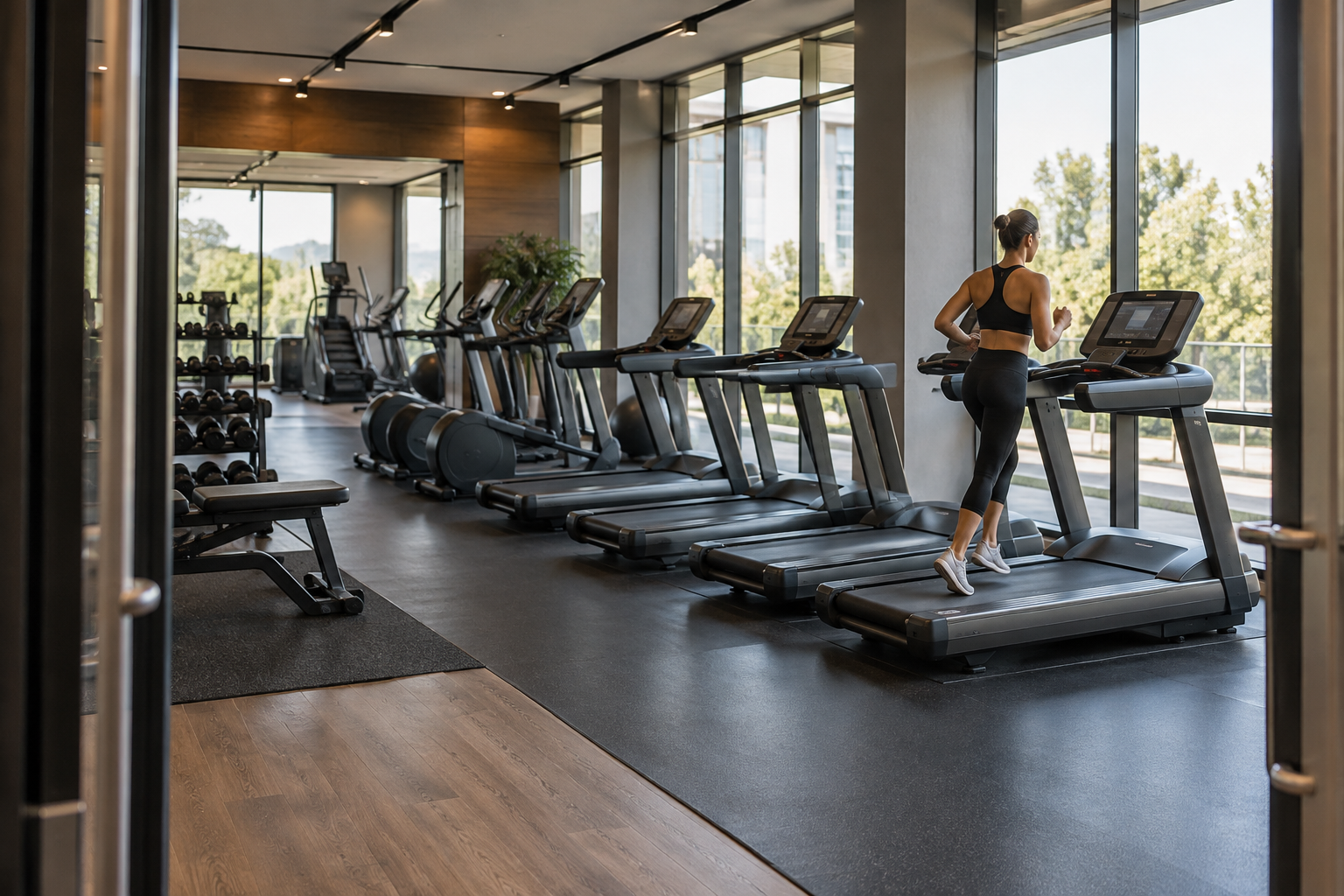
Treadmill for intense daily use: how to choose a reliable machine
A treadmill used every day must offer more than a high speed: you need continuity, clear controls, and a support plan compatible with the room.
To choose among professional models, it is useful to start from the people who will use them and the expected hours, then compare the declared characteristics with the available space.
This guide brings together practical checks for managers and fitness supervisors, from running surface to maintenance.
- What intense use really means
- Motor and operating continuity
- Belt, deck, and running surface
- Controls, safety, and accessibility
- Room layout and organization
- Support, spare parts, and maintenance
- Comparing models before choosing
What intense use really means
Intensity does not only coincide with maximum speed. In a busy gym, a treadmill can be used for many successive sessions, by people with different weight, stride, and goals. A machine destined for this context must sustain service continuity and make checks predictable. The choice therefore begins with plausible usage hours, session duration, and the times when multiple people might be waiting. A model adequate for a few home walks should not be automatically considered suitable for the same pace as a room open all day.
User profile matters as much as the calendar. Walking, slow running, intervals, and incline workouts produce different demands; even the ease with which a person steps onto the belt or reaches the controls influences the experience. Describe the most frequent scenarios before comparing specifications and offers, and check the declared intended use with the manufacturer.
A practical example: a corporate room with accesses concentrated during the lunch break may record short and close sessions; a fitness center may have peaks in the morning and evening. In both cases, availability is of interest, but the number of machines needed and maintenance windows can be different. Observing the flow allows sizing the purchase without relying on a single advertising number.
Motor and operating continuity
The motor specification sheet should be read together with the usage conditions indicated by the manufacturer. It is not enough to compare an isolated figure: ask whether the data represents continuous power or a peak value, how it is defined, and for which usage category the machine is intended. Data expressed with different criteria are not directly equivalent.
Heat management also counts. A machine used for a long time must have ventilation conditions compatible with the chosen position and respect the control intervals provided in the manual. Avoid obstructing air vents and consider dust, ambient temperature, and accessibility for cleaning. A technical assessment includes the entire system, not just the motor taken alone.
During the test, observe the response to speed and incline changes, movement stability, and the possible presence of abnormal noises. The test does not replace the manufacturer's data, but helps detect ergonomic problems. Also ask which conditions may require a break or a technical check, without assuming that every model has the same limits.
Belt, deck, and running surface
The useful surface must allow intended users to move without perceiving an excessively restricted space. Length and width must be considered together with speed and stride: a controlled walk requires a different margin compared to running. It is advisable to test the machine with different user profiles, taking into account the instructions and declared limits.
The deck and cushioning system affect the feel underfoot and stability. A very soft surface is not automatically better for everyone: the point is to maintain a predictable and consistent footing with use. Ask how belt alignment and tension are checked and which interventions require qualified personnel.
Belt wear can compromise service if ignored. An inspection program should include visual checking, listening to unusual noises, and reporting irregular sliding. Cleaning and lubrication must follow the specific manual: applying products or procedures not provided for can damage components or alter operation.
Controls, safety, and accessibility
A readable console reduces the time needed to start and modify the workout. Essential controls must be recognizable even during movement; speed and incline must change in an understandable way. Additional programs and connectivity can be useful, but must not hide fundamental functions behind difficult steps.
Check the position of the emergency stop and safety key when provided. Staff must know the procedure indicated by the manufacturer and explain to users how to interrupt the activity. Handrails, step-up height, and lateral space influence accessibility; evaluate these elements with those who know the needs of the people who will use the room.
Instructions near the machine should explain how to start the belt, modify its speed, stop it, and report a problem. Anyone experiencing pain, dizziness, or an unusual sensation should stop the activity and seek appropriate assistance. For users with particular clinical needs, the choice and use must be agreed upon with competent professionals.
Room layout and organization
Measure the actual footprint of the machine and verify the spaces required by the manufacturer for use, access, and support. Do not design the layout solely on the floor footprint: consider the rear area, passage paths, any doors, and the possibility of reaching the machine for cleaning and interventions.
The position of the outlets must be compatible with electrical specifications. For power supply, connections, and system conditions, involve a qualified professional when necessary and follow the machine's instructions. Avoid improvised solutions that leave cables along the walkway or make it difficult to isolate the appliance.
An orderly arrangement also helps manage peaks. If several people are waiting, observe occupancy times and actual needs before introducing rules. Simple signage and a point to communicate any faults reduce uncertainty. The presence of multiple machines does not eliminate the need to plan checks and technical downtime.
Support, spare parts, and maintenance
For a machine subjected to intense daily use, support is part of the initial choice. Ask who receives reports, what information is needed to open a request, how interventions are handled, and whether spare parts for the model are available. Times and conditions must be defined in the offer, without assuming they are identical for all suppliers.
Prepare a logbook with model, serial number, installation date, checks, and anomalies. Staff can note observable symptoms, such as noise, display messages, or variations in sliding, without attempting repairs for which they are not trained. If the machine presents a defect that can compromise use, take it out of service and activate the provided channel.
Consult the selection of professional cardio machines to guide the request, then compare the actual model specifications. Ask for the specific maintenance schedule, allowed cleaning materials, and warranty conditions. A written plan makes it easier to distribute tasks and anticipate interruptions.
Comparing models before choosing
Build a table with equal columns for each proposal: intended use, surface dimensions, footprint, declared speed and incline, user limits, power supply, controls, maintenance, spare parts, and support. Add what is included in delivery and any installation conditions. Missing cells become questions to ask before deciding.
Prioritize features that are truly necessary. A facility that mostly hosts walking might appreciate easy access and simple controls; a room with frequent running should carefully evaluate surface, stability, and continuity. If users are diverse, try to represent multiple scenarios instead of optimizing the choice for a single person.
Before confirming, verify that the offer reports the model, configuration, and discussed conditions. Agree on who will perform the commissioning, who will receive instructions, and how the first check will be recorded. After the first weeks, gather observations from users and staff: queues, ease of use, and reports help adjust organization and maintenance to actual demand.
How to organize a useful test
The test should reproduce the most common conditions of the facility. Ask people with different experience to start the machine, change speed, and end the session following the available instructions. Observe where they hesitate, what information they look for, and whether they reach the controls without assuming uncomfortable postures. A guided test is also useful for staff who will have to explain the main functions.
During walking and running, evaluate whether the surface appears sufficiently spacious and whether the stride remains natural. Verify that the displayed data are readable, that the adjustment responds in an understandable way, and that the machine remains stable. Do not turn a short test into a promise on durability: documentation, support conditions, and appropriate maintenance are needed for that evaluation.
At the end, gather observations in an identical sheet for each model. If doubts arise about noise, component access, or maintenance, ask the supplier for written clarifications. The answers can be discussed with the room manager before ordering, along with electrical system constraints and actually available spaces.
A well-documented choice also facilitates the transition from the purchasing phase to daily management. Keep manuals, contacts, and agreed conditions in a place accessible to responsible persons. Plan an initial moment to illustrate the fault-reporting procedure and verify that everyone knows when to interrupt use and who to contact.
Comments (0)