
Trolley
You have no items in your shopping cart

 Budgets
 Dumbers
 Discs
Discs
 Benches
 Racks and Rigs
 Weights Holders
 Isotonic machines
 Calisthenics
 Cardio
 Kettlebells
 Flooring
 Gym Set
 Accessories
 Combat
 ARTI MARZIALI
 CONTAINER GYM
 Tug-Of-War
 Used Gym Equipment
 PILATES MACCHINARI
 GINNASTICA ARTISTICA
 CAMPI DA PADEL
 Prodotti in Pronta Consegna
 Informazioni
 IRONMAN
 Gift Card
- Donatif
- General information
- 0 I like it
- 7 Views
- 0 comments
- gym flooring, safety flooring, gym safety, shock-absorbing materials
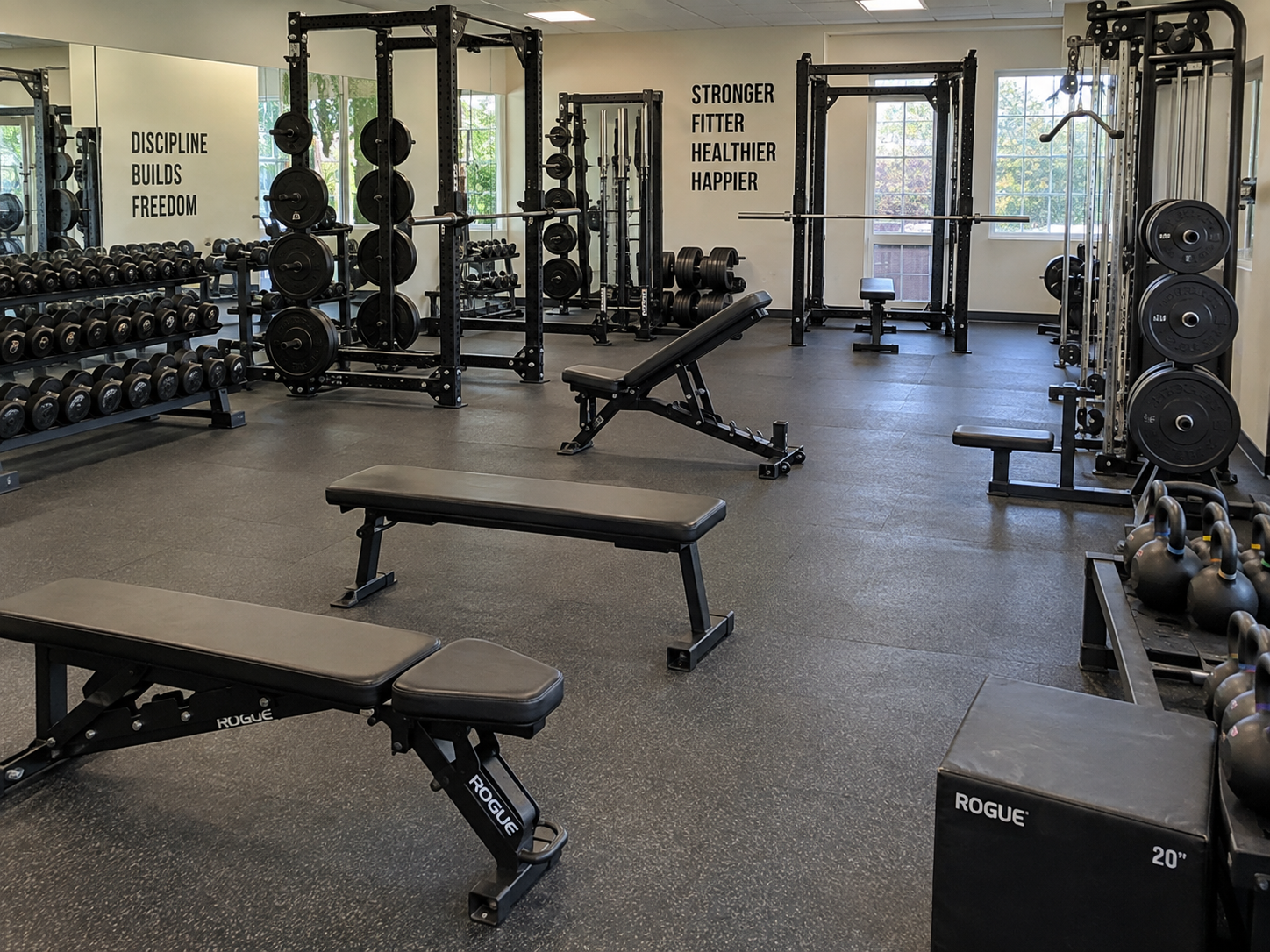
What equipment is needed in a weight room: essential selection guide
What equipment is needed in a weight room? A well-designed weight room must offer a balanced set of equipment that allows for the training of all major movement patterns, adapting to the different experience levels of users. The choice does not depend on the number of machines installed, but on the ability to cover training needs in a safe, functional, and easily manageable way.
For a commercial gym, it is essential to identify the categories of equipment truly necessary, avoiding redundant purchases or ones poorly consistent with the facility's target audience. A rational selection improves space utilization, facilitates maintenance, and makes it possible to offer a complete experience for both beginners and more experienced users.
The ideal configuration stems from the analysis of available surface area, number of members, type of training offered, and budget allocated for the investment. Each piece of equipment should be integrated within an overall project rather than as an isolated element.
- What equipment is essential?
- Why are free weights fundamental?
- When are guided machines needed?
- What accessories complete the weight room?
- How to choose the equipment?
- How to correctly use the equipment?
- Errors to avoid
- How to plan the investment
What equipment is essential?
The minimum equipment should allow for the training of all major muscle groups through multi-joint and complementary exercises. A complete weight room combines stations dedicated to free weights with guided machines and accessories.
The main categories include racks, benches, barbells, dumbbells, plates, isotonic machines, and weight storage systems. The quantity of each element varies depending on the size of the gym and expected attendance.
The goal is to offer a continuous training path while avoiding bottlenecks during peak usage hours.
Basic equipment
An essential configuration includes at least an area dedicated to free weights, a zone for guided machines, and spaces intended for complementary exercises.
Exercise coverage
The equipment should allow for the execution of pushing, pulling, squat, deadlift, lunge movements, and specific work for the trunk and upper limbs.
Why are free weights fundamental?
Free weights constitute the operational heart of many weight rooms because they allow for a high variety of exercises and promote the development of coordination and functional strength.
Barbells, dumbbells, and plates make it easy to adapt the load to the user's capabilities and are suitable for both beginners and advanced athletes.
To ensure safety and practicality, it is important to also provide adequate storage systems and flooring designed to withstand load impacts.
Barbells and plates
Barbells allow for the execution of the main multi-joint exercises and should be chosen based on intended use. You can explore the available range in the barbells category.
Dumbbells and benches
Dumbbells and adjustable benches broaden training possibilities by allowing numerous exercise variations and progressive use of loads.
When are guided machines needed?
Guided machines represent an important integration because they allow specific muscle groups to be trained with controlled trajectories and easily repeatable adjustments.
They are particularly useful for first-time users, functional recovery programs, and complementary workouts compared to free weights.
Their selection should be carried out by evaluating the audience's needs, the available surface area, and the type of program the gym intends to offer.
Main machines
Leg press, lat pulldown, pulley, chest press, leg extension, and leg curl represent some of the solutions commonly found in commercial gyms.
Integration with free weights
Machines do not necessarily replace free weights but complete the offering by allowing a greater variety of training.
What accessories complete a weight room?
Accessories improve space organization and expand training possibilities. Racks, plate supports, barbell collars, mats, resistance bands, and small tools allow numerous exercises to be performed in an orderly manner.
Proper organization also reduces the risk of leaving weights and accessories along passageways, improving the overall safety of the room.
Each accessory should be placed in an easily reachable position consistent with user flow.
Storage systems
Plate trees, racks, and dedicated supports facilitate the tidying up of equipment at the end of the workout.
Complementary equipment
Kettlebells, resistance bands, foam rollers, and other accessories can expand training possibilities without requiring large surfaces.
How to choose the equipment?
The choice should start from an analysis of the gym's needs rather than the catalog of available products. It is important to define the average number of users present simultaneously, the actually usable surface area, and the prevailing type of training.
It is also necessary to consider manufacturing quality, spare parts availability, maintenance simplicity, and the possibility of expanding the equipment over time.
A modular configuration allows the weight room to be progressively updated without having to replace the entire fleet of machines.
Space evaluation
Each piece of equipment requires not only the floor area occupied but also the operational space indicated by the manufacturer to allow safe use.
Audience analysis
A general fitness-oriented gym will have different needs compared to a facility dedicated to athletic preparation or powerlifting.
How to correctly use the equipment?
Each machine and piece of equipment should be used exclusively according to the instructions provided by the manufacturer. Adjustments must be made before the exercise, verifying that all safety systems are correctly positioned.
It is good practice to put away plates, dumbbells, and accessories at the end of the workout, keeping circulation paths clear and facilitating the work of other users.
Gym staff should also provide instructions on the correct use of equipment to new members, reducing the risk of improper use.
Equipment adjustment
Seats, backrests, supports, and locking systems must be adapted to the user's characteristics before starting the exercise.
Tidying up after training
Proper tidying preserves the equipment, improves safety, and makes the use of the weight room more efficient.
What errors should be avoided?
One of the most frequent errors consists of purchasing numerous pieces of equipment without a real plan for the available space. An overcrowded room is less functional and harder to manage.
Another critical issue is neglecting scheduled maintenance or choosing equipment that does not meet the actual needs of the clientele.
It is also advisable to avoid duplicating machines with very similar functions when versatile equipment capable of satisfying a larger number of users could be more useful.
Unplanned purchases
The choice should be guided by the gym project and not exclusively by promotions available on the market.
Neglecting maintenance
Periodic checks and regular cleaning help maintain high safety, reliability, and durability of the equipment.
How to plan the investment?
The selection of equipment should be evaluated considering the entire lifecycle of the weight room. Manufacturing quality, ease of maintenance, availability of spare parts, and the possibility of future expansion impact the overall cost much more than just the purchase price.
Before defining the final configuration, it is advisable to prepare a project that takes into account the available surface area, internal pathways, structural load capacities, and user needs. For technical characteristics, installation methods, and usage, it is appropriate to refer to manufacturer manuals and applicable standards, avoiding choosing equipment based solely on numbers or aesthetics.
Comments (0)