
Trolley
You have no items in your shopping cart

 Budgets
 Dumbers
 Discs
Discs
 Benches
 Racks and Rigs
 Weights Holders
 Isotonic machines
 Calisthenics
 Cardio
 Kettlebells
 Flooring
 Gym Set
 Accessories
 Combat
 ARTI MARZIALI
 CONTAINER GYM
 Tug-Of-War
 Used Gym Equipment
 PILATES MACCHINARI
 GINNASTICA ARTISTICA
 CAMPI DA PADEL
 Prodotti in Pronta Consegna
 Informazioni
 IRONMAN
 Gift Card
- Donatif
- General information
- 0 I like it
- 48 Views
- 0 comments
- gym flooring, safety flooring, gym safety, shock-absorbing materials
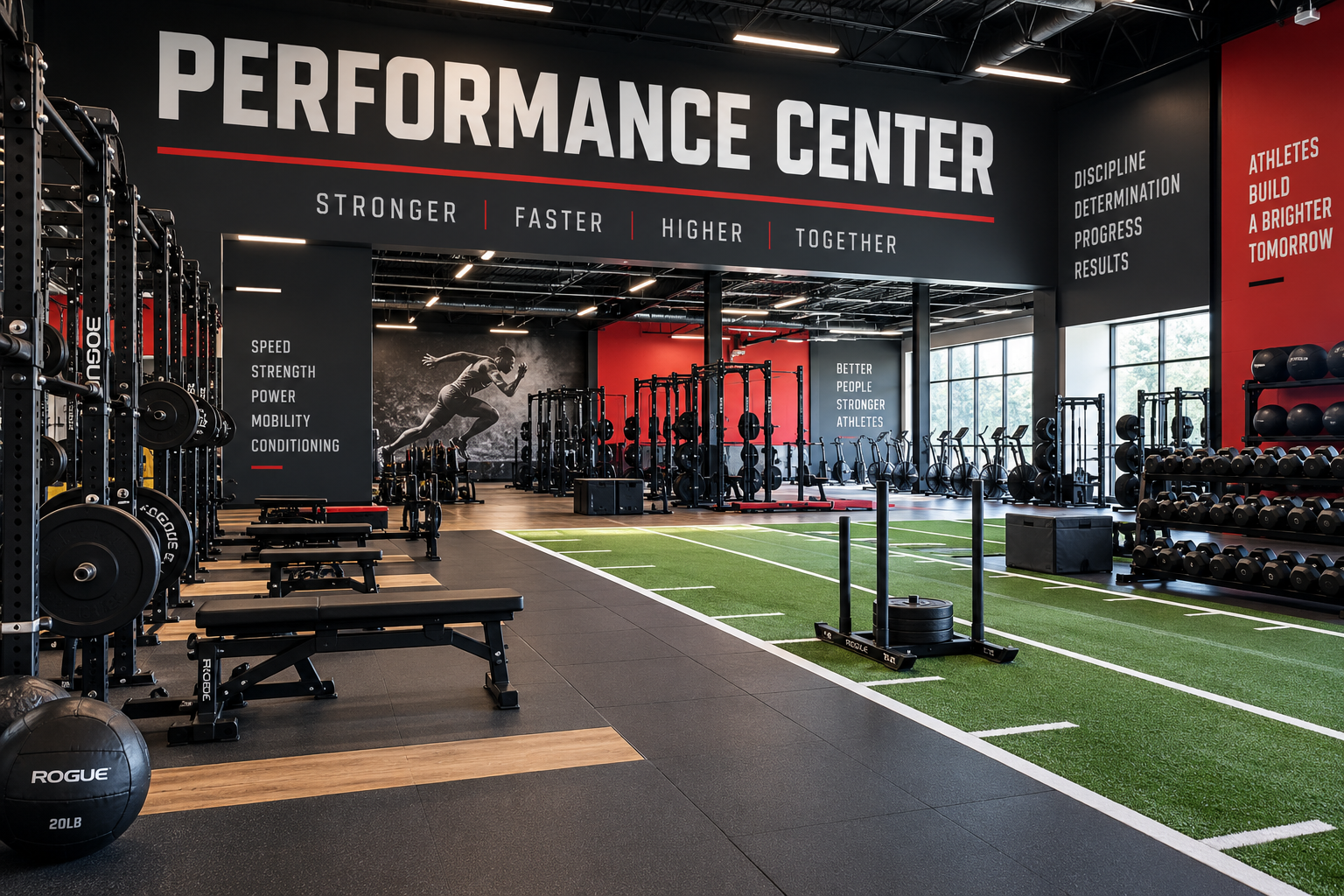
What equipment is needed in a performance center: configuration guide
A performance center is designed to support athletic preparation programs through areas dedicated to the development of strength, speed, power, coordination, and recovery. The choice of equipment must be consistent with the facility's goals, the profile of the athletes, and the layout of the available space.
There is no universal equipment package valid for every center. A performance center intended for team sports has different requirements compared to a facility dedicated to track and field, combat sports, or individual preparation. For this reason, equipment must be selected within a functional project rather than as simple independent items.
This guide illustrates which categories of equipment are normally provided in a professional performance center, proposing verifiable criteria for planning the setup without turning into a product catalog.
- Quick answer
- What equipment is indispensable?
- How to choose the equipment?
- How to distribute them in the space?
- How to ensure safety and operational continuity?
- Errors to avoid
- FAQ
- How to plan the investment?
What equipment is needed in a performance center?
Equipment must be selected based on the activities performed and normally includes stations dedicated to strength, spaces for dynamic work, areas for mobility exercises, conditioning tools, and accessories for athletic preparation. The configuration must be defined starting from the center's design, the number of users, and the planned training programs.
Before purchasing, it is advisable to prepare a complete floor plan with the location of each operational station.
Every choice should be supported by technical datasheets, manufacturer documentation, and verification of compatibility with the overall facility layout.
Objective of the equipment
The equipment must allow for the execution of athletic preparation programs while maintaining order, safety, and the possibility of simultaneous use.
Preliminary analysis
The number of athletes, sports disciplines, training methods, and available space represent the starting point of the design.
What categories of equipment are indispensable?
A performance center is generally organized through functional areas rather than individual machines. Each category of equipment supports a specific phase of athletic preparation.
The main categories include systems for strength training, equipment for dynamic exercises, tools for metabolic work, technical accessories, and solutions dedicated to mobility.
The final composition depends on the facility's goals and the type of athletes supported.
Strength area
Stations dedicated to strength represent one of the main cores of the center and must be organized to allow efficient use during sessions.
Athletic preparation accessories
Accessories complement technical work and allow for the development of differentiated programs based on the needs of different groups of athletes.
How to choose the equipment?
The choice should follow a structured procedure that considers project goals, usage methods, maximum number of simultaneous users, and potential for future expansion.
It is advisable to compare products using technical documentation, installation requirements, availability of support, and compatibility with available spaces.
Equipment selection should only take place after defining the overall layout of the performance center.
Selection criteria
Functionality, modularity, ease of maintenance, and compatibility with the project represent fundamental elements of the evaluation.
Comparing solutions
A technical specification document allows for the comparison of different proposals using homogeneous and verifiable parameters.
How to distribute the equipment in the space?
Equipment must be organized according to functional areas, avoiding interference between static exercises and dynamic activities.
The configuration should follow the natural flow of the session, favoring the transition between warm-up, strength, speed work, and recovery.
For the creation of the area dedicated to strength, the project can be integrated with professional racks and rigs designed for high-intensity use environments.
Path management
Passageways between stations must always remain clear and easily accessible during all activities.
Modular configuration
A flexible distribution facilitates any expansions and the updating of the facility over time.
How to ensure safety and operational continuity?
Safety depends on the correct installation of equipment, scheduled maintenance, and a space distribution that reduces interference among users.
Periodic checks and the logging of interventions facilitate center management and help maintain high operational efficiency.
Every piece of equipment should be used as outlined in the manufacturer's technical documentation.
Periodic checks
Verifications should include equipment stability, surface condition, and the correct functioning of stations.
Scheduled maintenance
A preventive maintenance plan reduces the risk of activity interruptions and extends the useful life of the equipment.
What errors should be avoided?
One of the most common mistakes is purchasing equipment before defining the center's layout. Concentrating all stations in a single area or choosing products without considering operational flows can also significantly reduce the facility's efficiency.
It is also advisable to avoid redundant equipment that limits the space available for dynamic activities.
Planning supported by detailed floor plans and a functional list of equipment helps avoid costly modifications during setup.
Purchasing without a design
The lack of a preliminary configuration makes it difficult to correctly distribute equipment in the space.
Oversizing the equipment
An excessive number of equipment items can compromise the overall functionality of the performance center.
Frequently asked questions
Are many isostratic machines needed?
The composition of the equipment depends on the project's goals and the athletic preparation methodology adopted by the center.
Are accessories important?
Yes. Accessories allow for the expansion of training possibilities and the adaptation of exercises to different groups.
Is it useful to choose modular equipment?
A modular configuration facilitates future updates and makes it easier to adapt the center to new operational needs.
How to plan the investment?
The choice of equipment should be included within a design strategy that considers the life cycle, technical assistance, availability of spare parts, maintenance, and the possibility of facility expansion.
To compare different suppliers, it is advisable to prepare a specification document including a floor plan, a list of functional areas, equipment characteristics, installation methods, and assistance services. This approach allows proposals to be evaluated through objective and verifiable criteria.
A well-designed performance center is not distinguished by the quantity of equipment present, but by the ability to integrate each element within a layout consistent with the goals of athletic preparation and the future evolution of the facility.
Comments (0)