
Trolley
You have no items in your shopping cart

 Budgets
 Dumbers
 Discs
Discs
 Benches
 Racks and Rigs
 Weights Holders
 Isotonic machines
 Calisthenics
 Cardio
 Kettlebells
 Flooring
 Gym Set
 Accessories
 Combat
 ARTI MARZIALI
 CONTAINER GYM
 Tug-Of-War
 Used Gym Equipment
 PILATES MACCHINARI
 GINNASTICA ARTISTICA
 CAMPI DA PADEL
 Prodotti in Pronta Consegna
 Informazioni
 IRONMAN
 Gift Card
- Donatif
- General information
- 0 I like it
- 9 Views
- 0 comments
- gym flooring, safety flooring, gym safety, shock-absorbing materials
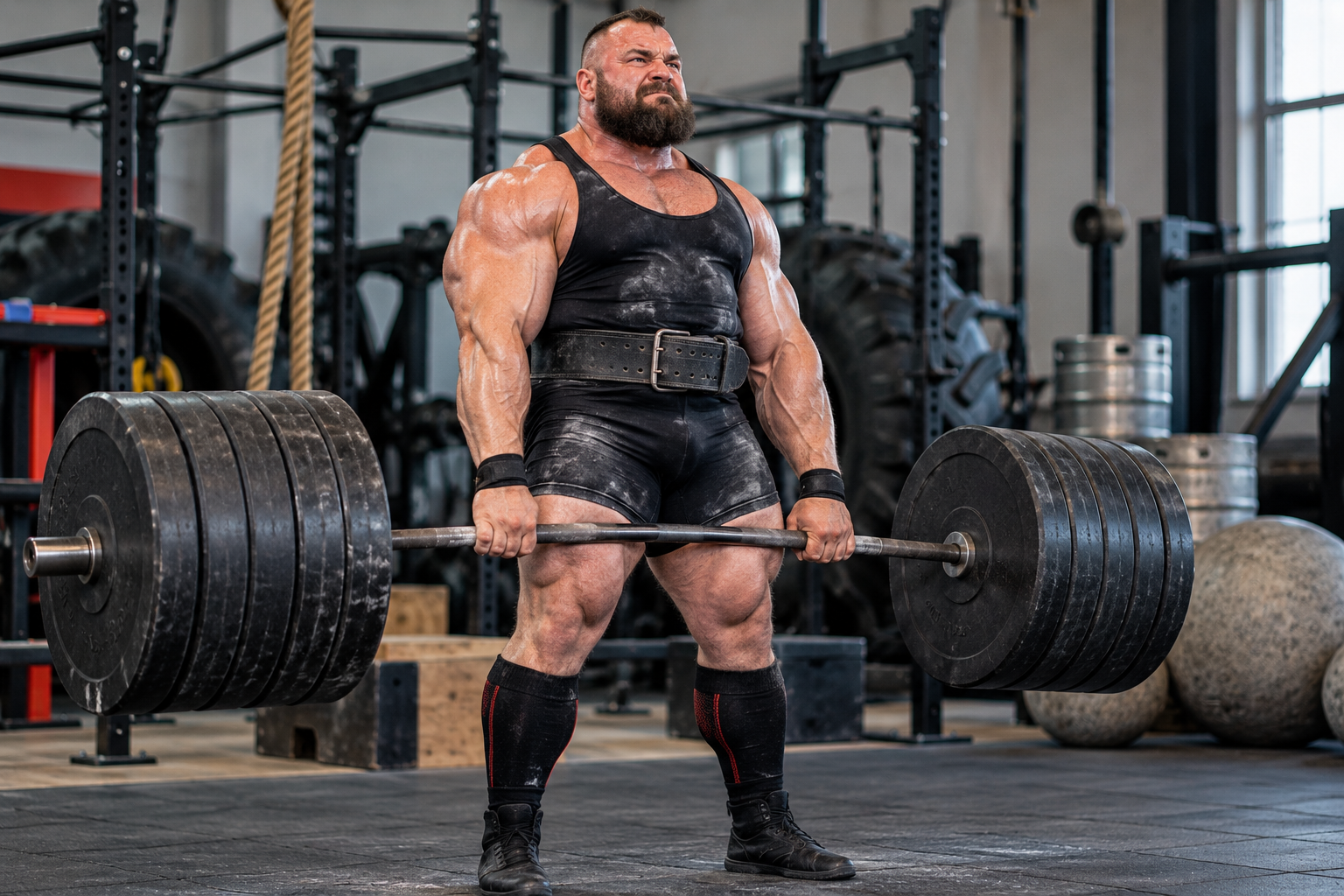
Strongman: what it is and what events it includes
Strongman is a strength discipline that tests athletes through dynamic and static events based on lifting, carrying, towing, and pushing very heavy loads. Unlike powerlifting or Olympic weightlifting, strongman combines maximal strength, muscular endurance, coordination, and the ability to handle unconventional implements.
Competitions can vary in the number and type of events, but they follow a common principle: the athlete must complete a given task in the shortest possible time or move the heaviest load. For this reason, training requires specific preparation, careful space organization, and the use of equipment designed to withstand intensive use.
For gyms, functional boxes, and sports centers, creating a dedicated strongman area means offering a highly specialized service. However, it is essential to know the characteristics of the events, choose the correct equipment, provide adequate safety spaces, and use flooring suitable for handling heavy loads.
- What is strongman
- What events it includes
- What equipment is needed
- How to set up a strongman area
- Practical criteria for choosing equipment
- Errors to avoid and safety
- FAQ
- Evaluating the investment
What is strongman
Strongman is a strength sport in which athletes tackle exercises that simulate carrying and moving heavy objects. Competitions do not feature a single technical movement but rather a succession of different events that require complementary physical qualities.
The discipline stands out because it often uses dedicated equipment instead of traditional barbells. Logs, sleds, yokes, farmer's walks, and stones represent some of the most characteristic tools.
Each competition can propose different combinations of exercises, making preparation very varied and oriented toward developing strength applied in real-life situations.
Origins of the discipline
Modern strongman derives from competitions born in the 1970s, inspired by traditional strength tests found in numerous European and North American cultures.
What makes strongman unique
The goal is not exclusively to lift the maximum possible load but to complete functional tasks that require technique, stability, endurance, and movement control.
What events it includes
Competitions generally include a set of different events selected by the organizers. Each event can modify weights, distances, and execution methods.
Among the most widespread events are carrying implements, overhead lifting, vehicle pulling, loading objects onto platforms, and static hold events.
The variety of events requires complete preparation and specific training programming.
Farmer's Walk
The farmer's walk consists of carrying two weights over a predetermined distance while maintaining a stable posture, speed, and grip control.
Yoke Walk
The yoke is carried on the shoulders for a defined distance. Trunk stability, balance, and lower limb strength prove decisive.
Other common events
Atlas Stones, Log Lift, Tire Flip, Deadlift, Truck Pull, Sandbag Carry, and Loading Race represent some of the most frequent events in international competitions.
What equipment is needed
Training requires robust equipment designed to withstand heavy loads and repeated use.
The main tools include yokes, farmer handles, log lift logs, pulling sleds, sandbags, atlas stones, flipping tires, and pulling systems.
To complete preparation, Olympic barbells, racks, and professional weight plates are also useful. Those wishing to integrate dedicated equipment can also evaluate professional gym accessories to expand training possibilities.
Specific equipment
Each piece of equipment is designed to develop a precise quality such as grip, stability, explosive strength, or carrying capacity.
Complementary equipment
Barbells, plates, plyo boxes, resistance bands, and sleds allow for building complete programs even when all competition equipment is not available.
How to set up a strongman area
A dedicated area must be designed considering operating space, user flows, and the ability to move bulky equipment.
Zones dedicated to carries must be sufficiently long and free of obstacles. Dynamic events require easily controllable linear paths.
Impact-absorbing flooring represents a fundamental element to protect both the subfloor and the equipment during impacts.
Required space
Dimensions depend on the planned exercises. Farmer's walks and yokes require clear corridors, while atlas stones and log lifts need dedicated lifting areas.
Area organization
The arrangement of equipment should allow for orderly paths while avoiding interference between different work stations.
Practical criteria for choosing equipment
Selection should consider build quality, load capacity, ease of maintenance, and compatibility with the users' level.
For a commercial gym, it is preferable to choose modular equipment that allows for progressively increasing difficulty.
Resistant materials, quality welds, and proper finishes help reduce wear during intensive use.
Materials
Structural steel, durable paint finishes, and replaceable components favor greater longevity over time.
Versatility
Adjustable equipment allows training to be adapted for both beginners and experienced athletes.
Errors to avoid and safety
The most common mistake consists of using improvised equipment lacking the necessary characteristics to support heavy loads.
It is important to provide adequate surfaces, periodically check the integrity of the structures, and keep the area free of obstacles.
Users should learn the correct technique before increasing loads and use accessories only when truly necessary.
Frequent errors
Neglecting load progression, underestimating technique, and using insufficient space increases the risk of accidents.
Good practices
Periodic equipment checks, qualified supervision, and orderly space management represent fundamental elements for safe use.
FAQ
Is strongman suitable for beginners?
Yes, provided the program is adapted to the athlete's level and loads are increased gradually.
What are the essential tools?
Farmer handles, yoke, sandbag, sled, log, and atlas stones represent the most characteristic equipment.
Is a lot of space needed?
It depends on the planned events. Carrying exercises require wider paths compared to stationary movements.
What standards should be followed?
Competition rules can vary between federations and organizers. For technical data, measurements, and regulations, it is advisable to consult the official documents of the federation or reference event. This article does not report numerical measurements because no single standard applies to all competitions.
Evaluating the investment
Integrating a dedicated strongman area allows you to expand the gym's offering toward athletes, trainers, and strength sports enthusiasts. The choice of equipment should be made considering build quality, space availability, user type, and the possibility of progressively expanding the training area. Careful design allows you to obtain a versatile, safe environment suitable for both individual training and preparation for specific competitions.
Comments (0)