
Trolley
You have no items in your shopping cart

 Budgets
 Dumbers
 Discs
 Benches
 Racks and Rigs
 Weights Holders
 Isotonic machines
 Calisthenics
 Cardio
 Kettlebells
 Flooring
 Gym Set
 Accessories
 Combat
 ARTI MARZIALI
 CONTAINER GYM
 Tug-Of-War
 Used Gym Equipment
 PILATES MACCHINARI
 GINNASTICA ARTISTICA
 CAMPI DA PADEL
 Prodotti in Pronta Consegna
 Informazioni
 IRONMAN
 Gift Card
- Donatif
- General information
- 0 I like it
- 195 Views
- 0 comments
- gym flooring, safety flooring, gym safety, shock-absorbing materials
Pilates Equipment: Choosing Based on Studio Goals
A Pilates studio can offer mat classes, sessions with small equipment, or work on dedicated machinery. The useful equipment depends on the planned activities and the preparation of those leading them: purchasing more tools does not automatically make a proposal more complete.
To understand which Pilates equipment to choose based on the goal, each purchase must be connected to a concrete function. Space, adjustments, supervision possibilities, and number of participants contribute to the choice just as much as the available exercise repertoire.
This guide helps the owner organize the comparison between different equipments. The instructions do not replace professional training, manufacturer instructions, or a health assessment when necessary for the participating individual.
The first practical step can be the description of a typical session, from the participant's arrival to final cleanup. Note the materials used, the time needed to change them, and the moments when the instructor must approach. This sequence makes visible needs that a product list might hide.
If the studio offers multiple services, check which tools are shared and how they are prepared between appointments. A machine used at different times can serve multiple activities, provided that configurations, skills, and times are compatible. Sharing should not leave components out of place or unassigned checks.
During the comparison, also ask to see operations less visible in the commercial demonstration: putting away accessories, cleaning contact points, and identifying components to inspect. The staff performing these activities can highlight difficulties useful for the decision. A complete evaluation therefore considers the entire cycle of use, not just the moment the equipment is tested.
- Define goals and lesson format
- Floor work and small equipment
- Evaluating the Reformer
- Other machines and equipment
- Space and accessibility
- Management and maintenance
- Building the purchase plan
Define goals and lesson format
From intentions to activities
Describe what activities you want to offer, with what frequency, and to how many people. Generic goals like wellness or mobility do not independently identify a machine: exercises, supervision methods, and adaptation criteria are needed. This description helps distinguish essential tools from those possibly useful at a later stage.
Also consider staff experience and training. Equipment may offer many possibilities, but require specific skills to adjust resistance and set up exercises. Before purchasing, verify that those leading the sessions know the model and can manage the planned activities.
Individual or group
An individual session allows modifying the configuration more frequently and closely following the steps. In a group, however, adjustments and accessory changes must be compatible with available time and the instructor's ability to observe each participant.
The number of stations should not be established solely by counting footprints. Consider space to assist, correct instructions, and reach each person. A configuration with fewer stations may be preferable if it allows adequate supervision and more accessible paths.
Floor work and small equipment
When to start from the mat
Floor work can be a base for activities where the instructor guides control, coordination, and movement awareness. Choose mats compatible with exercises, surface, and cleaning. Thickness and softness are not sufficient criteria: also observe stability, dimensions, and storage methods.
Some individuals may encounter difficulties getting down to the floor or getting back up. The professional must evaluate adaptations and alternatives consistent with their own skills. Mat selection does not automatically resolve these difficulties and must not replace individual evaluation.
Accessories with a precise function
Balls, circles, bands, and supports can vary the exercise or offer a reference. Select them based on the movement you intend to propose, verifying instructions and resistances. An accessory should have an understandable function, not be added solely to make the lesson more complex.
Before use, check integrity, cleanliness, and compatibility with the person. Damaged bands or unstable supports must be removed. In a group, prepare quantities and storage positions so distributing and storing materials does not block pathways.
Evaluating the Reformer
Possibilities and configuration
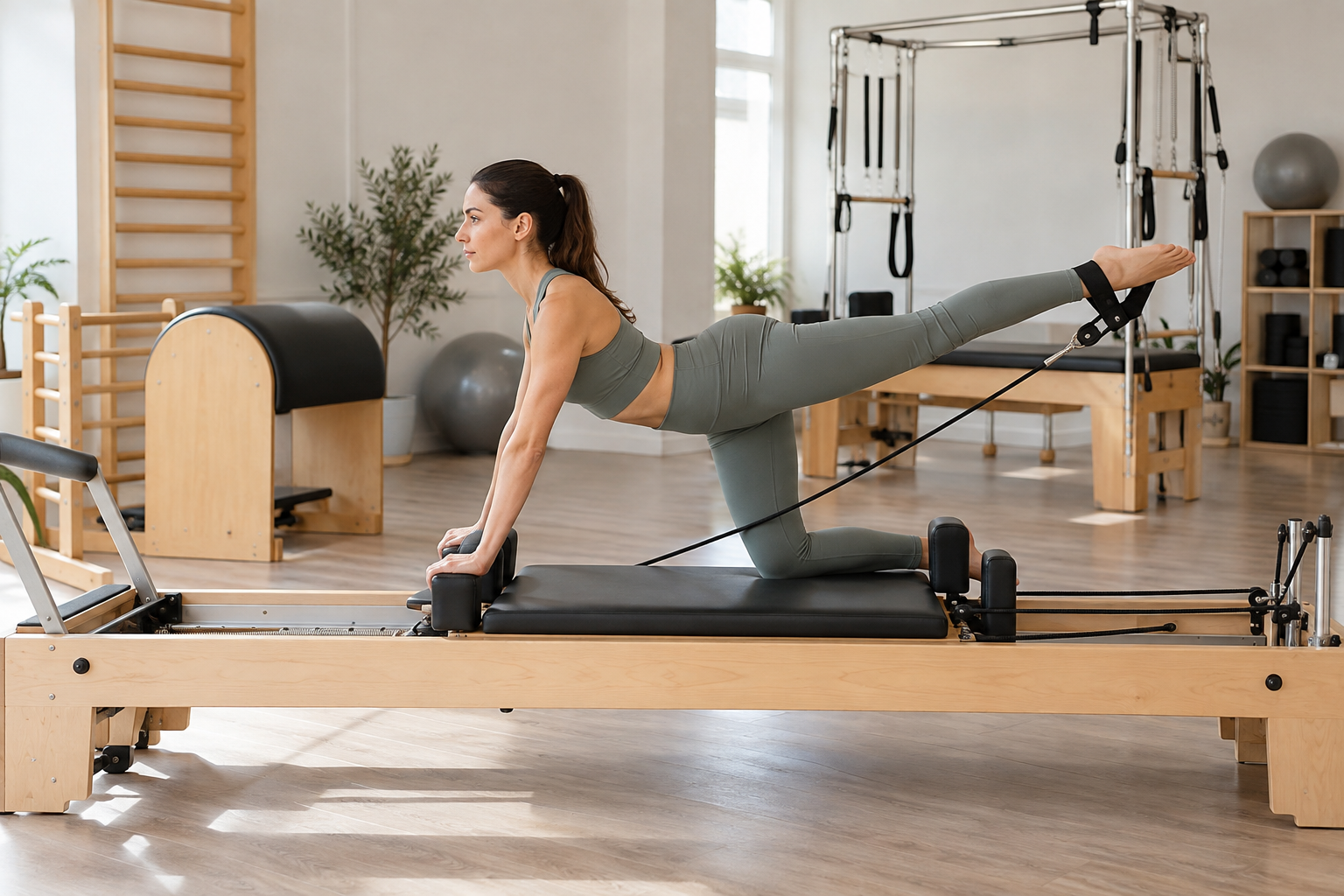
The Reformer uses a moving platform and resistance systems according to the model's design. Exercise possibilities depend on adjustments, accessories, and the training of the person leading it. Do not deduce suitability for your activity solely from the presence of springs or a catalog photograph.
Request the spec sheet, manual, and demonstration of daily operations. Check how to adjust components, get on and off, and prepare the machine for different people. A test organized with staff can highlight difficulties that do not emerge from the feature list.
Adjustments and supervision
Springs and other devices must be used according to the manufacturer's instructions and the instructor's competence. Colors and names do not guarantee equivalence between brands. Load or perceived assistance changes with exercise and configuration, so no universal setting exists for everyone.
Consider how much time exercise changes require and who should perform them. Adjustments must be explained and checked before movement. In the presence of a component that does not lock correctly or an anomaly in movement, suspend use and contact support.
Other machines and equipment
Chair, structures, and supports
Other equipment can expand the repertoire, but introduces its own requirements for access, balance, assembly, and control. Before selecting them, describe what activities they add to the service and whether the staff possesses the necessary skills. Variety is not a sufficient goal to justify a purchase.
Verify dimensions, support points, limits, and expected accessories. For structures to be installed or fixed, consult the manufacturer and involve competent figures for room conditions. Do not replace components or fasteners with seemingly equivalent solutions without confirmation.
Avoiding unnecessary overlaps
Compare the functions offered by already present equipment with those of the new product. Two tools may propose similar exercises but differ in adjustments and accessibility. The choice depends on the concrete advantage they add to activities, not on the number of different names in the catalog.
The Pilates equipment can be a starting point to identify categories. To decide, specifications and conditions of individual models are then needed, in addition to verifying compatibility with the studio's space, skills, and program.
Space and accessibility
Measuring the operating area
Mark model dimensions and areas needed for movement, adjustment, and assistance on a floor plan. Consider doors, pillars, and pathways. The footprint of a stationary machine does not match that of activity, especially when accessories or limbs move beyond the frame.
Also provide space for cleaning and technical interventions. If a machine can be moved or stored, verify permitted methods and the required number of operators. The ability to clear the room must result from instructions, without relying on improvised maneuvers.
Environment and pathways
Lighting, ventilation, flooring, and accesses must be consistent with intended use and applicable regulations. Any technical property checks are the responsibility of competent professionals. A commercial project alone does not prove environment suitability.
Keep pathways clear even during exercise changes. Supports, bags, and cleaning materials must have a recognizable placement. Observe how people enter, settle, and leave their station: these moments contribute to organizational quality just as much as the central exercise.
Management and maintenance
Cleaning and control
Define products and procedures compatible with upholstery, springs, and components of the model. Avoid detergents or lubricants not specified. Staff must know which points to check and when to report an anomaly, distinguishing cleaning and ordinary observation from technical interventions.
A logbook with equipment identification, dates, and reports facilitates comparison with support. Follow frequencies and replacement criteria indicated by the manufacturer. The absence of noise or visible defects does not replace required periodic checks.
Spare parts and support
Before purchase, ask which spare parts are available, how to request service, and what conditions apply to the warranty. Times and services must be stated in the offer, without assuming they are the same for all machines or included in installation.
If a part requires replacement, verify code and compatibility with model and revision. Visual similarity does not guarantee equivalence. Returning to service after an intervention must follow appropriate procedures and involve competent people.
Building the purchase plan
Priorities and comparison
Prepare a grid linking goal, exercises, intended users, space, adjustments, and skills. Add delivery, assembly, training, and maintenance. Ask for clarification on missing cells before comparing totals: offers with different services are not directly equivalent.
Progressive equipment can make sense if the initial phase already meets service needs. Define what observations would justify expansion, such as actual demand, usage times, and instructor needs. Do not base expansion solely on initial interest in a novelty.
Verify after opening
Collect staff observations on adjustments, cleaning, and pathways, and listen to difficulties reported by participants. Distinguish comfort and preferences from clinical results: a positive evaluation of the experience does not prove a therapeutic effect. Use comments to improve organization and explanations.
Update layout and maintenance plan when activities or user numbers change. Keep documents, conditions, and purchase motivations. A coherent choice remains connected to the studio's actual service and the capabilities of those running it, even as equipment grows.
Comments (0)