
Trolley
You have no items in your shopping cart

 Budgets
 Dumbers
 Discs
Discs
 Benches
 Racks and Rigs
 Weights Holders
 Isotonic machines
 Calisthenics
 Cardio
 Kettlebells
 Flooring
 Gym Set
 Accessories
 Combat
 ARTI MARZIALI
 CONTAINER GYM
 Tug-Of-War
 Used Gym Equipment
 PILATES MACCHINARI
 GINNASTICA ARTISTICA
 CAMPI DA PADEL
 Prodotti in Pronta Consegna
 Informazioni
 IRONMAN
 Gift Card
- Donatif
- General information
- 0 I like it
- 474 Views
- 0 comments
- gym flooring, safety flooring, gym safety, shock-absorbing materials
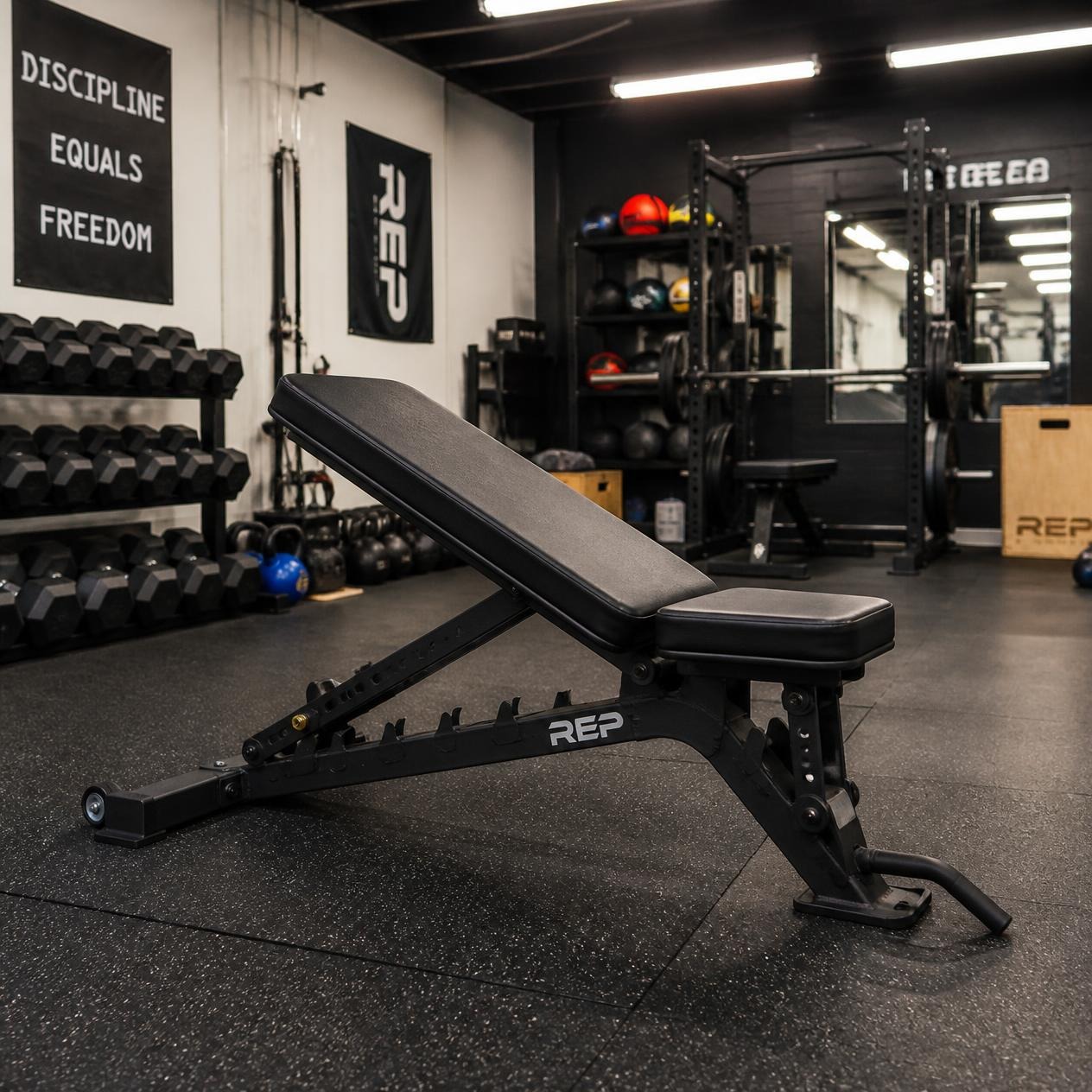
Gym bench for tall athletes: how to choose the correct dimensions
For those who are over 185 cm tall, choosing a gym bench does not simply mean buying a sturdy accessory, but finding equipment truly designed to ensure stability, comfort, and safety during every exercise. Many benches on the market are sized for the average build, leaving taller athletes with a backrest that is too short, a seat that is poorly proportioned, or a position that compromises the biomechanics of their movements.
An inadequate bench can negatively affect both the quality of training and the ability to express strength. If the head remains off the backrest during a bench press, or if the shoulders do not find a stable support, it becomes more difficult to maintain a correct position, effectively transfer force, and reduce stress on the joints.
This guide explores all the elements to evaluate when choosing a gym bench for tall people, analyzing dimensions, ergonomics, materials, and construction features that allow for comfortable training even when one's height significantly exceeds that considered by market standards.
- Why dimensions are fundamental
- The ideal backrest measurements
- Ergonomics and posture during exercises
- Structural stability
- Adjustments and versatility
- Errors to avoid when choosing
- The perfect bench for a home gym
- Why invest in the right bench
Why dimensions are fundamental
When talking about gym benches, many users focus exclusively on the maximum weight capacity or the number of available adjustments. In reality, for a tall athlete, the overall dimensions represent the primary evaluation criterion.
A backrest that is too short forces a change in the body's natural position. This leads to a reduction in stability during pushing exercises and can increase the load on the neck and shoulders.
A correctly sized bench, on the other hand, allows for full support along the entire spine, promoting safer technique and better performance.
When height changes everything
An athlete of 190 or 200 centimeters has very different body proportions compared to the average. Longer levers require an adequate support surface to effectively support the torso and head during exercises.
Comfort during long sessions
Frequent and high-intensity workouts make the importance of a bench designed to offer continuous comfort, avoiding excessive pressure points, even more evident.
The ideal backrest measurements
The length of the backrest is probably the most important parameter for those who are tall. A surface that is too short prevents proper support during barbell or dumbbell presses.
The best long gym benches offer a backrest sufficiently extended to completely support the head, shoulders, and back even for users over 185 cm.
In addition to length, it is important to also evaluate the width of the backrest, which must ensure stability without limiting the natural movement of the shoulder blades.
How long the backrest should be
There is no universal measurement valid for everyone, but taller athletes should look toward models with longer backrests compared to entry-level standards.
Importance of padding
High-density padding maintains support even after years of use and helps to distribute weight evenly during exercises.
Ergonomics and posture during exercises
Ergonomics is not just about comfort, but directly affects the quality of technical execution. A properly designed bench allows for maintaining the physiological position of the spine and promotes better force transmission.
The correct weight bench dimensions allow for positioning the feet, pelvis, and shoulders stably, improving safety during multi-joint exercises.
For those training with heavy loads, small ergonomic details can make a significant difference in both performance and injury prevention.
Shoulder support
The shoulder blades must be able to remain stable throughout the pushing phase without coming off the backrest or losing contact with the surface.
Head support
The head must be fully supported to maintain correct posture and avoid cervical tension during training.
Structural stability
A sturdy structure is essential especially for tall athletes, who often use heavier loads and generate greater leverage than average-height users.
The quality of the frame, the diameter of the tubing, and the precision of the welds directly affect the stability of the bench during every exercise.
A stable structure increases the athlete's confidence and allows them to focus exclusively on technical execution.
Construction materials
High-thickness steel, resistant coatings, and quality components contribute to the bench's durability over time.
Load capacity
It is always advisable to choose a load capacity higher than your needs to ensure a safety margin even during intensive training.
Adjustments and versatility
An adjustable bench allows for performing numerous exercises while always maintaining a correct ergonomic setup. The inclines must be simple to change and sufficiently numerous to adapt to different training goals.
For tall users, it is important that the seat also maintains adequate proportions relative to the backrest, avoiding unbalanced configurations.
Careful design improves the user experience during both presses and dumbbell exercises.
Available inclines
More positions allow for effectively training different muscle groups while always maintaining a natural posture.
Ease of use
Adjustment systems must be intuitive, stable, and designed to withstand frequent use.
The most common errors in choosing
Many users buy a bench by evaluating only the price or design, neglecting the real needs related to their body type.
Another error consists of considering only the maximum supported weight without checking the length of the backrest and the actual ergonomics.
Ignoring the quality of the padding and the structure can also translate into an unsatisfactory investment in the medium term.
Looking only at cost
A cheap bench that is unsuitable for your physical characteristics risks compromising comfort and safety during every workout.
Considering only capacity
Load capacity is important, but it must be accompanied by dimensions that are truly suitable for tall athletes.
The ideal bench for a home gym
Those building a home gym should choose a bench capable of accompanying their progress over the years. A solid and well-designed structure represents one of the most important investments in the entire equipment setup.
The availability of compatible accessories, ease of movement, and construction quality significantly affect the daily user experience.
To learn more about the features of the best equipment, you can consult the guide dedicated to professional gym benches, which is useful for comparing models designed to ensure high performance even in the most advanced home gyms.
Optimizing space
A versatile bench allows for performing numerous exercises while reducing the number of pieces of equipment needed inside the home gym.
Thinking long-term
Choosing a quality model means having reliable equipment that will accompany thousands of workouts while maintaining comfort and stability.
Why invest in the right bench
A bench designed for tall users improves comfort, safety, and the technical quality of exercises, allowing you to train without constantly adapting your posture to undersized equipment.
Taking care of gym bench ergonomics means enhancing every workout, reducing the risk of compensations, and fully exploiting your athletic potential regardless of height. The right equipment eliminates a limit that many consider inevitable and allows you to focus exclusively on the progression of results.
Carefully evaluating dimensions, materials, adjustments, and construction quality therefore represents a strategic choice for any athlete who wishes to build an efficient, comfortable home gym that is ready to accompany their growth over the years.
Comments (0)