
Trolley
You have no items in your shopping cart

 Budgets
 Dumbers
 Discs
Discs
 Benches
 Racks and Rigs
 Weights Holders
 Isotonic machines
 Calisthenics
 Cardio
 Kettlebells
 Flooring
 Gym Set
 Accessories
 Combat
 ARTI MARZIALI
 CONTAINER GYM
 Tug-Of-War
 Used Gym Equipment
 PILATES MACCHINARI
 GINNASTICA ARTISTICA
 CAMPI DA PADEL
 Prodotti in Pronta Consegna
 Informazioni
 IRONMAN
 Gift Card
- Donatif
- General information
- 0 I like it
- 423 Views
- 0 comments
- gym flooring, safety flooring, gym safety, shock-absorbing materials
Calisthenics Beginner Workout: The 3 Mistakes That Block Your Progress
A calisthenics beginner workout can represent the start of an extraordinary journey toward a stronger, more athletic, and functional physique. However, many beginners find themselves in the same situation: after initial enthusiasm, improvements slow down or even seem to stop. This often leads to the belief that one is not cut out for calisthenics, when in most cases the problem is simply related to errors in programming and technique.
Calisthenics does not reward strength alone, but above all the quality of movement. Learning fundamental exercises correctly, building good mobility, and respecting a logical progression allows for much faster results compared to indiscriminately increasing the number of sets or repetitions.
In this guide, we will analyze the three most frequent mistakes that block beginners' progress and see how to correct them through a smarter approach to training. Understanding these principles from the beginning allows you to develop solid foundations that will make it much easier to learn advanced skills like the Muscle-Up, Front Lever, and Handstand.
- Mistake 1: too much volume
- Mistake 2: neglected technique
- Mistake 3: lack of mobility
- How to build an effective program
- How to monitor improvements
- Equipment that facilitates progress
- Practical tips for beginners
- Building solid foundations for the future
Mistake 1: Training with too much volume
One of the most common mistakes is thinking that training more automatically means getting better results. Many beginners continuously add sets and exercises in the belief that they will accelerate progress, but they only end up accumulating fatigue and worsening the quality of their execution.
During the early stages of learning, the body responds very well even to relatively moderate stimuli. What matters is not the total number of repetitions, but the ability to perform them with control and precision.
A balanced program allows you to recover completely between sessions, favoring the muscular and neurological adaptations necessary to improve strength and coordination.
How much volume is really needed?
In most cases, three well-organized weekly workouts are more effective than daily sessions performed without sufficient recovery.
Recovery is part of training
Muscles, tendons, and the nervous system improve during recovery. Neglecting this aspect means slowing down progress and increasing the risk of joint discomfort.
Mistake 2: Sloppy technique and imprecise movements
The second major mistake concerns the quality of execution. Trying to quickly increase the number of repetitions by sacrificing technique prevents the development of correct motor patterns and makes it more difficult to tackle advanced skills.
A repetition performed slowly and with control produces much more useful adaptations than numerous incomplete movements or those performed by using momentum and compensations.
Bodyweight exercise technique represents, in fact, the true foundation of calisthenics. Every exercise should be considered an opportunity to improve coordination, stability, and body control.
Quality before quantity
Temporarily reducing the number of repetitions to maintain impeccable technique allows you to build much more solid foundations in the long run.
Recording exercises
Observing your own execution through short videos allows you to identify technical errors that are often difficult to perceive during training.
Mistake 3: Neglecting mobility
Many beginners dedicate all available time to strength exercises, completely ignoring work on joint mobility. This choice quickly limits progress and increases the risk of compensations.
Stiff shoulders, limited wrist mobility, and limited thoracic extension make it much more difficult to correctly perform exercises like dips, pull-ups, handstands, and numerous other skills.
Many of the calisthenics mistakes observed in beginners stem precisely from insufficient joint preparation rather than a real lack of strength.
Shoulder mobility
Dynamic exercises and specific mobilizations progressively improve the quality of movements and facilitate the learning of skills.
Preparing the wrists
Gradually increasing the load on the joints allows you to tackle support exercises with greater safety and comfort.
How to build an effective program
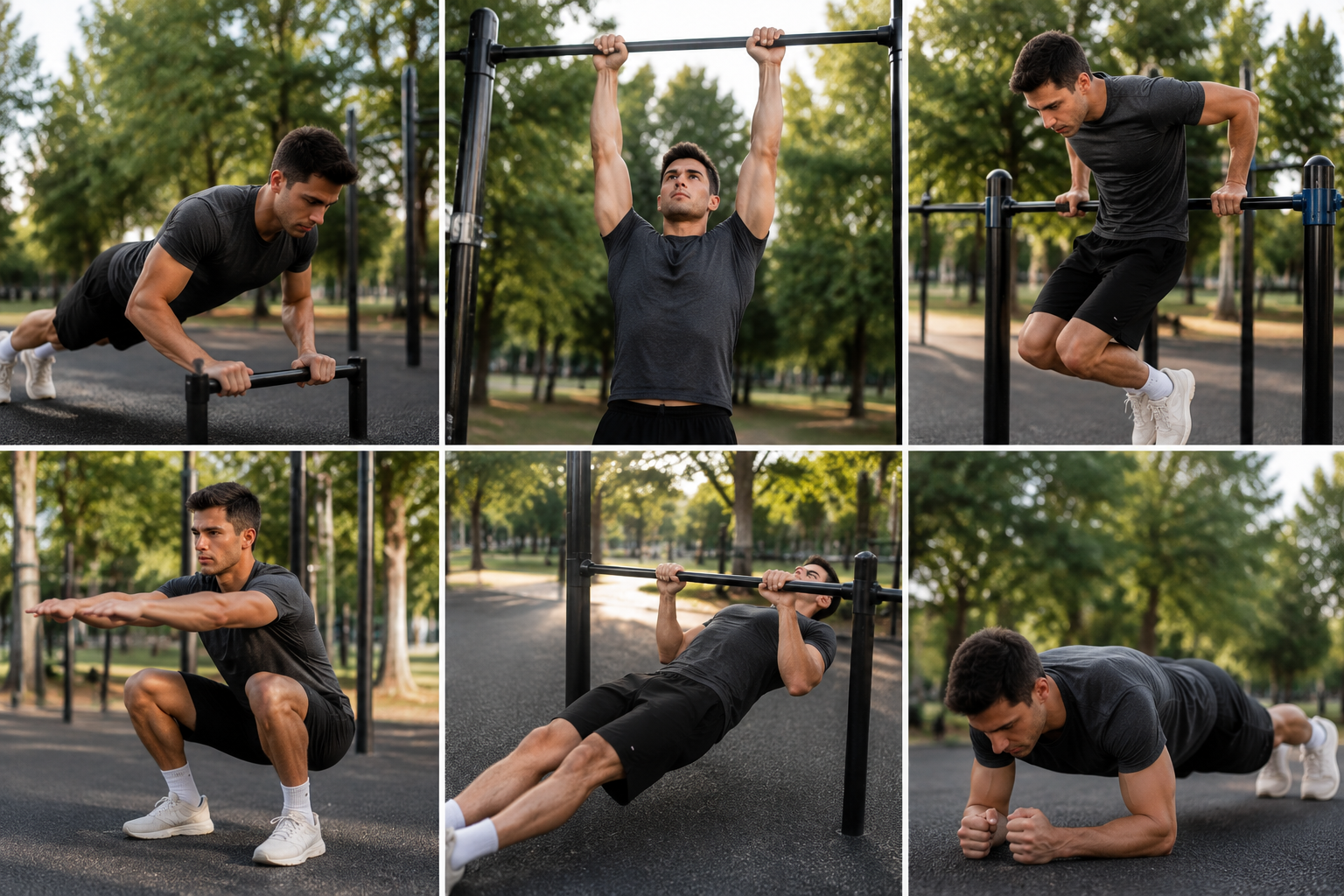
A program for beginners should focus on fundamental movements: assisted pull-ups, push-ups, squats, rows, planks, and assisted dips. These exercises develop the strength necessary to tackle increasingly advanced progressions.
Each session should include a warm-up, technical work, main exercises, and a short phase dedicated to mobility. This approach allows you to simultaneously improve strength, control, and quality of movement.
The goal is not to completely exhaust your energy during every workout, but to accumulate weeks and months of consistent work while maintaining high quality of execution.
Following progressions
Every exercise has simpler and more difficult variations. Consolidating each level before moving on to the next is the safest way to improve.
Consistency beats intensity
Training regularly produces much better results than alternating extremely intense sessions with long periods of inactivity.
How to monitor improvements
To understand if the program is working, it is useful to record the number of repetitions, time under tension, and the technical quality of the exercises. Monitoring these parameters allows you to observe progress that is often not immediately visible in the mirror.
Also, noting down sensations during each workout helps to understand when to increase difficulty or when it is preferable to dedicate more attention to recovery.
Those who wish to progress in calisthenics should focus on the evolution of technique and strength rather than simply increasing the volume of work.
Keeping a journal
Noting down every session allows you to easily identify improvements and correct any errors in programming.
Setting small goals
Progressively reaching realistic milestones keeps motivation high and makes the journey much more rewarding.
Equipment that facilitates progress
Training with stable equipment allows you to focus exclusively on the quality of movements. A bar that wobbles or unstable parallel bars force you to make constant compensations that slow down technical learning.
A good home gym for beginners does not require numerous tools, but a few reliable instruments designed to accompany growth over time.
A professional calisthenics structure offers the stability necessary to learn fundamental exercises correctly and progressively tackle more advanced skills without limitations due to equipment.
Why stability is important
A rigid base improves safety, makes movement more precise, and allows you to develop correct technique from the very first sessions.
Thinking about the future
Choosing modular equipment allows you to add new accessories as your experience and goals increase.
Practical tips for beginners
Focusing on fundamental exercises, respecting recovery times, and dedicating a few minutes to mobility before each workout are simple but extremely effective habits.
It is also important to avoid constant comparisons with much more experienced athletes. Every practitioner has different adaptation times, and the best parameter for comparison remains your own personal evolution.
Finally, maintaining curiosity and a desire to learn allows you to approach every workout as an opportunity to improve the quality of movement and build lasting skills.
Patience pays off
Calisthenics is a discipline in which the best results come through gradual progressions and increasingly refined technique.
Training with method
Following a consistent program produces significantly better benefits than constantly changing exercises and strategies.
Building solid foundations for the future
The first months of training represent the most important moment of the entire journey in calisthenics. Correcting common mistakes right away allows you to develop efficient technique, build strength safely, and prepare the body for the advanced skills that will come later.
Limiting excessive volume, paying attention to every repetition, and dedicating time to mobility are three habits capable of making the difference between a journey full of improvements and one characterized by long periods of stagnation.
Combining these principles with stable equipment designed for continuous use allows you to create an ideal environment to learn, grow, and transform every workout into a concrete step toward your calisthenics goals.
Comments (0)