
Trolley
You have no items in your shopping cart

 Budgets
 Dumbers
 Discs
Discs
 Benches
 Racks and Rigs
 Weights Holders
 Isotonic machines
 Calisthenics
 Cardio
 Kettlebells
 Flooring
 Gym Set
 Accessories
 Combat
 ARTI MARZIALI
 CONTAINER GYM
 Tug-Of-War
 Used Gym Equipment
 PILATES MACCHINARI
 GINNASTICA ARTISTICA
 CAMPI DA PADEL
 Prodotti in Pronta Consegna
 Informazioni
 IRONMAN
 Gift Card
- Donatif
- General information
- 0 I like it
- 477 Views
- 0 comments
- gym flooring, safety flooring, gym safety, shock-absorbing materials
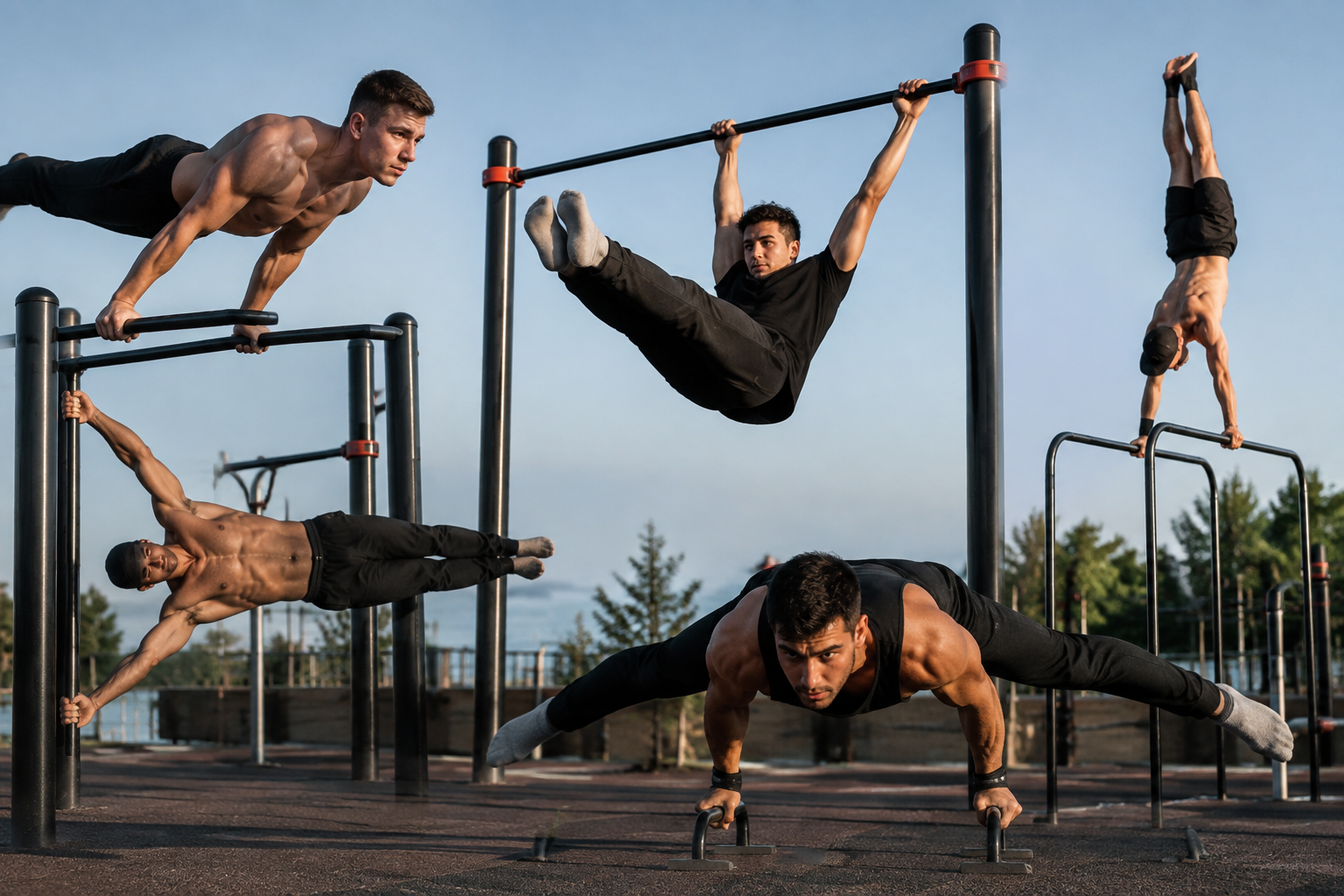
Complete Guide to Calisthenics Skills: From First Steps to Pro Evolutions
Calisthenics skills represent one of the most fascinating aspects of bodyweight training. These are not just spectacular exercises to perform to impress others, but true demonstrations of relative strength, motor control, coordination, and body awareness. Each skill is the result of a progressive journey during which strength, mobility, and technique develop simultaneously, allowing the athlete to tackle increasingly complex movements in complete safety.
One of the most common mistakes is wanting to quickly learn advanced exercises like the Muscle Up, Front Lever, or Planche without having consolidated the basics. This approach often leads to long periods of stagnation, incorrect technique, and an increased risk of injury. In calisthenics, there are no shortcuts: every progression prepares for the next and builds the necessary adaptations to face ever-increasing levels of difficulty.
This guide collects the complete path to learning the main calisthenics skills, illustrating the correct prerequisites, fundamental exercises, mistakes to avoid, and the importance of using professional and stable structures during training. By following a progressive method, it will be possible to develop strength, control, and safety, building solid foundations for any future evolution.
- The foundations of calisthenics
- The Pull-Up as a starting point
- How to learn the Muscle Up
- Planche progressions
- The path to the Front Lever
- How to program skills
- The ideal equipment
- Building a lasting progression
The foundations of calisthenics
Every advanced skill is born from a base built with patience. Before tackling complex exercises, it is essential to develop strength in the fundamental movements of pushing, pulling, core stabilization, and scapular control.
Push-ups, dips, pull-ups, rows, planks, and squats constitute the basic language of calisthenics. Improving these exercises means building the physical capabilities necessary to tackle increasingly advanced progressions.
Neglecting this initial phase often leads to technical compensations that slow down learning and increase the risk of overloading joints and tendons.
Strength before skills
Good relative strength allows you to tackle every prerequisite with greater control, reducing the reliance on explosive movements or compensations.
Mobility and joint control
Shoulders, wrists, and the thoracic spine must possess adequate mobility to allow for correct and safe execution of the main skills.
The Pull-Up as a starting point
Pull-ups represent the foundation of most pulling skills. A Pull-Up performed with impeccable technique develops the lats, biceps, scapular musculature, and core strength.
Before increasing the number of repetitions, it is important to consolidate a full execution, with maximum range of motion and control during the eccentric phase.
The calisthenics prerequisites dedicated to pull-ups include Australian rows, assisted pull-ups with resistance bands, and scapular pull-ups—exercises that progressively improve the strength needed to tackle more complex movements.
The importance of grip
A solid grip improves force transfer and increases safety during all pulling progressions.
Scapular control
Learning to manage the movement of the scapulae is one of the fundamental prerequisites for developing efficient technique.
How to learn the Muscle Up
The Muscle Up is one of the most sought-after calisthenics skills because it combines explosive strength, coordination, and technique. It is not enough to perform many pull-ups: you need to learn how to transfer your body over the bar with a fluid movement.
Correct muscle up technique requires explosive pull-ups, solid dips, and a transition performed at the right moment, avoiding excessive swinging that reduces the quality of the movement.
Prerequisites include chest-to-bar pull-ups, straight bar dips, false grip when applicable, and numerous exercises dedicated to the transition phase.
The transition phase
The passage from the pull-up to the dip represents the most delicate moment of the entire movement and must be trained with specific exercises.
Developing explosiveness
Increasing the speed of the pull-up significantly improves the ability to complete the Muscle Up with clean technique.
Planche progressions
The Planche represents one of the highest expressions of pushing strength in calisthenics. Keeping the body parallel to the ground requires high relative strength, core control, and significant preparation of the wrists and tendons.
Planche progressions follow a precise path: Planche Lean, Frog Stand, Tuck Planche, Advanced Tuck, Straddle Planche, and Full Planche. Each phase builds the adaptations necessary to tackle the next.
It is essential to also dedicate time to joint preparation, as wrist health is one of the most important factors for progressing without interruptions.
Planche Lean
The Lean teaches you to progressively shift your weight forward while maintaining correct body alignment and stable scapular protraction.
Protecting the wrists
Mobility, strengthening, and gradual load progression allow you to increase joint tolerance and reduce the risk of inflammation.
The path to the Front Lever
The Front Lever is an isometric pulling skill in which the body is held horizontally while suspended from the bar. It requires extremely strong lats, pelvic control, and great scapular stability.
An effective front lever tutorial starts with the Tuck Front Lever and continues through the Advanced Tuck, One Leg, Straddle, and finally the full Front Lever, always respecting the quality of the technique.
Accessory work includes rows, Front Lever Raises, Hollow Body Holds, and numerous exercises aimed at improving trunk strength and rigidity.
The role of the core
A stable trunk allows you to keep the body aligned, avoiding pelvic sagging that increases the difficulty of the lever.
Developing the lats
Strict pull-ups, rows, and isometric work represent the basis for progressively increasing the specific strength required by the Front Lever.
How to program skills
Training multiple skills simultaneously requires intelligent planning. It is advisable to focus on one or two main goals per training cycle, keeping other exercises as maintenance work.
Skills should be performed at the beginning of the session, when the nervous system is fresh and technical quality can reach its maximum level.
Correctly programming volume, recovery, and progressions allows you to avoid overtraining and maintain constant improvement over the long term.
Ideal frequency
Two or three sessions dedicated to skills each week generally represent a good compromise between training stimulus and recovery.
Quality over quantity
Short and technically impeccable sets produce superior adaptations compared to long workouts performed with imprecise movements.
The ideal equipment
The quality of the equipment directly affects the safety and effectiveness of the training. An unstable bar or flimsy parallel bars force continuous adjustments that reduce the technical quality of the exercises.
To tackle advanced progressions, it is advisable to use professional structures capable of offering rigidity, stability, and the possibility of expansion with new accessories.
A modular calisthenics structure is an ideal solution because it allows you to train pull-ups, dips, Muscle Ups, Front Levers, Planches, and numerous other skills while maintaining high standards of safety and versatility.
Why stability matters
A rigid structure allows you to transfer all your strength to the exercise without loss due to unwanted oscillations or flexing.
A gym that grows with you
Modular structures allow you to add accessories and stations following the athlete's technical evolution without replacing the entire system.
Building a lasting progression
Learning calisthenics skills means embarking on a path of continuous improvement in which every goal achieved becomes the foundation for the next. Patience, technical quality, and respect for progressions are the most important tools for achieving solid and lasting results.
Skipping steps rarely accelerates the path. On the contrary, consolidating basic strength, developing mobility, and progressively improving body control allows you to tackle more advanced evolutions with greater safety and a lower risk of injury.
With intelligent programming, professional equipment, and the willingness to constantly perfect every technical detail, calisthenics becomes a journey capable of developing strength, coordination, and mastery of your own body, transforming every new skill into a natural consequence of the work done in previous phases.
Comments (0)