
Trolley
You have no items in your shopping cart

 Budgets
 Dumbers
 Discs
 Benches
 Racks and Rigs
 Weights Holders
 Isotonic machines
 Calisthenics
 Cardio
 Kettlebells
 Flooring
 Gym Set
 Accessories
 Combat
 ARTI MARZIALI
 CONTAINER GYM
 Tug-Of-War
 Used Gym Equipment
 PILATES MACCHINARI
 GINNASTICA ARTISTICA
 CAMPI DA PADEL
 Prodotti in Pronta Consegna
 Informazioni
 IRONMAN
 Gift Card
- Donatif
- General information
- 0 I like it
- 51 Views
- 0 comments
- gym flooring, safety flooring, gym safety, shock-absorbing materials
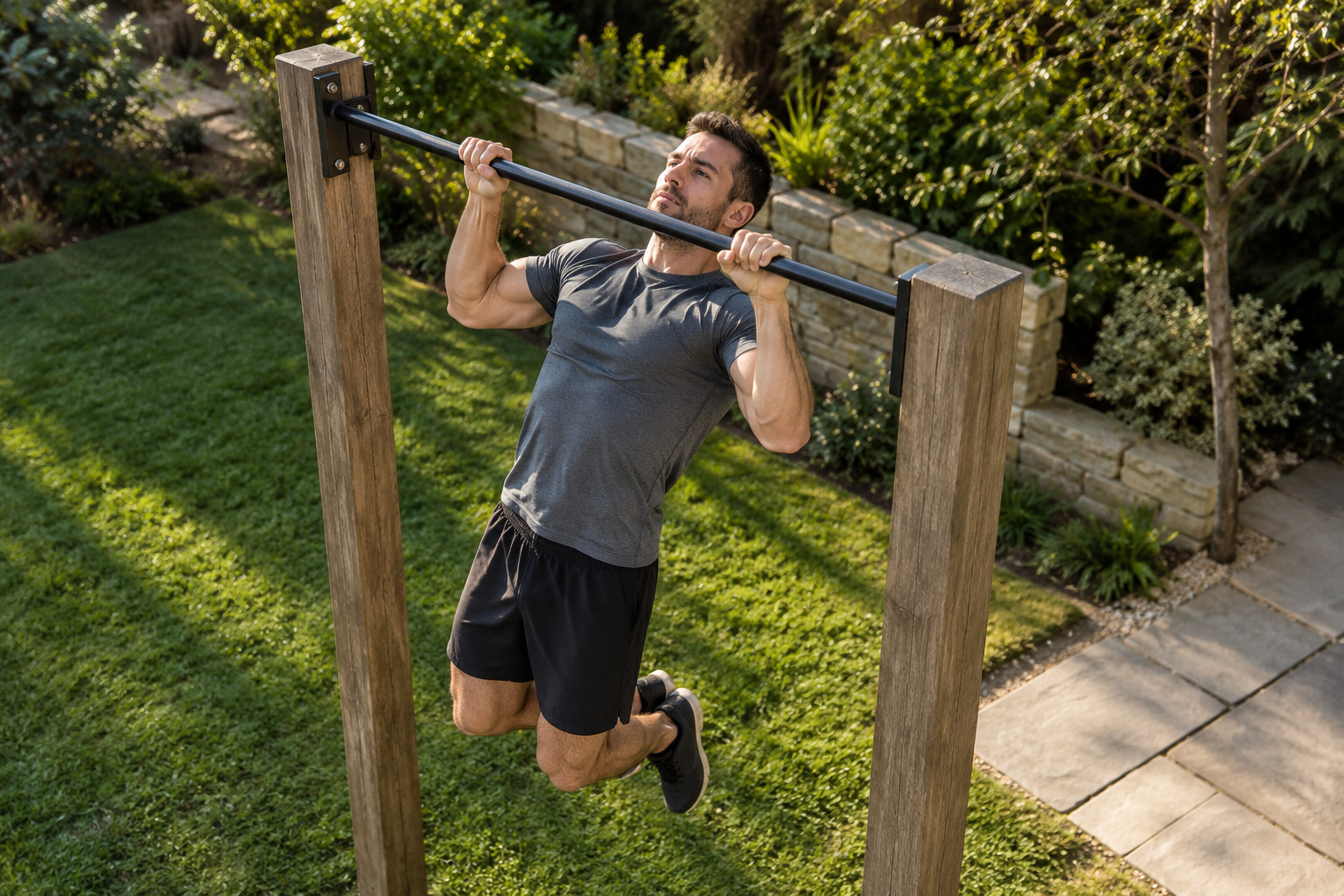
Weather-resistant garden pull-up bar: a professional selection guide
Creating an outdoor fitness area represents an interesting opportunity for gyms, sports centers, hospitality facilities, and operators looking to expand their training services. Among the most versatile equipment, the pull-up bar plays a central role due to the possibility of performing bodyweight exercises dedicated to developing strength, stability, and motor control. However, when the installation takes place in a garden or an outdoor space, the choice must consider environmental conditions that are very different from those of a traditional gym.
A weather-resistant garden pull-up bar must maintain adequate characteristics of stability, structural integrity, and functionality even when exposed to rain, humidity, solar radiation, and temperature variations. Resistance to climatic conditions does not depend exclusively on the material used, but involves surface treatments, weld quality, fastening systems, and installation methods. For a purchasing manager, understanding these aspects means reducing the risk of corrective interventions and planning a sustainable investment.
This guide delves into the technical criteria to use in selecting a pull-up bar intended for a professional outdoor environment. The goal is not to identify a single product, but to provide concrete tools to compare different solutions, correctly interpret construction specifications, and evaluate the suitability of the equipment relative to the operational needs of the sports facility.
- Structural characteristics of an outdoor pull-up bar
- Materials and corrosion resistance
- Protective treatments against atmospheric agents
- Installation, anchoring, and safety
- Ergonomics and features for professional use
- Maintenance and durability of the equipment
- Designing an outdoor fitness area
- Supplier evaluation and technical documentation
- How to evaluate a long-term investment
Structural characteristics of an outdoor pull-up bar
Structural quality represents the first element to verify when choosing a pull-up bar intended for a professional garden. Unlike equipment used occasionally in a home setting, a structure installed at a gym may be subjected to consecutive sessions, dynamic loads, and use by people with different physical characteristics. The project must therefore consider not only the static weight of the user but also the stresses generated during the execution of exercises.
Traditional pull-ups produce predominantly vertical loads, while movements such as controlled swings, explosive lifts, and bar transitions can introduce horizontal and torsional components. These conditions require a careful assessment of overall rigidity, connections, and anchor points. An apparently robust structure could, in fact, manifest unwanted movements when subjected to repeated stress.
For this reason, it is appropriate to request information from the manufacturer regarding the declared load capacity, intended usage conditions, and any limitations related to dynamic exercises. Nominal capacity, considered in isolation, is not sufficient to establish the suitability of a structure for professional use.
Tubing dimensions and rigidity
The sizing of uprights and crossbars directly influences the stability of the bar. Sections, thicknesses, length of elements, and geometry of connections must be evaluated as parts of a single structural system. It is incorrect to assume that a larger tube automatically guarantees superior performance, as the quality of the material and the configuration of the whole also affect the response to loads.
When comparing different solutions, it is useful to verify the presence of reinforcements at the most stressed points and the structure's ability to limit perceptible flexing during training. Adequate rigidity improves the user's sense of control and contributes to preserving mechanical connections over time.
Welds and mechanical connections
Welds are particularly important points for structural continuity. They must be performed with processes appropriate to the materials used and protected against oxidation, especially in areas where water and dirt can accumulate. Bolted connections also require attention, as external exposure can promote corrosive phenomena or make subsequent maintenance operations more difficult.
Professional design should allow for the inspection of main connection points without requiring complete disassembly of the structure. This aspect facilitates periodic checks and allows for the timely identification of any anomalies.
Materials and corrosion resistance
The choice of material is decisive for the lifespan of a bar installed outdoors. Continuous exposure to humidity and precipitation can promote corrosion, especially when metal surfaces have scratches, discontinuities in coatings, or points where water stagnates. Evaluation must therefore consider the characteristics of the base material along with the applied surface protection.
Carbon steel is frequently used in the construction of fitness structures due to its mechanical properties and the possibility of creating robust geometries. However, without adequate treatment, it can be subject to oxidation. Stainless steel generally offers superior corrosion resistance in certain conditions, but its effectiveness depends on the specific alloy, workmanship, and exposure environment.
For professional installations, it is therefore preferable to compare materials and finishes according to the real context. A gym located in an inland area with moderate exposure to rain has different requirements than a coastal sports facility, where salt spray can accelerate the deterioration of metal components and fasteners.
Carbon steel for outdoor structures
Carbon steel allows for the construction of uprights and crossbars with mechanical characteristics suitable for numerous sports applications. Its suitability for outdoor use, however, depends on the effectiveness of the anti-corrosion system. It is important to verify that the treatment also covers less visible areas, including joints, edges, and surfaces exposed during assembly.
Another element to consider concerns the presence of internal cavities in the tubing. If water and condensation can penetrate without the possibility of drainage, internal corrosion can develop that is difficult to identify by simple visual inspection.
Stainless steel and harsh environments
Stainless steel can be an interesting solution for installations characterized by high humidity or particularly challenging environmental conditions. However, not all alloys exhibit the same behavior in the presence of chlorides and salt deposits. The choice must be supported by precise information on the material composition and the conditions for which it is recommended.
Stainless steel surfaces also require periodic cleaning and checks. Persistent deposits and surface contamination can compromise corrosion resistance, making a maintenance program consistent with the installation environment necessary.
Protective treatments against atmospheric agents
Effective anti-corrosion protection for outdoor equipment helps maintain the integrity of metal components over time. Surface treatment should not be considered merely an aesthetic finish, but an integral part of the technical design. Its function is to limit contact between the base material and the environmental agents responsible for deterioration.
Solutions used for outdoor metal structures include galvanization and paint systems specifically formulated for atmospheric exposure. Performance depends on surface preparation, coating thickness, correct application, and compatibility between different treatments. It is therefore not enough to read a generic indication of weather-resistant paint.
For a purchasing manager, it is useful to request documented information on the protective cycle adopted and the procedures for restoration in case of damage. Effective protection must in fact also be evaluated in relation to the possibility of carrying out localized interventions during the useful life of the structure.
Hot-dip galvanizing and metal protection
Hot-dip galvanizing is a process through which a zinc coating is applied to properly prepared steel surfaces. This treatment offers protection that combines a barrier effect with the electrochemical behavior of zinc. Its effectiveness depends on the characteristics of the coating and environmental conditions.
When evaluating a galvanized bar, it is important to verify that the construction project is compatible with the process, considering vent holes, drainage, and treatment of welded areas. The surface appearance must also be compatible with sports use, avoiding irregularities in areas directly involved in the grip.
Powder coating and combined systems
Powder coating allows for uniform finishes and offers various aesthetic possibilities. For outdoor use, however, it is essential that the cycle is designed to withstand atmospheric exposure. Substrate preparation, potential primer, and powder characteristics affect the durability of the coating.
In some applications, combined systems are used that involve metallic protection and a subsequent painted finish. This configuration can offer advantages, provided the treatments are compatible and correctly applied. The mere presence of colored paint does not constitute a sufficient guarantee of corrosion resistance.
Installation, anchoring, and safety
The safety of a pull-up bar depends on the structure and the installation system. Even equipment designed with adequate materials may be unsuitable if fixed to an inappropriate support or positioned without considering the stresses generated by users. For this reason, the project must include an assessment of soil characteristics, foundations, and available space.
Permanent installations may involve uprights anchored to concrete elements or specifically designed foundation systems. The dimensions and characteristics of the anchors must be defined in relation to the expected loads, the geometry of the structure, and site conditions. It is not appropriate to adopt standard measures without verifying their actual compatibility.
Another aspect concerns applicable documentation. Depending on the intended use and type of equipment, different technical standards and safety regulations may be relevant. The manager should verify with the manufacturer and the professionals in charge which requirements are actually applicable to the planned installation.
Foundations and anchoring systems
Foundation sizing must consider the weight of the structure, dynamic actions, and the geotechnical characteristics of the soil. In the presence of loose soil or special conditions, additional checks may be necessary. Drainage of the surrounding area also helps limit water accumulation near the uprights.
Mechanical anchors must be chosen based on the support and manufacturer's instructions. Correct installation includes adhering to fixing depths, edge distances, and tightening procedures. Any unauthorized modifications can alter structural behavior.
Safety distances and usage area
A pull-up bar requires sufficient space to allow for exercises without interference from walls, trees, fences, or other equipment. Distances must take into account expected movements and possible body oscillation during training. The height of the structure must also be consistent with the stature of users and permitted exercises.
Design should include an assessment of the underlying surface, grip conditions, and the possible need for impact attenuation. These elements must be defined in relation to the intended use and relevant safety requirements, avoiding the assumption that any grassy surface is automatically adequate.
Ergonomics and features for professional use
A professional pull-up bar must offer ergonomic characteristics consistent with the intended use. Grip diameter, surface finish, installation height, and available space directly influence the quality of the training experience. For a gym that welcomes users with different levels of preparation, these aspects take on particular importance.
The bar diameter conditions the involvement of hand and forearm muscles. An excessively large grip can be demanding for beginner users, while a surface that is too thin might not offer the desired sense of control. The choice should therefore be linked to the training program and the characteristics of the audience.
The finish must ensure a balance between grip and comfort. Excessively rough surfaces can cause discomfort during long sessions, while particularly smooth coatings can become slippery in the presence of humidity. A practical grip check represents a useful step before defining the final setup.
Grip diameter and surface
Bar geometry influences the user's ability to maintain a stable grip during exercise. For a fitness center, it is appropriate to prioritize solutions that allow for versatile use, considering prone, supine, and other variants compatible with the structure's configuration.
The contact surface must be checked periodically to identify any coating alterations. Chipping, localized oxidation, or irregularities can compromise comfort and require intervention before the area is reopened to users.
Installation height and accessibility
The bar height must allow for sufficiently free movement without creating unnecessary difficulty in access. A structure intended for users of different statures may benefit from the presence of multiple grip levels, provided the configuration is designed and verified for such use.
For sports centers that offer guided activities, it is important to also consider instructor visibility and the space required to assist users. An ergonomic layout facilitates session management and allows for the organization of more effective didactic progressions.
Maintenance and durability of the equipment
Maintenance represents one of the main factors influencing the actual lifespan of fitness equipment installed outdoors. Even materials and coatings designed to resist atmospheric agents can deteriorate progressively in the presence of continuous exposure, intensive use, and inadequate cleaning. A check program allows for the timely identification of any anomalies.
For a professional gym, it is useful to distinguish between frequent visual checks and in-depth technical inspections. The former allow for the identification of obvious damage, loosening, or surface alterations. The latter concern the state of connections, anchors, and structural components, according to manufacturer indications and operational conditions.
Maintenance of outdoor fitness equipment should be documented through a logbook that records checks performed, detected anomalies, and interventions carried out. This procedure facilitates facility management and helps make operating costs more predictable.
Periodic checks and prevention of deterioration
During inspections, it is appropriate to check for corrosion, deformations, coating damage, and abnormal movements. Particular attention must be paid to areas near the ground, connections, and surfaces where water can stagnate. Local environmental conditions may require a higher frequency of checks than that provided for less exposed installations.
In case of anomalies that could compromise safety, the equipment must be taken out of service until verified and, if necessary, restored. Continuity of service should never prevail over the need to maintain adequate operating conditions.
Cleaning and coating restoration
Periodic cleaning helps remove dirt, organic residues, and deposits that can retain moisture. It is important to use products compatible with the material and surface treatment, avoiding unauthorized abrasive procedures that could compromise anti-corrosion protection.
When the coating shows scratches or damage, restoration interventions must follow the manufacturer's technical instructions. A poorly performed surface repair can hide corrosive phenomena without resolving the causes.
Designing an outdoor fitness area
The choice of pull-up bar should be part of an overall project for organizing the outdoor space. A professional fitness area must allow for a rational distribution of activities, ensuring adequate access paths and reducing interference between users. The position of the structure also influences exposure to sun, wind, and precipitation.
For gym managers, integrating the bar with other equipment can expand training possibilities. Modular structures, parallel bars, and supports for bodyweight exercises allow for the development of progressive paths, provided each element is compatible with the intended use and correctly installed.
When the project includes different stations, it is useful to evaluate solutions belonging to the category of calisthenics equipment, considering dimensions, structural characteristics, and integration possibilities. Selection should start with the activities one intends to offer, avoiding the addition of elements without a real function in the sports program.
Organization of training stations
The distribution of stations must take into account the number of expected users, average duration of exercises, and supervision methods. In a fitness center with group classes, the availability of multiple work points can reduce waiting times and favor smoother session management.
It is appropriate to provide circulation spaces separate from areas where dynamic movements are performed. The placement of any accessories should also be studied to avoid obstacles and keep the training area tidy.
Climatic exposure and site characteristics
The position of the bar can significantly influence its deterioration. An installation completely exposed to precipitation requires particular attention to connection protection and drainage, while a structure located near vegetation may be more affected by organic deposits and persistent humidity.
The presence of shading can improve comfort during hot months but does not replace the need to use materials suitable for outdoors. Any covers must also be evaluated considering ventilation and the risk of condensation formation.
Supplier evaluation and technical documentation
Choosing a specialized supplier requires an analysis that goes beyond price and the aesthetic appearance of the structure. A professional operator should be able to provide clear information on material characteristics, protective treatments, and intended usage conditions. The availability of technical documentation is an important element for comparing different proposals.
It is useful to verify the presence of assembly instructions, indications regarding anchors, usage limits, and maintenance procedures. When relevant, declarations and information regarding compliance with applicable requirements should also be available. Documentation should refer to the model actually purchased and not just to a generic product family.
For structures that involve continuous use, the possibility of obtaining technical assistance and replacement parts is particularly important. A damaged connection or an unavailable fastener can cause operational downtime even when the rest of the equipment is still in good condition.
How to interpret technical data sheets
A useful technical data sheet should report dimensions, materials, surface treatment characteristics, load limits, and installation conditions. Information must be sufficiently precise to allow for a comparative assessment between different solutions.
It is important to distinguish between commercial claims and verifiable data. Generic expressions like "maximum robustness" or "total weather resistance" do not replace documented technical specifications. When a parameter is unclear, it is appropriate to request clarification before proceeding with the purchase.
Technical assistance and spare parts availability
The ability to replace parts subject to wear or damage helps extend the useful life of the equipment. For this reason, it is advisable to verify which spare parts are available and which interventions can be performed directly by personnel in charge of maintenance.
A supplier capable of supporting the client during installation and subsequent management offers a concrete operational advantage. The quality of assistance becomes particularly relevant when the outdoor area represents a stable part of the services offered by the gym.
How to evaluate a long-term investment
The purchase of an outdoor pull-up bar should be evaluated by considering the total cost during the equipment's useful life. The initial price represents only one component of the investment, to which may be added expenses for transport, ground preparation, foundation construction, installation, and scheduled maintenance. Comparing only the purchase cost can therefore lead to decisions that are not representative of the actual financial commitment.
For a professional manager, it is useful to analyze the relationship between initial investment and operational continuity. A structure characterized by adequate materials, documented surface protection, and inspectable components can help reduce the frequency of corrective interventions. This advantage must be evaluated based on the actual characteristics of the product and environmental conditions, without assuming an identical lifespan for all installations.
Another element concerns the future flexibility of the fitness area. If the sports center plans to gradually expand the outdoor training offer, it may be convenient to choose structures compatible with a modular project. It is, however, necessary to verify in advance which expansions are permitted by the manufacturer and which require new structural assessments.
Total cost of ownership and service continuity
The total cost of ownership of fitness equipment includes all expenses incurred during the usage period. In addition to purchase and installation, it is appropriate to consider periodic checks, cleaning, any coating restoration, and component replacement. The availability of technical documentation and spare parts can significantly influence these costs.
An effective economic comparison should use a consistent time horizon for all examined alternatives. It is possible to prepare a simple evaluation that includes initial investment, planned maintenance, and possible extraordinary interventions. Even when precise estimates are not available, identifying the main cost items allows for asking more pertinent questions to suppliers.
Practical decision-making criteria
Before approving the investment, the purchasing manager should verify the compatibility of the structure with the site, the presence of sufficient technical information, and the adequacy of materials relative to environmental exposure. It is also important to ensure that planned exercises are included in the conditions of use declared by the manufacturer.
The choice of a weather-resistant garden pull-up bar must therefore derive from an integrated assessment of safety, corrosion resistance, ergonomics, and management sustainability. Correctly selected and installed equipment allows for the organization of a reliable outdoor service, with characteristics consistent with user needs and the operational objectives of the facility.
For a gym that intends to stably develop outdoor training, the value of the investment also depends on the ability to maintain adequate usage standards over time. Defining verifiable purchasing criteria, scheduling maintenance, and choosing suppliers capable of offering technical support allows for managing the equipment as a durable component of the sports infrastructure, rather than as a simple garden accessory.
Comments (0)