
Trolley
You have no items in your shopping cart

 Budgets
 Dumbers
 Discs
Discs
 Benches
 Racks and Rigs
 Weights Holders
 Isotonic machines
 Calisthenics
 Cardio
 Kettlebells
 Flooring
 Gym Set
 Accessories
 Combat
 ARTI MARZIALI
 CONTAINER GYM
 Tug-Of-War
 Used Gym Equipment
 PILATES MACCHINARI
 GINNASTICA ARTISTICA
 CAMPI DA PADEL
 Prodotti in Pronta Consegna
 Informazioni
 IRONMAN
 Gift Card
- Donatif
- General information
- 0 I like it
- 23 Views
- 0 comments
- gym flooring, safety flooring, gym safety, shock-absorbing materials
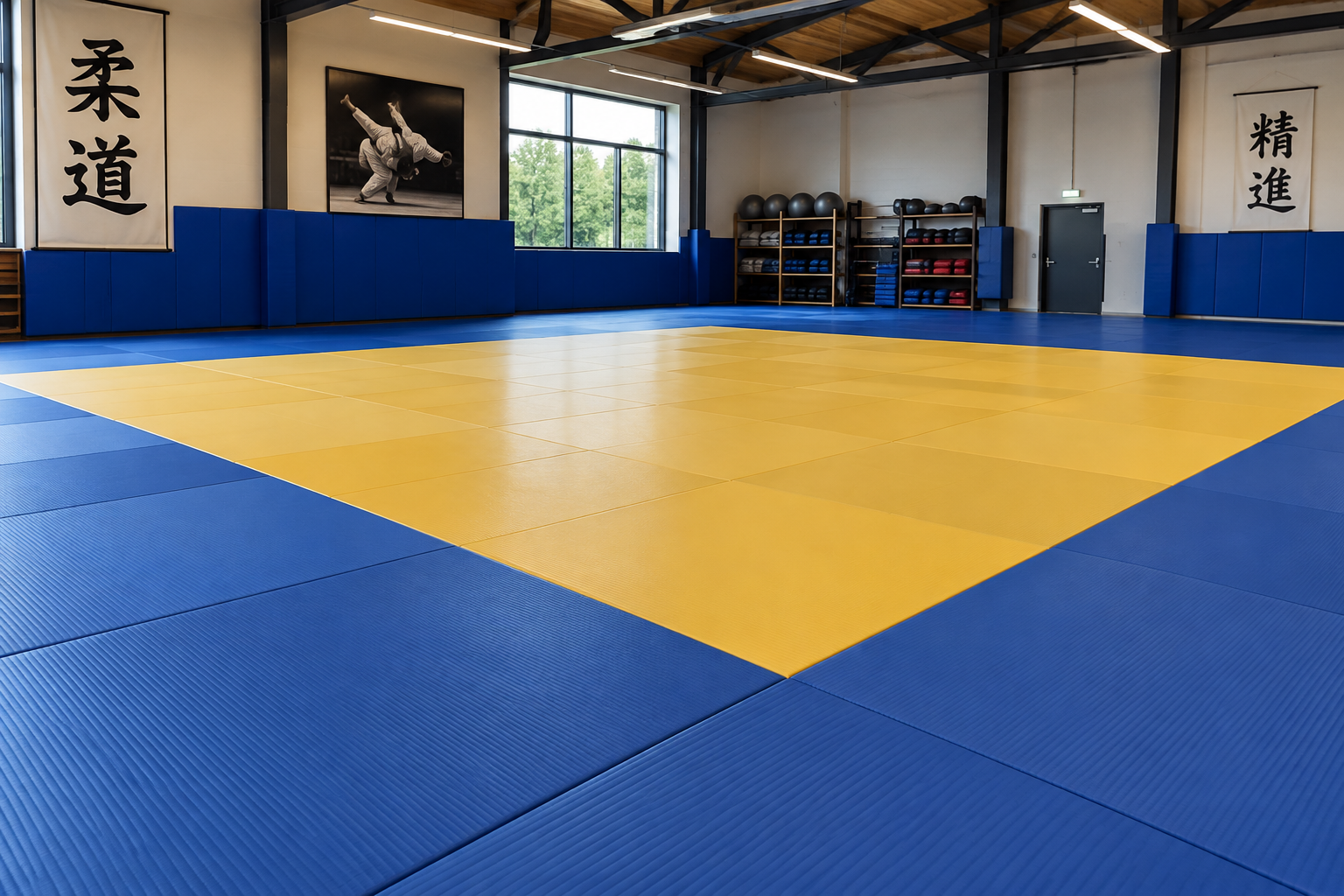
Judo tatami in a professional gym: layout, edging and installation
judo tatami is the element that determines the safety, functionality and durability of an area intended for judo practice. In a professional gym or dedicated dojo, the choice of material cannot be limited to aesthetics or price, but must be based on verifiable technical characteristics, correct space sizing and appropriate installation methods.
A well-developed project considers the number of practitioners, the type of use, the frequency of sessions, the purpose of the facility and the possibility of hosting training sessions, federal courses or competitions. Layout, edging and installation directly influence athlete safety and the continuous use of the surface.
This guide explores the design aspects related to tatami intended for professional environments, offering practical criteria for configuring an efficient dojo without overlapping with in-depth guides dedicated to product selection, technical characteristics or routine maintenance.
- Quick answer
- What requirements must the space have?
- How to design the dojo layout?
- Why is edging important?
- How to install the judo tatami?
- Facility safety and maintenance
- Design errors to avoid
- Evaluating the professional investment
What is the correct configuration of a professional judo tatami?
A professional area must include a well-identified combat surface, an adequate perimeter safety area, a stable and uniform installation, and edging that eliminates unevenness and critical points. The objective is to obtain a continuous flooring capable of maintaining constant performance during intensive use.
Decision-making criteria must start from the activity carried out. A dojo dedicated exclusively to training has different needs compared to a multi-purpose facility or a plant also intended for official events.
When applicable, it is appropriate to refer to the regulations of the International Judo Federation, the prescriptions of the competent national federation and the manufacturer's instructions regarding installation, use and maintenance.
Design criteria
The main parameters concern available dimensions, presence of obstacles, distance from walls, access routes, lighting and the possibility of installing wall protections.
Reference standards
For facilities intended for federal events, it is necessary to check the dimensions of the competition area and safety zone required by the updated regulations of the competent bodies before final design.
What requirements must the space have?
Space design always precedes the choice of material. The room must allow complete movements in all directions while maintaining adequate distances from walls, pillars, doors and other equipment.
The base must be flat, dry and stable. Any irregularities can compromise the durability of the flooring and generate points of instability during throws.
Ventilation, lighting and humidity management also affect the conservation of the tatami and user comfort.
Area sizing
Before installation, it is useful to create a complete floor plan showing dimensions, emergency exits, columns and technical areas so as to avoid unnecessary cuts or poorly functional configurations.
Accessory spaces
Areas dedicated to warm-up, equipment storage, instructor paths and public areas must be separated from the combat surface.
How to design the dojo layout?
The layout must guarantee fluidity of movement, maximum visibility for instructors and the possibility of organizing different groups without interference.
In professional centers, modular configurations are often preferred that allow the layout of the surface to be quickly modified according to activities.
The arrangement of the modules must limit waste and facilitate any future replacements while keeping the entire flooring uniform.
Module configuration
The regular orientation of the elements facilitates installation and helps distribute loads evenly during continuous use.
Flow management
Athlete entry, coach access and emergency routes must always remain free without crossing the combat surface.
For facilities dedicated to martial arts, it may be useful to evaluate a specific solution of martial arts equipment compatible with the overall gym project.
Why is edging essential?
Edging is not a simple aesthetic element but a functional component that contributes to the safety of the facility.
Proper finishing reduces the risk of tripping along the perimeter and protects the edges of the modules from accidental impacts.
The most appropriate solution depends on the room configuration, the presence of nearby walls and the type of use intended.
Edging types
Sloped elements, perimeter connectors or systems designed by the tatami manufacturer can be used so that they are perfectly compatible with the installed floor.
Side area protection
When walls are close to the operational surface, it is advisable to integrate adequate vertical protections to reduce risks during throws.
How to install the judo tatami?
Installation must be carried out following the manufacturer's instructions. Each system can provide different assembly, interlocking or fixing methods.
Before installation, the substrate must be carefully cleaned and checked. Residual moisture or irregularities can compromise the stability of the entire surface.
The final check includes controlling alignments, the continuity of joints and the absence of abnormal movements.
Subfloor preparation
The subfloor must be regular, resistant and free of elements that could damage the material over time.
Post-installation checks
Before commissioning, it is advisable to perform a complete inspection of the installation, checking stability, alignment and surface continuity.
How to maintain safety and performance?
Professional management requires periodic checks of the flooring status, scheduled cleaning and replacement of any damaged elements.
Verifications should include joints, edging, any deformations and the condition of the underlying substrate.
judo tatami thickness and density, together with construction quality, influence the behavior of the surface over time and must be monitored during the useful life of the facility.
Scheduled checks
A periodic checklist facilitates the early identification of wear, surface damage or localized problems before they compromise safety.
Professional cleaning
Operational procedures must follow what is indicated by the manufacturer using products compatible with the surface material.
What design errors must be avoided?
Among the most frequent errors are undersizing the area, the lack of a safety zone, installation on unsuitable surfaces and the absence of perimeter protections.
Also, the choice of materials not intended for intensive use can lead to early deterioration of the flooring.
how many tatami are needed for a dojo and how to choose a judo tatami are evaluations that must be addressed in the initial phase of the project to avoid subsequent modifications.
Layout errors
Inserting columns or obstacles within the practice surface limits the use of the area and increases operational risks.
Installation errors
Unnecessary cuts, irregular joints and a lack of final checks can compromise the functionality and durability of the facility.
How to evaluate a professional investment?
The design of a dojo must consider the entire life cycle of the flooring and not exclusively the initial cost. Material quality, availability of spare parts, simplicity of maintenance and technical assistance affect the overall management cost.
A detailed technical specification facilitates comparison between suppliers because it allows the evaluation of objective characteristics such as dimensions, installation systems, available certifications, installation methods and technical documentation.
For any professional project, it is advisable to request complete technical datasheets, installation manuals and manufacturer instructions, also verifying compliance with applicable standards and any federal regulations provided for the use of the structure. how to install and clean the judo tatami must always follow the official documentation provided by the manufacturer to preserve the performance and durability of the flooring.
Comments (0)