
Trolley
You have no items in your shopping cart

 Budgets
 Dumbers
 Discs
Discs
 Benches
 Racks and Rigs
 Weights Holders
 Isotonic machines
 Calisthenics
 Cardio
 Kettlebells
 Flooring
 Gym Set
 Accessories
 Combat
 ARTI MARZIALI
 CONTAINER GYM
 Tug-Of-War
 Used Gym Equipment
 PILATES MACCHINARI
 GINNASTICA ARTISTICA
 CAMPI DA PADEL
 Prodotti in Pronta Consegna
 Informazioni
 IRONMAN
 Gift Card
- Donatif
- General information
- 0 I like it
- 14 Views
- 0 comments
- gym flooring, safety flooring, gym safety, shock-absorbing materials
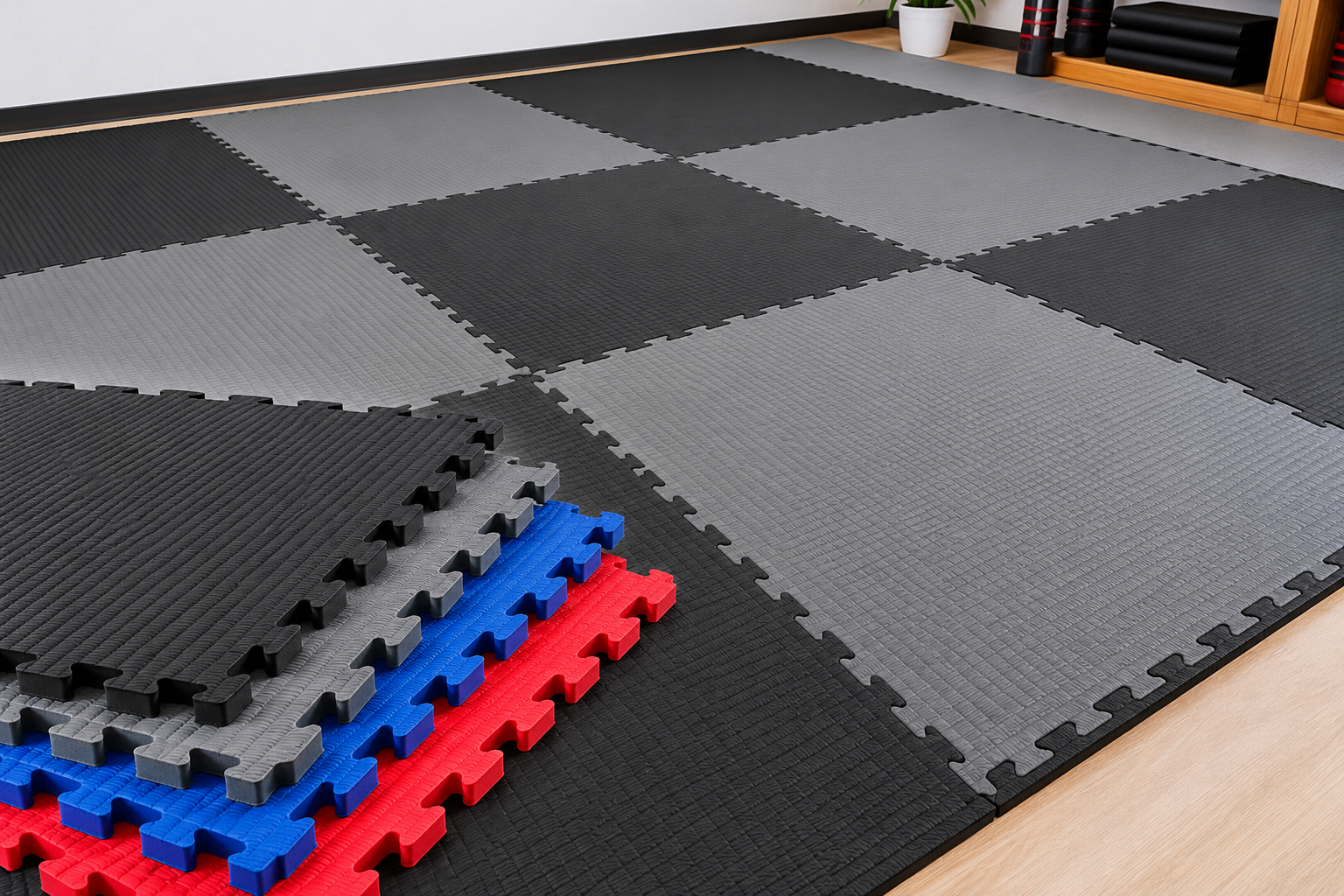
Judo tatami vs generic EVA tatami: differences and selection criteria
judo tatami and generic EVA tatami are often considered equivalent, but they meet different design requirements. Although both are modular flooring solutions for sports activities, they present construction characteristics, performance levels, and intended uses that must be carefully evaluated before purchase.
For sports associations, dojos, and professional gyms, the choice should not be based solely on initial cost. The type of discipline, intensity of use, frequency of throws, and any federation requirements represent much more significant criteria in defining the most suitable solution.
This guide compares the two types of flooring through verifiable technical criteria, helping to understand in which scenarios it is appropriate to adopt a specific tatami for judo or an EVA surface intended for less demanding activities.
- Quick answer
- What are the main differences?
- Comparative table
- How to choose the most suitable solution?
- When to choose a judo tatami or an EVA one?
- Mistakes to avoid
- FAQ
- Evaluating the professional investment
Are judo tatami and generic EVA tatami the same thing?
No. The judo tatami is designed to absorb impacts typical of throws and training in the discipline, while a generic EVA tatami can be intended for different sports activities and is not necessarily developed to withstand the same stresses. The choice must be made by verifying technical documentation, the intended use declared by the manufacturer, and facility requirements.
When the surface is intended for a dojo or a gym with continuous use, it is appropriate to evaluate products specifically designed for judo rather than relying solely on the constituent material.
For competitions or federal activities, it is always necessary to refer to the updated regulations of the International Judo Federation, the provisions of the competent national federation, and the manufacturer's indications.
What is a judo tatami?
It is flooring developed for the practice of judo, with characteristics designed to offer adequate behavior during throws, movements, and intensive use.
What is a generic EVA tatami?
It is a modular flooring made of EVA material intended for multiple sports or recreational activities, not necessarily designed to meet the specific requirements of judo practice.
What are the main differences?
The main difference concerns the intended use. A tatami designed for judo is developed considering the needs of the discipline, while a generic EVA one can be designed for fitness, light motor activities, play areas, or other martial arts with different levels of impact.
Surface structure, mechanical behavior, installation methods, and technical documentation can also differ significantly.
thickness and density of the judo tatami must be evaluated according to what is declared by the manufacturer and based on the activity actually performed.
Performance during use
Training sessions with numerous throws require a surface designed for this specific use and not simply soft flooring.
Duracy over time
Resistance to wear depends on construction quality, frequency of use, and the maintenance methods indicated in the technical documentation.
Comparative table
Below is a summary of the main comparison criteria.
| Criterion | Judo tatami | Generic EVA tatami |
|---|---|---|
| Intended use | Practice of judo | Generic sports activities |
| Design | Specific for the discipline | Variable according to the manufacturer |
| Intensive use | Generally provided in professional models | To be verified case by case |
| Technical documentation | To be verified | To be verified |
| Competitive use | To be compared with applicable regulations | Not automatically suitable |
How to interpret the comparison
The table highlights general criteria. Each product must be evaluated through official technical sheets and manuals.
Why the material alone is not enough
The mere presence of EVA does not allow establishing the performance of the flooring without further technical information.
How to choose the most suitable solution?
The choice should follow a structured procedure.
First, define the prevailing discipline. Second, analyze the number of practitioners and the intensity of use. Third, verify any federal regulations. Fourth, compare the technical documentation of the products.
how to choose a judo tatami therefore means evaluating the entire design context and not exclusively the price or the material used.
Analyze the facility
Available dimensions, subfloor, installation methods, and frequency of activities directly influence the choice.
Analyze use
A dedicated dojo requires different criteria compared to a multipurpose room intended for different disciplines.
In which scenarios should you choose one solution or the other?
For a dojo intended mainly for judo, it is generally appropriate to lean towards flooring designed for this discipline and compatible with the requirements provided by the activity carried out.
For light motor activities or multi-purpose rooms, a generic EVA can be adequate if the characteristics declared by the manufacturer meet the needs of the intended use.
For a complete project dedicated to combat sports, it is also possible to evaluate a solution of martial arts equipment integrated with the facility setup.
Dojo scenario
The priority is to have a surface designed to support continuous training and frequent throws.
Multifunctional gym scenario
The choice must balance flexibility, management practicality, and compatibility with the various activities hosted.
What mistakes should be avoided?
One of the most frequent mistakes consists in considering all EVA tatami equivalent. Apparently similar materials can in fact present very different technical characteristics.
It is also inadvisable to purchase without verifying intended use, technical documentation, installation instructions, and facility requirements.
how to lay and clean the judo tatami must always follow the manufacturer's instructions while how many tatami are needed for a dojo must be defined through a precise floor plan and not through approximate estimates.
Choosing solely based on price
The initial cost does not represent the only useful parameter in evaluating professional flooring.
Ignoring technical specifications
The manufacturer's documentation is the main reference to compare different products objectively.
Frequently asked questions
Is an EVA tatami always suitable for judo?
No. Suitability depends on the intended use declared by the manufacturer and the technical characteristics of the product.
Can the same tatami be used in competition?
For official events, it is necessary to check the regulations of the competent federation and the specific requirements for the event.
Does maintenance change?
Procedures must always follow what is reported in the manufacturer's manuals regardless of the material used.
How to evaluate a professional investment?
A correct comparison considers the entire life cycle of the flooring, including expected duration, availability of spare parts, ease of maintenance, and technical documentation.
To compare different offers, it is advisable to prepare a specification that reports intended use, installation methods, declared characteristics, assistance services, and available documentation. In this way, the choice is based on verifiable criteria rather than simple commercial descriptions.
An accurate technical evaluation allows sports associations, public bodies, and facility managers to select the solution most consistent with the operational needs of the project, keeping the comparison focused on objective and verifiable requirements.
Comments (0)