
Trolley
You have no items in your shopping cart

 Budgets
 Dumbers
 Discs
Discs
 Benches
 Racks and Rigs
 Weights Holders
 Isotonic machines
 Calisthenics
 Cardio
 Kettlebells
 Flooring
 Gym Set
 Accessories
 Combat
 ARTI MARZIALI
 CONTAINER GYM
 Tug-Of-War
 Used Gym Equipment
 PILATES MACCHINARI
 GINNASTICA ARTISTICA
 CAMPI DA PADEL
 Prodotti in Pronta Consegna
 Informazioni
 IRONMAN
 Gift Card
- Donatif
- General information
- 0 I like it
- 426 Views
- 0 comments
- gym flooring, safety flooring, gym safety, shock-absorbing materials
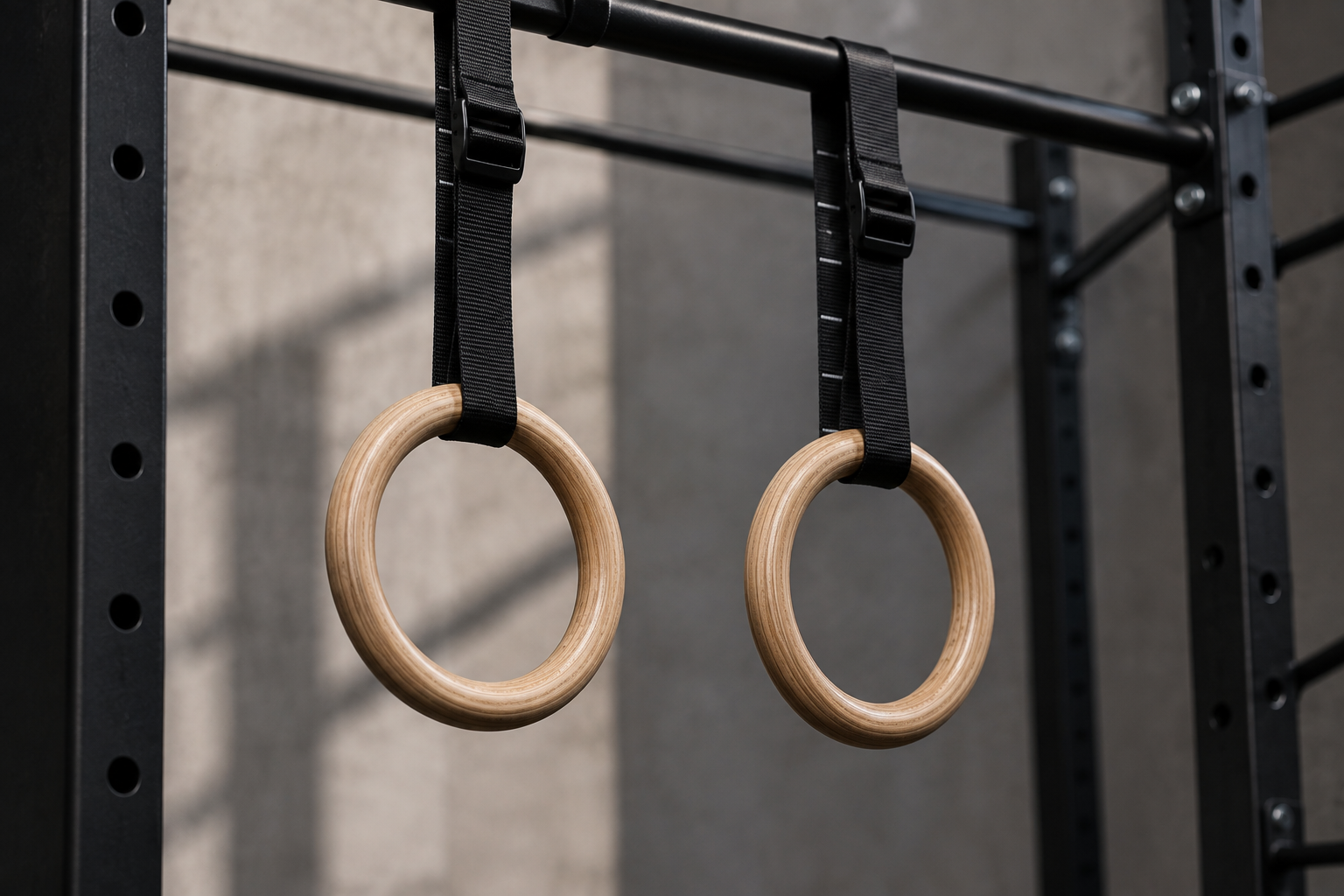
Pull-up Bar vs Rings: Which Tool Should You Choose to Start?
When starting a bodyweight training journey, one of the first questions concerns the equipment to purchase. Is a pull-up bar or rings better? Both represent fundamental tools for calisthenics and functional training, but they offer very different characteristics. The choice depends on your goals, experience level, available space, and the type of training you wish to perform.
Many beginners tend to see the bar and rings as alternatives, when in reality they are complementary tools. The bar allows you to quickly develop basic strength and learn fundamental movements, while the rings introduce a higher level of instability that improves coordination, motor control, and muscle activation. Understanding these differences allows you to invest in the most suitable equipment without purchasing products that are useless or unsuited to your level.
In this guide, we will analyze the advantages and limitations of both solutions, the main exercises, the benefits for those training at home, and the situations in which it is better to choose one tool over the other. We will also see why a modular structure capable of hosting both tools often represents the most complete solution for a home gym destined to grow over time.
- The main differences
- Why start with the bar
- The advantages of rings
- Which exercises you can perform
- The choice for the home gym
- How to evolve over time
- Mistakes to avoid
- Which investment is worth making
The main differences
Both the bar and rings allow you to train the upper body through pulling and pushing movements, but they do so in different ways. The bar offers a fixed grip point that facilitates learning technique and makes it easier to measure your progress. The rings, on the other hand, move freely in space and require greater involvement of the stabilizing muscles.
This difference profoundly influences the difficulty of the exercises. A pull-up on rings generally requires superior control compared to the same one performed on a bar, because the body must continuously manage small movements of instability.
For those who are beginners, it is important to understand that neither of the two tools is universally better: each develops different qualities and can become an integral part of a complete training program.
Stability versus instability
The bar favors the repeatability of the technical gesture, while the rings increase the work of coordination and joint control.
Different goals
Those who wish to quickly build strength in pull-ups may find the bar a more immediate starting point, while rings represent an excellent evolution to improve stability and control.
Why start with the bar
The bar represents one of the most effective tools for developing fundamental calisthenics strength. It allows you to learn pull-ups, hanging, knee raises, preparatory muscle-ups, and numerous other exercises that form the basis of bodyweight training.
Thanks to the stability of the grip point, the beginner can focus on technique without having to simultaneously manage the instability typical of rings. This accelerates the learning of fundamental movements and makes it easier to monitor improvements.
The main pull-up bar exercises also allow you to develop the lats, biceps, forearms, shoulders, and core musculature with a relatively small number of exercises.
The basics of calisthenics
Pull-ups, scapular pull-ups, and assisted variations constitute the ideal starting point for building relative strength and body control.
Simple progressions
The bar allows you to gradually increase difficulty through variations, resistance bands, and weights, accompanying the athlete for many years.
The advantages of rings
Gymnastic rings represent one of the most complete tools available for bodyweight training. Thanks to their freedom of movement, they allow the joints to follow more natural trajectories compared to the bar, improving comfort and adaptability during many exercises.
The benefits of gymnastic rings include greater involvement of the stabilizing musculature, the development of coordination, and the possibility of performing a huge variety of movements by simply adjusting the height of the rings.
At the same time, they require good technical preparation, because even the simplest exercises are generally more demanding than the corresponding versions performed on a fixed structure.
More natural movements
The ability to rotate freely during exercises allows you to adapt the position of the hands to the individual characteristics of the athlete.
More body control
The instability of the rings constantly stimulates the deep musculature, improving balance and coordination.
Which exercises you can perform
Both tools allow you to effectively train the whole body, but with some important differences. The bar excels in pull-ups, muscle-ups, and suspension skills, while the rings significantly expand the possibilities in pushing, dips, and stabilization exercises.
With rings, it is possible to perform push-ups, dips, rows, L-Sits, support holds, and numerous progressions toward advanced skills like the Ring Muscle-Up and Iron Cross.
The bar remains an irreplaceable tool for developing strength in pull-ups and tackling progressions like the Front Lever and Human Flag.
Pulling training
Both solutions allow you to effectively train the lats and biceps, with different levels of stability and technical difficulty.
Pushing training
The rings offer an extraordinary variety of exercises for the chest, shoulders, and triceps, easily adapting to the user's experience level.
The choice for the home gym
For those who wish to create a space dedicated to home bodyweight training, the bar often represents the first purchase due to its ease of use and immediacy. Subsequently, rings can be integrated without requiring major modifications to the existing setup.
Rings take up very little space and can be installed on the same structure used for pull-ups, significantly increasing the number of available exercises.
This complementarity makes the choice of a structure designed to host both pieces of equipment particularly interesting.
Optimizing space
A single structure can support both the bar and the rings, transforming a few square meters into an extremely versatile gym.
More training possibilities
Integrating different tools allows you to build complete programs dedicated to both strength and mobility and motor control.
How to evolve over time
For many beginners, the ideal path consists of starting with the bar, consolidating the basics of strength, and subsequently introducing rings as a complement.
This progression allows you to tackle the instability of the rings with sufficient preparation, reducing the risk of technical compensations and improving the quality of learning.
Over time, the two tools can coexist in the same program, offering different stimuli and favoring a more complete development of strength.
Starting from the basics
Building strength in pull-ups makes it much easier to tackle exercises on the rings with control and safety.
Using both tools
Alternating between the bar and rings allows you to exploit the strengths of each piece of equipment, avoiding limitations in technical development.
Mistakes to avoid
One of the most common mistakes is to consider rings a direct substitute for the bar or vice versa. In reality, each tool possesses specific characteristics that make it particularly effective in certain contexts.
Another mistake concerns choosing solely based on price. A stable and quality structure represents the foundation upon which to build any training program, regardless of the tool used.
Finally, trying to learn exercises that are too advanced without having consolidated the fundamental movements slows down progress and increases the risk of injury.
Don't skip steps
Every advanced exercise requires solid foundations of strength and control. Respecting progressions is the best way to improve safely.
Invest in quality
A stable structure improves the training experience and allows you to use both the bar and the rings in the best possible conditions.
Which investment is worth making
The choice between a bar and rings depends mainly on personal goals and experience level. For those starting from scratch, the bar often represents the most intuitive entry point, while rings constitute a natural evolution capable of enormously expanding training possibilities.
Rather than choosing between the two tools, the best strategy consists of considering them complementary. Once a good base of strength has been built, integrating rings allows you to improve coordination, stability, and exercise variety without revolutionizing your home gym.
For this reason, a Donatif modular structure designed to host both a bar and rings represents an intelligent investment, capable of accompanying the beginner in their first workouts and continuing to offer new possibilities even when the technical level becomes more advanced.
Comments (0)