
Trolley
You have no items in your shopping cart

 Budgets
 Dumbers
 Discs
Discs
 Benches
 Racks and Rigs
 Weights Holders
 Isotonic machines
 Calisthenics
 Cardio
 Kettlebells
 Flooring
 Gym Set
 Accessories
 Combat
 ARTI MARZIALI
 CONTAINER GYM
 Tug-Of-War
 Used Gym Equipment
 PILATES MACCHINARI
 GINNASTICA ARTISTICA
 CAMPI DA PADEL
 Prodotti in Pronta Consegna
 Informazioni
 IRONMAN
 Gift Card
- Donatif
- General information
- 0 I like it
- 540 Views
- 0 comments
- gym flooring, safety flooring, gym safety, shock-absorbing materials
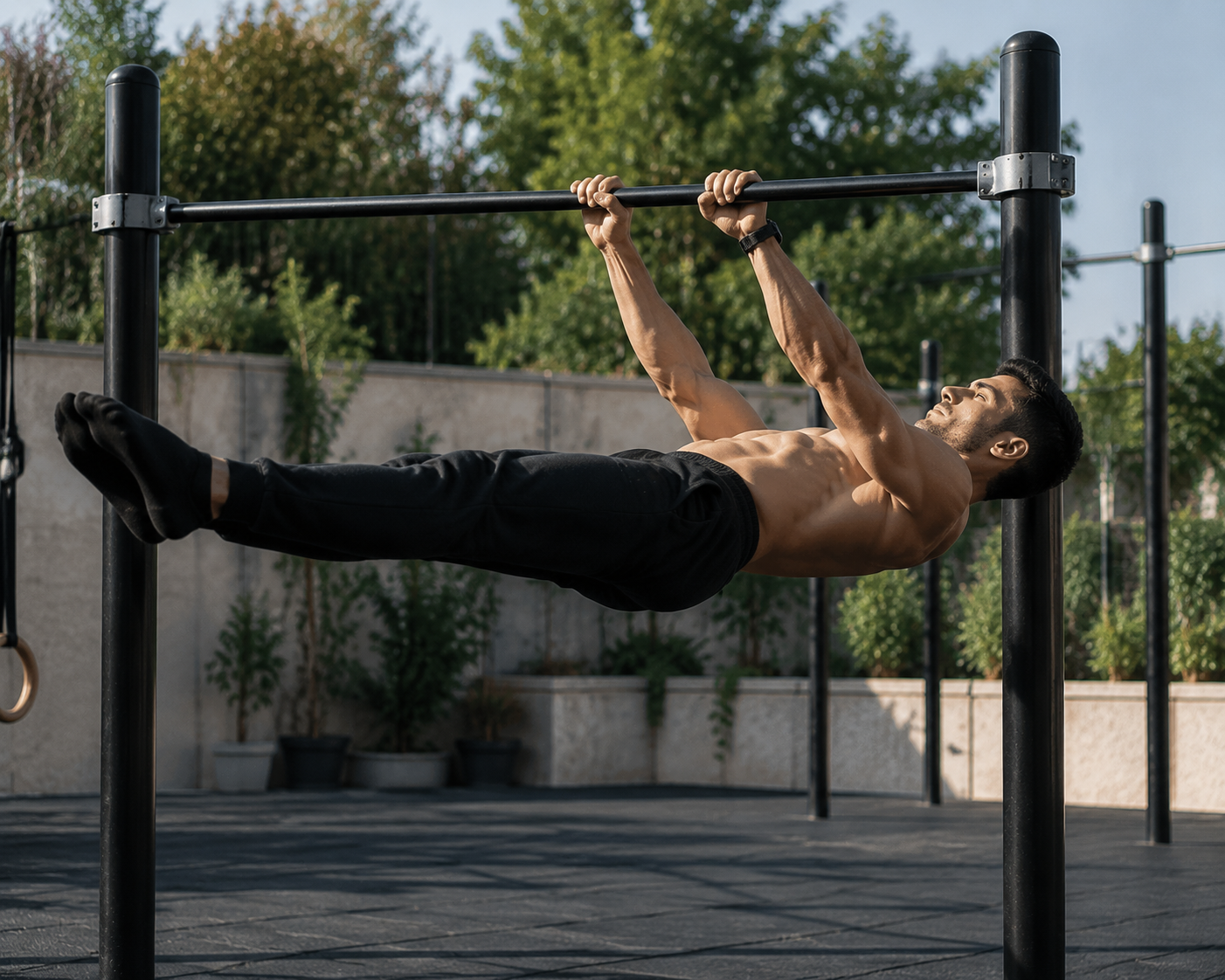
From Tucked to Full Front Lever: Strength Protocol for Lats
The front lever progression is one of the most spectacular and technically demanding skills in calisthenics. Keeping the body perfectly horizontal while suspended from a bar requires an extremely high level of relative strength, scapular control, core activation, and neuromuscular coordination. It is not simply a matter of having strong lats: the Front Lever is the result of the integration of numerous muscle groups that must work in perfect synergy.
Many practitioners remain stuck for months in the tucked front lever or in the initial progressions, mistakenly convincing themselves that they do not have the right genetics. In reality, plateaus almost always depend on incomplete programming, poor quality of scapular activation, or the use of unstable structures that dissipate part of the force produced during each attempt.
In this guide, we will analyze the biomechanics of the Front Lever, the most effective progressions to reach the full version, essential accessory exercises, and the importance of training on an extremely stable structure. A solid base allows you to transfer all your strength to the bar, significantly improving the quality of your training and the speed of learning.
- Biomechanics of the Front Lever
- Strength prerequisites
- Progressions from Tucked to Full
- Complementary exercises
- How to program your training
- The importance of structure stability
- Most common mistakes
- Investing in the right equipment
Biomechanics of the Front Lever
The Front Lever is a lever exercise in which the body acts as a long mechanical arm. The greater the distance between the center of mass and the bar, the greater the torque that the lats, shoulders, and core must counteract.
The correct position requires scapular depression, pelvic retroversion, and maximum trunk rigidity. Even small losses in alignment considerably increase the perceived load.
Understanding these principles allows you to choose truly effective progressions instead of relying exclusively on maximal attempts.
The role of levers
Every change in leg position changes the lever arm. For this reason, progressions are extremely effective in modulating the level of difficulty.
Scapular stability
Correct depression and protraction of the scapulae allow for optimal load distribution and increased stability throughout the hold.
Strength prerequisites
Before tackling advanced progressions, it is necessary to develop high pulling strength and complete core control.
Strict pull-ups, scapular pull-ups, hollow body holds, and rows represent the foundation upon which to build the entire skill.
Another often underestimated element is the activation of the serratus anterior, which is fundamental for maintaining a stable scapular position throughout the lever.
Lat strength
Increasing maximum strength in pull-ups directly improves the ability to support the body in Front Lever progressions.
Core rigidity
The trunk must behave as a single rigid structure. Any sagging of the pelvis immediately compromises the quality of the position.
Progressions from Tucked to Full
The most effective path follows a gradual progression: tucked, advanced tucked, one leg, straddle, and finally the full Front Lever. Each phase must be consolidated before increasing the difficulty.
The tucked front lever allows you to develop the correct motor pattern by reducing the torque and allowing for longer hold times.
Front lever exercises must be performed with absolute control, prioritizing technical quality and time under tension over the simple duration of the hold.
Advanced Tucked
Gradually extending the pelvis compared to the tucked position significantly increases the load without compromising technical control.
From Straddle to Full
The straddle position slightly reduces the torque and represents the final step before the full version.
Complementary exercises
Accessory exercises allow you to bridge specific weaknesses that limit Front Lever progression.
Front Lever raises, ice cream makers, ring rows, and scapular pull-ups develop strength in the critical points of the movement.
Targeted work on the serratus anterior, deep abdominals, and hip extensors improves the ability to maintain a perfectly horizontal line.
Isometric work
Isometric holds increase the ability to maintain high levels of tension for increasingly longer times.
Dynamic work
Alternating dynamic and isometric exercises promotes complete development of specific strength.
How to program your training
Training the Front Lever requires careful management of volume and intensity. The quality of repetitions is much more important than the quantity.
Two or three dedicated weekly sessions, integrated within a complete pulling program, generally represent an optimal frequency.
Progression should be monitored by recording hold times, technical quality, and perceived ease during each variation.
Volume management
It is preferable to accumulate numerous high-quality sets rather than performing a few maximal attempts with compromised technique.
Recovery
Recovery between sessions allows the nervous system and musculature to adapt to the high levels of tension required by the skill.
The importance of structure stability
One of the most overlooked aspects concerns the quality of the structure used for training. Every oscillation of the bar dissipates part of the force produced and forces the athlete to make compensations that limit performance.
For this reason, training on a simple door bar is not the ideal choice for such an advanced skill. A rigid structure allows you to transfer force entirely to the movement, improving both safety and technical quality.
A Modular Power Rack or a self-supporting outdoor structure offers the stability necessary to tackle intense workouts without unwanted oscillations.
Why a stable structure is needed
A rigid base eliminates energy dispersion and allows you to focus exclusively on force production and position control.
Advanced Home Gym
Investing in a professional structure allows you to train numerous advanced skills beyond the Front Lever, increasing the versatility of the entire training area.
Most common mistakes
Many practitioners try to move too quickly to the full version without consolidating intermediate progressions. This almost always leads to technical compensations and long periods of stagnation.
Another frequent mistake is neglecting scapular strength. Powerful lats are not enough if you lack the ability to maintain stable depression throughout the lever.
Also, training to failure every time slows down progress, increasing nervous system fatigue and worsening the quality of motor learning.
Skipping progressions
Each variation must be mastered before tackling the next one. Patience is one of the determining factors for success.
Neglecting technique
An imperfect body line alters the biomechanical levers and makes every attempt much more difficult than necessary.
Investing in the right equipment
The Front Lever represents one of the highest expressions of relative strength in calisthenics and requires methodical preparation, intelligent progressions, and consistent programming over time.
Understanding the biomechanics of the skill, progressively developing lat strength, improving scapular stability, and constantly monitoring your progress allows you to overcome the plateaus that block many intermediate practitioners.
Training on an extremely stable structure is an often underestimated but decisive element for expressing your full potential. A professional base allows you to apply force without dispersion, improving the quality of every workout and making the path to the Full Front Lever more efficient, safe, and repeatable.
Comments (0)