
Trolley
You have no items in your shopping cart

 Budgets
 Dumbers
 Discs
Discs
 Benches
 Racks and Rigs
 Weights Holders
 Isotonic machines
 Calisthenics
 Cardio
 Kettlebells
 Flooring
 Gym Set
 Accessories
 Combat
 ARTI MARZIALI
 CONTAINER GYM
 Tug-Of-War
 Used Gym Equipment
 PILATES MACCHINARI
 GINNASTICA ARTISTICA
 CAMPI DA PADEL
 Prodotti in Pronta Consegna
 Informazioni
 IRONMAN
 Gift Card
- Donatif
- General information
- 0 I like it
- 473 Views
- 0 comments
- gym flooring, safety flooring, gym safety, shock-absorbing materials
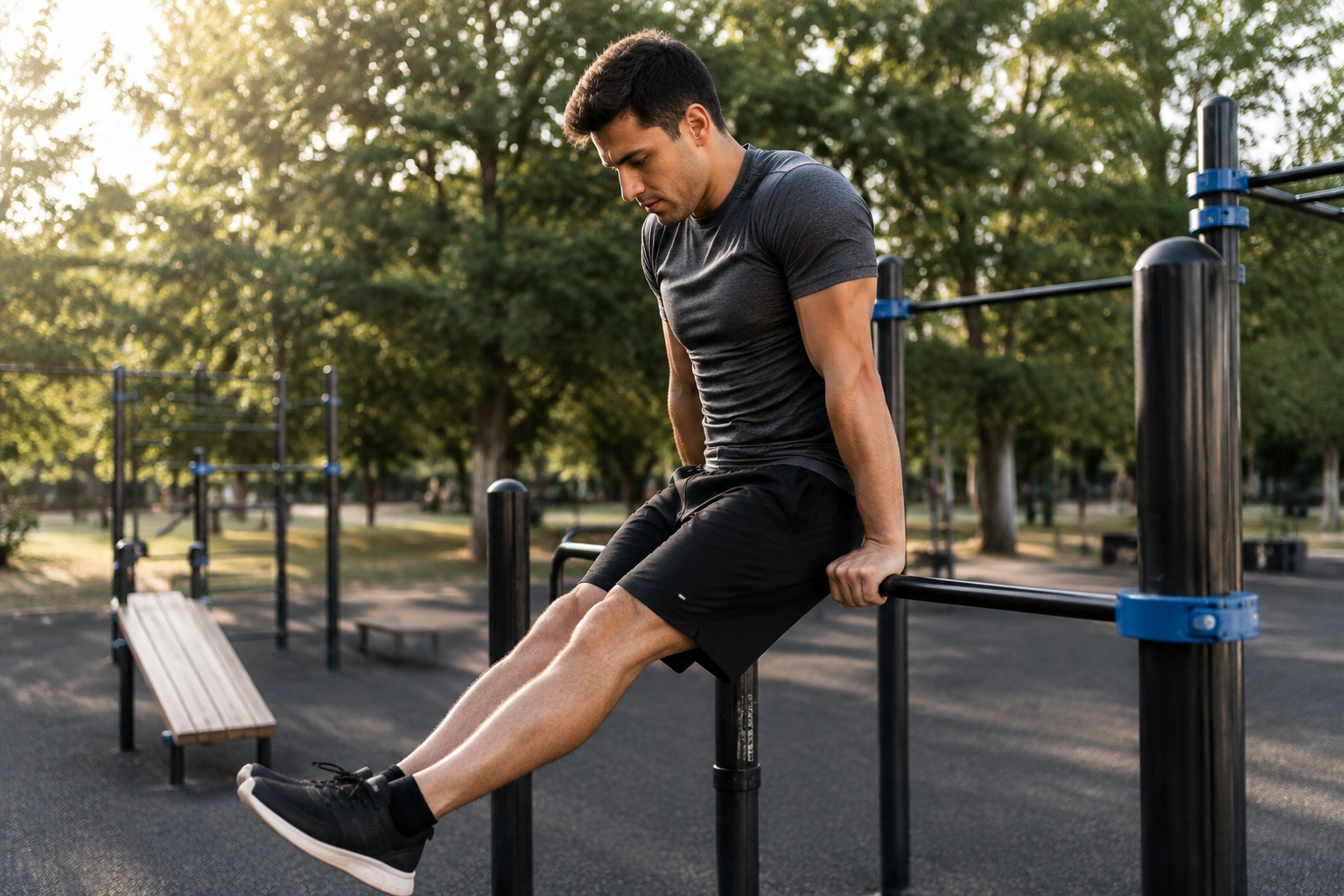
Calisthenics Beginner Routine: Your First Month of Training
A well-structured calisthenics routine is the best way to start bodyweight training without wasting time on random exercises or overly complex programs. Those approaching calisthenics often think they need advanced skills like Muscle-Ups, Front Levers, or Planches right away, but the reality is very different. The foundations built during the first month of training determine the speed at which you will be able to progress in the following years.
The first goal is not to learn spectacular exercises, but to develop strength in fundamental movements, improve coordination, increase joint mobility, and create a consistent training habit. A simple, progressive, and sustainable program allows you to achieve results much faster than excessively complex programs.
In this guide, you will find a complete program dedicated to the first month of training, with basic exercises, progressions, tips on recovery, and information on the most useful equipment to build a solid home gym. By following these instructions, you will be able to develop the foundations necessary to tackle all the main calisthenics skills in the future.
- Why follow a program
- The fundamental movements
- The first-month routine
- How to increase difficulty
- Recovery and mobility
- Recommended equipment
- Mistakes to avoid
- How to continue after the first month
Why follow a program
One of the most common mistakes beginners make is constantly changing exercises and routines. A consistent program allows the body to gradually adapt to stimuli, improving strength, coordination, and motor control.
Following a routine also allows you to monitor progress, verify increases in repetitions, and keep motivation high thanks to concrete and easily measurable goals.
The first month should be dedicated exclusively to building the foundations, avoiding the introduction of exercises that are too advanced, which could compromise the quality of learning.
Consistency above all
Training three times a week with regularity produces significantly better results than sporadic, very intense sessions.
Measuring improvements
Recording repetitions, sets, and sensations allows you to observe progress that is often invisible to the naked eye during the first few weeks.
The fundamental movements
Every effective program should focus on the main movement patterns: push, pull, legs, and core. These movements develop general strength and prepare the body for future progressions.
The five fundamental exercises are push-ups, rows or assisted pull-ups, squats, planks, and facilitated dips or incline push-ups, depending on your initial level.
These basic calisthenics exercises involve most of the musculature and allow you to quickly build a solid physical foundation.
Pushing movements
Push-ups develop the chest, shoulders, and triceps while simultaneously improving core stability and body control.
Pulling movements
Rows and assisted pull-ups strengthen the lats, biceps, and scapular musculature, which are often neglected by beginners.
The first-month routine
A simple program can be organized into three alternating weekly sessions, leaving at least one day of recovery between one workout and the next.
Each session should start with five to ten minutes of mobility and warm-up, continue with the fundamental exercises, and end with a short session dedicated to the core and stretching.
A possible structure includes: push-ups 3x8-12, Australian rows or assisted pull-ups 3x6-10, squats 3x12-15, planks 3x30-45 seconds, and assisted dips or incline push-ups 3x8-10. The exact number of repetitions can be adapted to your level while always maintaining clean technique.
Three workouts per week
Training on alternate days allows you to recover effectively while maintaining a frequency sufficient to improve rapidly.
Technique comes first
Every repetition must be controlled. It is better to reduce the number of repetitions rather than sacrifice the quality of execution.
How to increase difficulty
After the first few weeks, the body will begin to adapt to the exercises. At this stage, it is important to gradually increase the stimulus without completely changing the program.
Progressions can involve the number of repetitions, increasing the sets, or introducing slightly more demanding variations while always maintaining correct technique.
For those who want to start calisthenics for beginners in the best way, gradual progression is the most important principle to respect.
Increasing repetitions
When you easily reach the upper limit provided by the routine, you can progressively increase the volume of work.
Moving to the next variations
Only after consolidating the fundamental exercises is it advisable to introduce more demanding versions of the movements.
Recovery and mobility
Recovery is an integral part of training. Sleeping enough, eating correctly, and respecting rest days promotes muscular and nervous adaptations.
Mobility should be present in every session, paying particular attention to the shoulders, wrists, hips, and thoracic spine.
Even a few minutes of dynamic stretching and joint mobilization significantly improve the quality of exercise execution.
Sleeping well
Adequate nightly recovery accelerates adaptation processes and allows you to approach every workout with more energy.
Preparing the joints
Good mobility reduces the risk of compensations and makes it easier to learn new movements.
Recommended equipment
To start, you don't need to buy numerous tools. A stable bar, a mat, and some resistance bands are often enough to perform most of the first month's exercises.
Over time, it will be possible to integrate parallel bars, gymnastic rings, and a modular structure that allows you to tackle increasingly advanced progressions.
Those who want to build a home gym destined to grow along with their skills can choose a modular calisthenics structure, designed to offer stability, versatility, and the possibility of expansion over time.
Few but quality tools
Investing in sturdy equipment initially allows you to train safely and avoid premature replacements.
Building your own Home Gym
A modular home gym allows you to add new accessories as your experience and goals increase.
Mistakes to avoid
Many beginners seek immediate results by rapidly increasing volume and intensity. This approach often leads to joint pain, loss of technique, and reduced motivation.
Another mistake is neglecting pulling work, focusing almost exclusively on push-ups. Maintaining a balance between pushing and pulling is essential for developing a harmonious physique.
Constantly changing programs also slows down improvements. The basics require time to consolidate and must be trained with continuity.
Wanting to do too much
Gradual progression allows you to build lasting strength and prepares the body for more advanced exercises.
Training the whole body
A complete program avoids muscle imbalances and improves the overall quality of movement.
How to continue after the first month
At the end of the first four weeks, you will have built a base of strength, coordination, and control that will make it much easier to tackle more advanced progressions. At this point, it will be possible to introduce full pull-ups, dips, push-up variations, and the first preparatory exercises for calisthenics skills.
The key to success remains consistency. A simple routine followed with regularity produces significantly better results than complex programs abandoned after a few weeks.
By following a progressive path, using stable equipment, and continuing to improve technique and mobility, the first month will become the foundation on which to build a lasting growth journey in the world of beginner bodyweight training, preparing you to confidently face the increasingly stimulating challenges of calisthenics.
Comments (0)