
Trolley
You have no items in your shopping cart

 Budgets
 Dumbers
 Discs
Discs
 Benches
 Racks and Rigs
 Weights Holders
 Isotonic machines
 Calisthenics
 Cardio
 Kettlebells
 Flooring
 Gym Set
 Accessories
 Combat
 ARTI MARZIALI
 CONTAINER GYM
 Tug-Of-War
 Used Gym Equipment
 PILATES MACCHINARI
 GINNASTICA ARTISTICA
 CAMPI DA PADEL
 Prodotti in Pronta Consegna
 Informazioni
 IRONMAN
 Gift Card
- Donatif
- General information
- 0 I like it
- 651 Views
- 0 comments
- gym flooring, safety flooring, gym safety, shock-absorbing materials
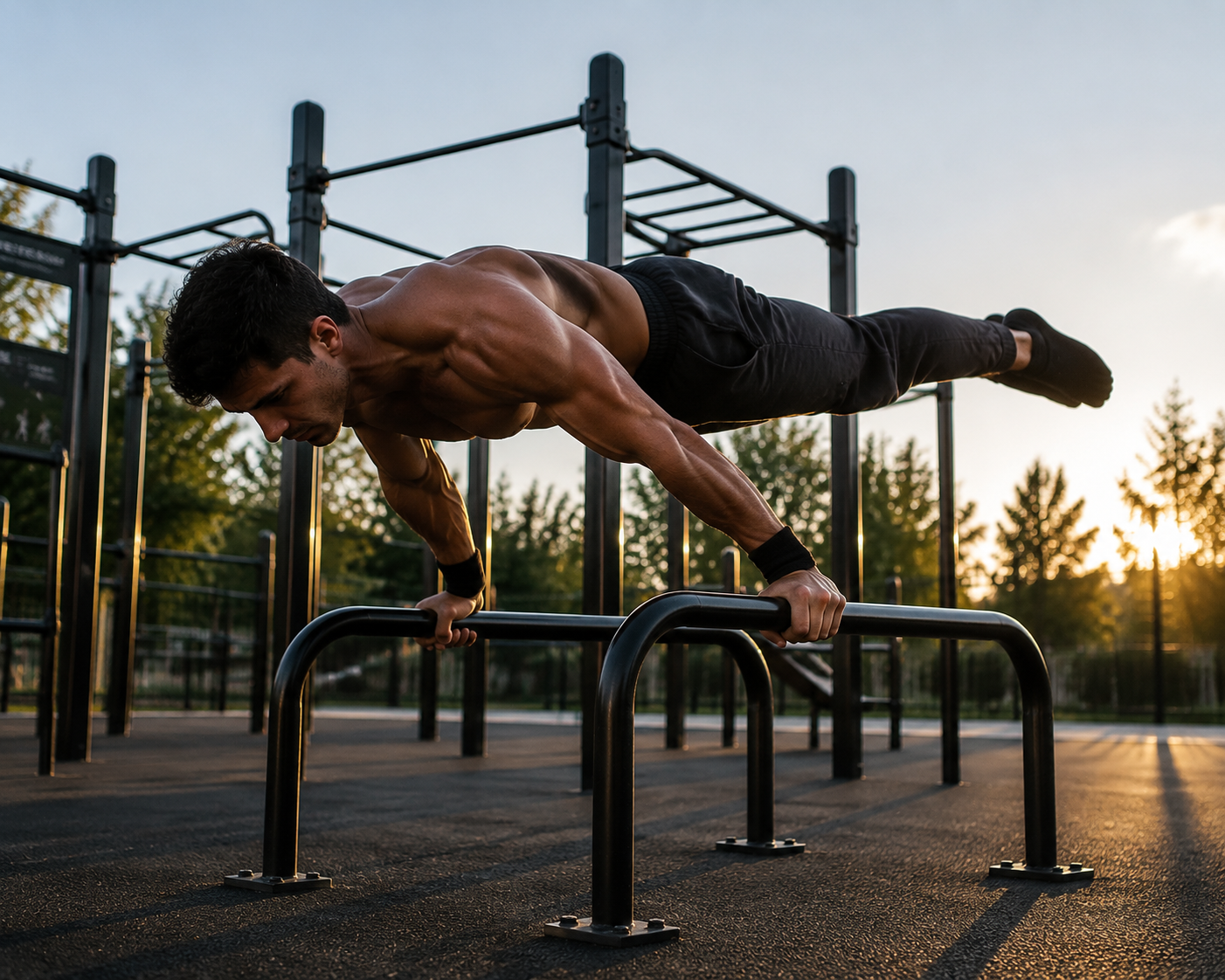
Injury Prevention in Calisthenics: A Guide to Wrist and Elbow Health
Calisthenics injuries represent one of the main causes of training interruptions, especially among athletes who rapidly increase their workload or tackle advanced skills without adequate joint preparation. Pain in the wrists, elbows, and shoulders is not an inevitable consequence of calisthenics, but often the result of poorly balanced programming, insufficient warm-ups, or suboptimal technique.
The joints involved in bodyweight exercises are subjected to high and repetitive loads. Handstands, planches, dips, muscle-ups, front levers, and pull-ups generate significant stress on tendons, ligaments, and connective tissues that require time to adapt. Ignoring the body's signals or accelerating progressions too much can turn a simple discomfort into a problem that forces you to suspend training for weeks or months.
The good news is that most injuries can be prevented through proper preparation. A specific warm-up, mobility exercises, intelligent load management, and the use of ergonomic equipment allow you to train consistently, improving performance and significantly reducing the risk of inflammation.
- The main causes of injuries
- Protecting your wrists
- How to prevent elbow pain
- The correct warm-up
- Mobility and joint preparation
- Managing training load
- The importance of equipment
- Why prevention is always worth it
The main causes of injuries in calisthenics
Most injuries do not stem from a single traumatic episode, but from a progressive accumulation of stress on the tissues. Increasing the number of workouts too quickly, introducing advanced skills without the necessary foundations, or neglecting recovery are very common mistakes.
Tendons adapt more slowly than muscles. It is therefore possible to feel strong enough to tackle complex exercises while the joint structures are not yet ready to withstand those levels of load. This imbalance promotes the onset of tendonitis, epicondylitis, and chronic inflammation.
Imprecise technique also contributes to the development of overloads. Incorrect positioning of the shoulder blades, wrists, and elbows modifies the distribution of forces, increasing stress on specific joints.
Too rapid progressions
Skipping preparatory exercises to quickly reach advanced skills increases the risk of joint overload.
Incorrect technique
Movements performed with compensations or loss of control distribute the load poorly and promote the onset of pain.
How to protect your wrists during training
Wrists are one of the most stressed joints in calisthenics. During handstands, planches, push-ups, and numerous variations, they must support the weight of the entire body while maintaining positions of high extension.
Calisthenics wrist pain often appears when the load increases faster than the tissues' ability to adapt. For this reason, it is essential to progressively prepare the joint with specific exercises before each session.
Joint rotations, quadrupedal mobilizations, controlled extensions, and gradual weight transfers help increase load tolerance while also improving the quality of movement.
Mobilize before loading
Devoting a few minutes to preparing the wrists improves joint lubrication and reduces initial stiffness.
Increase load gradually
Progressions must be planned in a way that allows tendons to adapt without excessive stress.
Preventing inflammation in elbows and forearms
Epicondylitis and epitrochleitis are among the most frequent ailments in calisthenics practitioners. These issues affect the tendons that connect the forearm muscles to the elbow and can appear after long periods of intense training.
Alternating pushing and pulling exercises, avoiding excessive volumes, and including recovery days significantly reduces the risk of inflammation.
It is also useful to dedicate part of the preparation to strengthening exercises for the forearms and grip, improving load distribution during pull-ups, dips, and muscle-ups.
Strengthen the forearms
Stronger musculature helps to better absorb the stress that reaches the elbow.
Do not ignore the first signs
Intervening at the first signs of discomfort often allows you to avoid chronic problems and long periods of inactivity.
The specific warm-up before skills
The calisthenics warm-up is one of the most effective tools for preventing injuries. The goal is not just to increase body temperature, but above all to prepare joints, tendons, and the nervous system for the planned exercises.
A complete routine should include wrist and shoulder mobility, scapular activation, dynamic core exercises, and specific movements for the skill being trained.
The warm-up should not be perceived as a waste of time. On the contrary, it improves the technical quality of the session and allows you to tackle exercises with greater control and safety.
Organize the sequence
Starting from general movements to progressively reach specific exercises improves the effectiveness of the preparation.
How long it should last
Ten or fifteen minutes is generally a good compromise to prepare the body without fatiguing it.
Shoulder mobility and joint preparation
Good calisthenics shoulder mobility allows you to perform wider and more controlled movements, reducing compensations and overloads.
Shoulders should be prepared through exercises with resistance bands, rotations, thoracic openings, and rotator cuff activation. This work improves the stability of the scapular girdle and promotes a more balanced distribution of forces.
Integrating mobility into your daily routine also helps counteract stiffness due to sedentary behavior, improving general posture and the quality of skills.
Work with resistance bands
Resistance bands allow you to gradually increase the range of motion while maintaining optimal control of the movement.
Scapular control
Correct management of the shoulder blades improves stability, strength, and joint protection during all exercises.
Load management and recovery
Training more does not necessarily mean improving faster. Tissues need time to adapt and consolidate the stimuli received.
Alternating high-intensity days with technical or recovery sessions allows you to maintain high training quality without accumulating excessive stress.
Sleep, nutrition, and hydration also play an important role in injury prevention, promoting tissue regeneration and reducing inflammation.
Plan recovery
Deload weeks allow you to fully recover and prepare for new training cycles.
Listen to your body
Persistent stiffness and increasing pain are signs that require a temporary reduction in load.
The importance of using ergonomic equipment
The quality of equipment also affects joint health. Stable bars, ergonomic grips, and optimized diameters allow for a more natural distribution of pressure, reducing stress on wrists and elbows.
A structure that wobbles during pull-ups or has uncomfortable grips forces the athlete to make constant compensations, increasing the risk of overload.
To learn more about solutions dedicated to bodyweight training, you can consult calisthenics warm-up and professional equipment designed to ensure stability, ergonomics, and maximum safety during every workout.
Structure stability
A rigid station improves the quality of the technical gesture and reduces unwanted movements that can fatigue the joints.
Grip diameter
Correctly designed grips promote a natural hold, increasing comfort and control during exercises.
Why prevention is always worth it
Consistency is one of the most important factors for achieving results in calisthenics. Every week of downtime due to inflammation slows down progress and makes it harder to maintain strength, technique, and motivation.
Investing time in mobility, warm-ups, and load management means protecting your body and creating the ideal conditions to tackle increasingly advanced progressions in total safety. Choosing equipment designed with ergonomic criteria also helps reduce joint stress during workouts.
The best athletes do not avoid injuries by luck, but because they dedicate great attention to joint preparation and respect their body's adaptation times. Making prevention an integral part of every session allows you to train with greater peace of mind, improve performance, and build lasting results over time.
Comments (0)