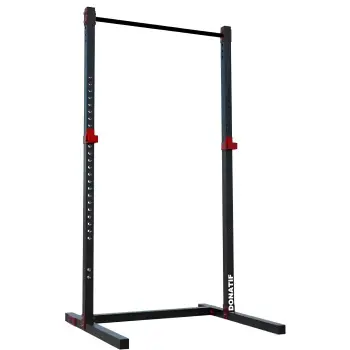
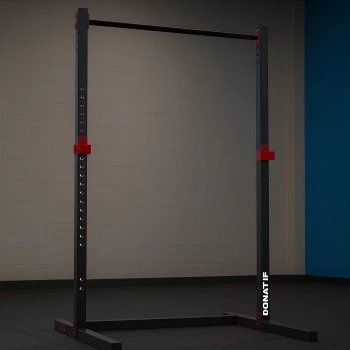
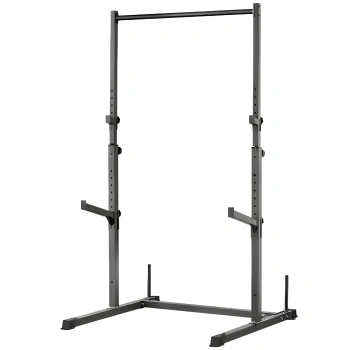
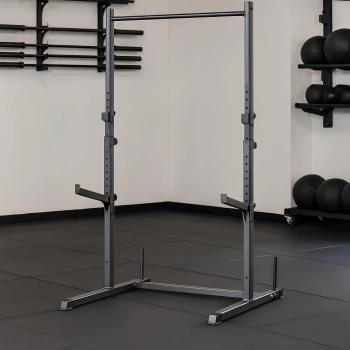
A freestanding pull-up bar represents one of the best solutions for those who want to train at home without having to drill into walls or ceilings. Whether it is a rented apartment, a basement, a garage, or a room dedicated to a home gym, a freestanding structure allows you to practice calisthenics, functional training, and bodyweight strength in total freedom, offering a stable and ready-to-use station.
In recent years, the market has expanded enormously, offering models that are very different from each other in terms of size, load capacity, configuration, and build quality. Not all structures, however, guarantee the same level of safety. A choice based solely on price can translate into less stability, vibrations during exercises, or limitations in more advanced progressions.
Before purchasing, it is therefore important to evaluate some fundamental elements: weight of the structure, frame geometry, steel quality, load capacity, expansion possibilities, and the type of exercises you wish to perform. In this guide, we analyze all the aspects to consider to choose the most suitable solution for your home gym.
Why choose a freestanding structure
A freestanding structure eliminates the need for permanent wall work, offering an ideal alternative for those who live in a rental or prefer to avoid modifications to their home. Once assembled, it can be used immediately and, if necessary, disassembled or moved with relative ease.
This solution also allows you to create a complete station for calisthenics without depending on the strength of walls or ceilings. All loads are in fact distributed directly onto the structure, which is designed to support both the athlete's weight and the dynamic stresses generated during training.
For many enthusiasts, it represents the best compromise between practicality, safety, and versatility, especially when the available space does not allow for the installation of permanent structures.
No holes in walls or ceilings
The ability to train without construction work makes this solution particularly attractive for apartments and rental properties.
A station always ready
Once assembled, the structure can host daily workouts without the need for adjustments or additional installations.
Why stability is the most important factor
When choosing a freestanding structure, stability is the most important parameter. During pull-ups, muscle-ups, swings, and weighted training, the frame is subjected to significant dynamic forces that must be absorbed without unwanted movement.
The total weight of the structure often constitutes an advantage. A heavier frame, built with quality profiles and a wide base, tends to offer greater stability compared to light models intended for occasional use.
The distribution of the support points, the rigidity of the connections, and the quality of the hardware also contribute to reducing vibrations and flexing during training.
Weight is an ally
A robust structure offers a superior feeling of solidity, improving safety and confidence during every exercise.
Rigidity and precision
Less oscillation means more controlled movements and better technical quality during advanced progressions.
The main types of freestanding bars
There are different configurations designed for different needs. The simplest structures are dedicated exclusively to pull-ups, while more complete models integrate parallel bars, dip supports, accessories, and multi-function stations.
A professional power tower represents one of the most popular solutions because it allows you to train practically the entire body using a single structure. Pull-ups, dips, leg raises, and numerous core exercises can be performed without additional equipment.
Modular structures dedicated to calisthenics, on the other hand, offer the maximum possibility of customization, allowing you to add new elements over time based on the evolution of your training.
Multi-function power tower
Ideal for those who want a compact solution capable of housing numerous stations in a limited space.
Modular structures
Perfect for advanced home gyms, they allow you to progressively expand the setup while maintaining a single training platform.
Features to check before purchasing
The quality of materials is one of the first aspects to evaluate. Structural steels, precise welds, and resistant coatings guarantee greater durability even after years of intensive use.
It is important to verify the load capacity declared by the manufacturer, considering that dynamic exercises can generate loads higher than simple body weight. A structure designed for intensive use generally offers higher safety margins.
Dimensions, available adjustments, and the possibility of integrating future accessories also influence the overall value of the investment.
Check the load capacity
A high load capacity generally indicates a more robust design that is also suitable for experienced users or weighted training.
Think about modularity
Choosing an expandable structure allows you to add new accessories without replacing the entire system.
Which exercises you can perform
A modern home pull-up station allows you to tackle a complete training program. In addition to classic pull-ups, it is possible to perform dips, chin-ups, Australian pull-ups, leg raises, L-sits, and numerous variants dedicated to the core.
More advanced structures also allow you to use gymnastic rings, resistance bands, ropes, and other accessories that further expand the number of available exercises.
Those who practice Street Lifting can also integrate weighted training, taking advantage of the rigidity of the structure to work in total safety.
Ideal for beginners
A stable station facilitates learning the correct technique and allows you to progress continuously.
Also suitable for experienced athletes
The ability to support heavy loads makes these structures suitable even for programs oriented toward maximal strength.
How to organize an efficient home gym
Before purchasing, it is essential to accurately measure the available space. In addition to the dimensions of the structure, you must consider the area necessary to perform exercises safely.
Leaving enough space around the bar allows you to perform dynamic movements without obstacles and makes it easier to add further equipment such as benches, racks, or parallettes.
Rational planning improves the fluidity of training and allows you to make the most of every square meter of your home gym.
Organize the layout
Correctly arranging each element avoids interference during exercises and increases general comfort.
Plan for growth
A home gym designed to evolve allows you to add new equipment while maintaining order and functionality.
The most common mistakes when choosing
Many users choose the structure based solely on price, neglecting fundamental aspects such as stability, build quality, and expansion possibilities.
Another mistake is underestimating the importance of assembly. Correctly assembling the frame, respecting the tightening torques indicated by the manufacturer, is essential to ensure safety and durability.
Finally, buying a structure that is too limited may make a new investment necessary after a few months, when your training level increases.
Don't just look at the price
A higher quality structure offers greater reliability and reduces replacement costs in the long run.
Correct assembly
Following the instructions carefully ensures maximum rigidity and a better user experience.
Why invest in a professional structure
An indoor calisthenics structure designed for intensive use represents an investment destined to last for many years. Quality materials, geometries designed for maximum stability, and expansion possibilities make training safer and more effective.
For those who want to create a complete home gym, it is possible to find professional calisthenics structures designed to offer high rigidity, modularity, and reliability, accompanying the athlete's growth from the first pull-ups to the most advanced workouts.
Choosing a freestanding bar carefully means building the heart of your home gym. A stable, resistant, and well-designed structure allows you to train continuously, develop strength, and tackle any calisthenics progression with the peace of mind of using equipment designed to support every goal.


 Budgets
 Dumbers
 Discs
 Benches
 Racks and Rigs
 Weights Holders
 Isotonic machines
 Calisthenics
 Cardio
 Kettlebells
 Flooring
 Gym Set
 Accessories
 Combat
 ARTI MARZIALI
 CONTAINER GYM
 Tug-Of-War
 Used Gym Equipment
 PILATES MACCHINARI
 GINNASTICA ARTISTICA
 CAMPI DA PADEL
 Prodotti in Pronta Consegna
 Informazioni
 IRONMAN
 Gift Card