For a calisthenics gym with a low ceiling, movement tests should be carried out before installing the bar and before choosing the structure. Mark on the floor and in the air the space needed by the movements you really want to offer, have coaches perform them, and compare the result with the manufacturer's instructions. Only then decide where and how to install.
The idea is to reverse the usual order: do not start from the structure to understand what you can do with it, but from the exercises your members must be able to perform, and check whether the space allows them. This reduces the risk of ending up with a mounted bar that cannot be used for half of the planned movements.
Here you will find a five-step test method, a matrix to record the outcome, and a list of what must be left to a qualified technician. This is not a technical validation: these are criteria for collecting data and arriving prepared at the discussion with the supplier and the technician.
In this article
Usable height and nominal height: what to measure?
The nominal height of the room is the one stated in the documents; the usable height is the space actually free at the point where people move. They can differ because of beams, suspended ceilings, light fittings, cable trays, vents or pipes.
For this reason, the test must be done at the exact point where the bar will be installed, not at any point in the room. Measure with a tape measure or laser distance meter, note the dimensions, and mark on the floor the projection of any protruding obstacles.
Remember that usable height is not only the height above the bar: it also includes the space needed by the person throughout the whole movement, at the start, at the top and during the descent. For a detailed survey of beams, lights and services, you can read more in how to survey beams, lights and services in a low-ceiling gym.
Which movements to allow and which to exclude?
Start from a short list of the movements your classes or clients need, and divide it into three groups: planned movements, movements to adapt, and movements to exclude in that space.
- Static or bodyweight-hold movements: hangs, basic pull-ups. They mainly require space for the arms and the head.
- Movements with range: wide-grip pull-ups, knees-to-chest raises, swinging exercises. They require more space in front, behind and to the sides.
- Dynamic or momentum movements: explosive variations or those involving body rotation. These are the ones most often excluded in confined spaces.
Excluding a movement is not a failure: it is a programming choice. You can replace it with a more compact variation, keeping the same training goal, on the advice of the coaches.
How does the test with the coaches work?
The test turns an assumption into data. Involve at least one coach who will use the station and, if possible, people of different builds, because the space that is enough for one person may not be enough for another.
- Define the movements to test, based on the list in the previous section.
- Simulate the bar with a temporary physical reference (for example a pole or a taut strap) at the assumed height, without fixing anything permanently. If the reference must bear a load, do not use it: the movement test is unloaded and does not replace the load verification.
- Have the movements performed at controlled speed, first without and then, if planned, with the wider variations, while a coach observes.
- Record free distances, points of contact or discomfort, and whether the movement was completed without adjustments.
- Repeat in real conditions: the room with other people present, proximity to other stations, walkways, doors and exits.
If you want to connect this with the class planning phase, you will find a deeper look in how to organise classes, stations and groups.
Beams, lights, services and anchor points: what to note?
During the test, note everything that is within the movement area and above it, not just the bar.
- Beams and floor slabs: position, direction and material type, to be assessed by a technician.
- Lights, sensors, sprinklers and exposed services: possible contact points.
- Nearby walls and columns: needed to understand whether a wall-mounted installation is even conceivable.
- Floor: presence and condition of protective flooring, since it affects landings and descents.
- Escape routes and walkways: the station must not block them.
As for fixing points, no distance or anchor is valid in general: it depends on the actual substrate and on the manual of the model. For typical requirements, see requirements for installing a wall-mounted pull-up bar and the guide to safe installation of a pull-up bar.
Freestanding rig, wall bar or stations: which solution to test?
Once you know what is feasible, you can compare solutions based on the data collected. The criterion is simple: the solution must allow the chosen movements in the measured space and comply with the manufacturer's instructions for that model.
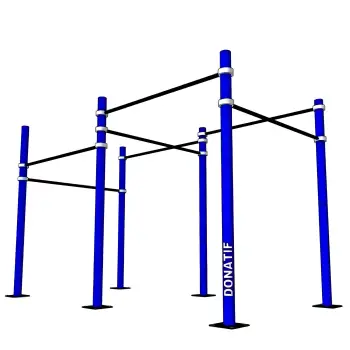
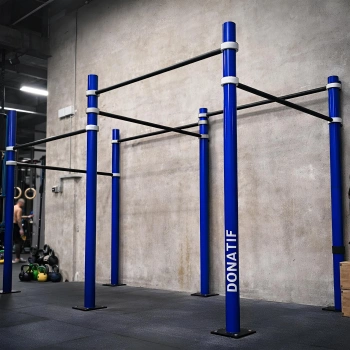
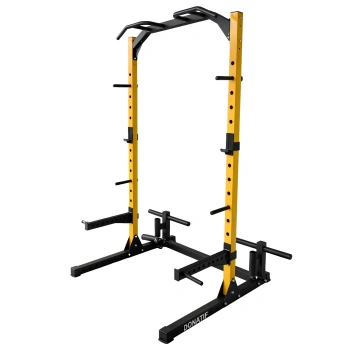
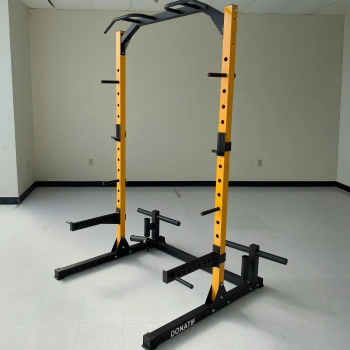
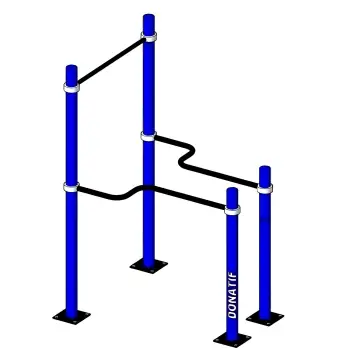
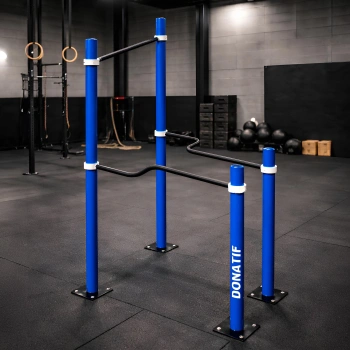
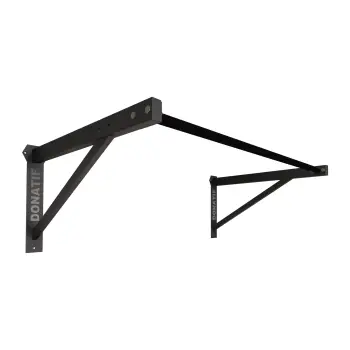
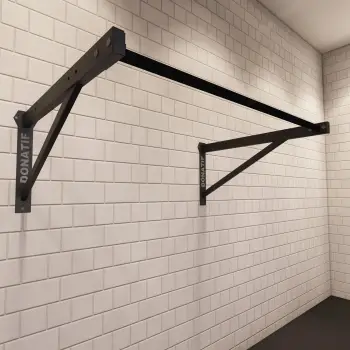
A custom wall-mounted pull-up bar is the most compact solution, but it depends entirely on the wall and on the free distance in front. A freestanding structure, such as a custom calisthenics power tower, allows more freedom of placement but takes up floor space and must fit within the usable height. A half squat rack with pull-up bar combines several functions in a single footprint, to be checked on the product page.
To explore the options, see the categories pull-up bars, D100 calisthenics structures and racks and rigs, and always check dimensions, installation and requirements on the individual model page: no structure suits every environment.
Control matrix to fill in after the test
Fill in one row for each movement tested. It helps you decide with written data and to show suppliers, technicians and property owners how you reasoned.
| Movement | Space to check | What to note | Who validates |
|---|
| Hang and basic pull-up | Usable height above the bar, space for head and arms | Free clearances, any contact | Coach |
| Wide-grip pull-up or knees to chest | Front and rear space, distance from walls | Actual range, adjustments needed | Coach and manager |
| Dynamic movement | Swing area, other nearby stations | Possible exclusion or variation | Coach |
| Fixing and load | Substrate: slab, wall or floor | Type of substrate, obstacles, documents | Qualified technician |
| Use and instructions | Requirements of the chosen model | Dimensions and constraints from the manual | Manufacturer or supplier |
If a row remains without an outcome, the decision is not yet ready. For the results of technical safety tests, see also how load tests on fitness equipment are carried out.
What to hand over to the technician and the manufacturer?
The movement test does not replace any technical verification. The assessment of the substrate (slab, wall, floor) and of the fixing remains with the qualified technician; confirmation that the model is suitable for the intended use, according to the manual and product page, remains with the manufacturer or supplier.
To make the best use of their time, bring the completed matrix, the measured dimensions, a photo of the area with the obstacles marked, and the list of permitted movements. This way the request is precise and the answer can be too.
If the job is larger, for example several stations in an already operating facility, the relationship with the overall layout is covered in movement tests before installing a bar with a low ceiling, useful as a second perspective on the same topic.
Frequently asked questions
Can I run the test before I have the bar?
Yes, and that is exactly the right moment. Use a temporary reference at the assumed height, unloaded, only to assess the space for the movements. Do not use it to support loads.
How many people should take part in the test?
There is no number that always works. It is best to test with at least one coach and with people of different builds, because the usable space changes from person to person.
If the test goes well, can I install straight away?
No. The test only assesses the movement space. The substrate, the fixing and the suitability of the model must be confirmed by a qualified technician and by the manufacturer's instructions.
What do I do if a movement does not fit the space?
Exclude it or choose a more compact variation together with the coaches. Alternatively, consider another position or another type of structure, always repeating the test.
Conclusion: decide with written data, not impressions
Before installing a bar, define the movements, test them in the real space with the coaches, fill in the matrix and bring the data to the technician and supplier. With this method you choose the solution after understanding what is feasible, not the other way round.
If you want to compare structures and bars compatible with your dimensions, start from the categories D80 calisthenics structures and pull-up bars, or contact Donatif with your matrix: we will help you identify the models to evaluate.


 Budgets
 Dumbers
 Discs
 Benches
 Racks and Rigs
 Weights Holders
 Isotonic machines
 Calisthenics
 Cardio
 Kettlebells
 Flooring
 Gym Set
 Accessories
 Combat
 ARTI MARZIALI
 CONTAINER GYM
 Tug-Of-War
 Used Gym Equipment
 PILATES MACCHINARI
 GINNASTICA ARTISTICA
 CAMPI DA PADEL
 Prodotti in Pronta Consegna
 Informazioni
 IRONMAN
 Gift Card