
Trolley
You have no items in your shopping cart

 Budgets
 Dumbers
 Discs
 Benches
 Racks and Rigs
 Weights Holders
 Isotonic machines
 Calisthenics
 Cardio
 Kettlebells
 Flooring
 Gym Set
 Accessories
 Combat
 ARTI MARZIALI
 CONTAINER GYM
 Tug-Of-War
 Used Gym Equipment
 PILATES MACCHINARI
 GINNASTICA ARTISTICA
 CAMPI DA PADEL
 Prodotti in Pronta Consegna
 Informazioni
 IRONMAN
 Gift Card
- Donatif
- Sports products
- 0 I like it
- 125 Views
- 0 comments
- gym flooring, safety flooring, gym safety, shock-absorbing materials
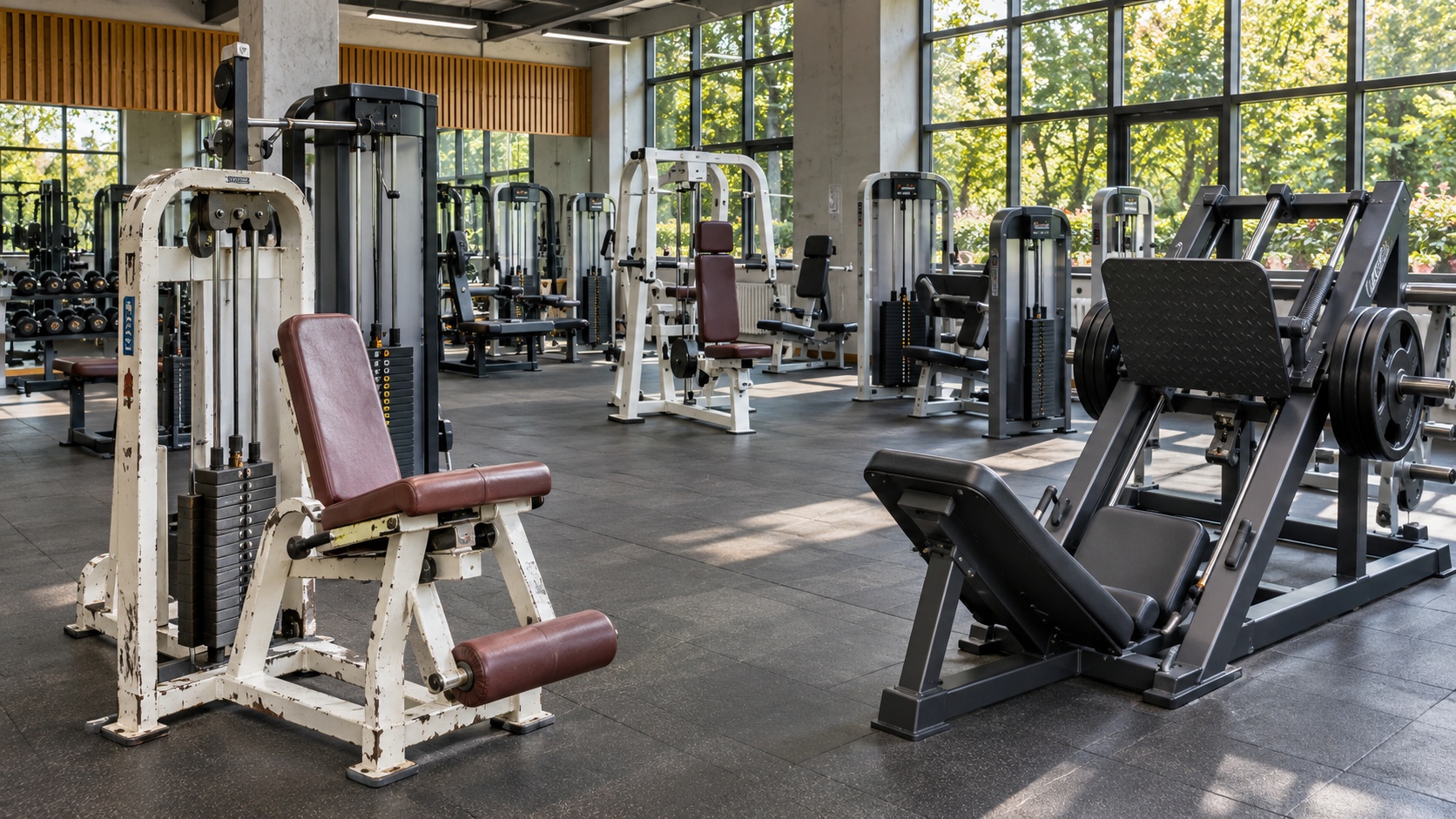
Renovating a weight room does not necessarily mean replacing all equipment with new machinery. For many gym owners, personal trainers, and procurement managers, an interesting solution consists of combining new machines and refurbished equipment, selecting each option based on function, intensity of use, and the actual condition of the product. The central point is understanding where this combination truly makes sense, without compromising safety, operational continuity, and the quality of the members' experience.
The search query renovate weight room new refurbished machines where sense mix expresses a concrete need: identifying a method to distribute the budget across different stations, preventing the initial price from becoming the sole decision-making criterion. A refurbished machine can represent an appropriate choice when its conditions are documented and costs are predictable. Conversely, new equipment may be preferable when specific characteristics, updated configurations, or support conditions better suited to the planned activity are needed.
To build a sustainable project, one must start from the actual use of the room, gather verifiable information on available equipment, and compare homogeneous scenarios. This guide proposes a technical and operational path to decide which machines to buy new, which to evaluate as refurbished, and how to organize controls, costs, and priorities without relying on presumed savings.
- The practical problem: renovating the weight room with new and refurbished machines
- Mapping stations, usage, and renovation priorities
- Documentation and checks on refurbished machines
- Where it makes sense to mix new and refurbished equipment
- Alternatives and edge cases to consider
- Comparing overall costs and purchase scenarios
- Application example for owners, PTs, and buyers
- Operational checklist and limits to be validated
- Planning investment and progressive renovation
The practical problem: renovating the weight room with new and refurbished machines
A professional weight room includes equipment with different functions, stress levels, and frequencies of use. Some stations are continuously occupied during peak hours, while others are used only for specific exercises. Applying the same purchasing strategy to all machines can generate an inefficient budget allocation. The decision should instead depend on the role each piece of equipment plays in the training schedule.
The first mistake to avoid is considering new and refurbished as automatically opposing categories in terms of quality. A new machine must still be evaluated for its characteristics, suitability for the intended use, and contractual conditions. A refurbished machine requires further checks on its initial condition, the work performed, and the availability of replacement parts. The commercial distinction alone does not prove which solution is more suitable.
A mixed project can work when each choice responds to an identifiable need. The manager should be able to explain why a certain station is purchased new and why another is selected as refurbished, indicating available data, checks performed, and aspects yet to be confirmed.
Distinguishing new, used, and refurbished
New equipment is normally offered without a previous cycle of use by other operators. Used products instead have an operational history that must be reconstructed as much as possible. The term refurbished can indicate control, restoration, or component replacement interventions, but it does not necessarily identify a uniform process among sellers. It is therefore essential to request a precise description of the work carried out.
Defining the objective before choosing the machines
Renovation can respond to different needs: replacing stations that are no longer adequate, expanding room capacity, improving space organization, or updating the training offering. Each objective modifies the selection criteria. If the main problem concerns waiting times, for example, it might be more useful to add a frequently requested station rather than replace a machine that is still functional for predominantly aesthetic reasons.
Mapping stations, usage, and renovation priorities
Before requesting quotes, it is advisable to build an inventory of the existing equipment. For each machine, it is useful to record the brand, model, serial number if any, acquisition year if known, position, observable condition, and history of available interventions. This survey makes it possible to distinguish between equipment to keep, equipment to subject to technical evaluation, and equipment for which replacement should be planned.
Frequency of use constitutes an important variable, but it should not be interpreted in isolation. A rarely used machine might be essential for certain training programs, while a high-demand station might require a different organization of access. The analysis should also consider the profile of the members, available supervision, and the variety of adjustments needed.
A simple system consists of assigning each station a motivated priority based on technical conditions, importance in the service, and consequences of a potential downtime. Evaluations must remain kept separate: a commercially important machine does not automatically become technically safe, just as a functioning machine is not necessarily consistent with the future organization of the room.
Analyzing usage during peak hours
Observing station occupancy across different time slots helps identify critical bottlenecks. The manager can note waiting times, frequency of adjustments, any user reports, and access difficulties. These data, collected over a representative period, offer a more reliable basis than occasional impressions and allow for assessing whether the renovation should prioritize capacity, versatility, or replacement.
Classifying priorities without confusing urgency and convenience
Stations can be divided into urgent interventions to be subjected to specialized verification, scheduled replacements, and possible expansions. When anomalies emerge that could affect safety, the equipment must be handled according to appropriate procedures and evaluated by competent personnel before any return to service. The price of an alternative must not influence the technical judgment on the suitability of the existing machine.
Documentation and checks on refurbished machines
The evaluation of used or refurbished fitness equipment requires information referring to the individual asset, not just the general reputation of the model. Two seemingly identical machines can present different conditions depending on previous use, maintenance received, installation environment, and restoration work. For this reason, commercial photographs and a brief description are not sufficient to qualify a professional purchase.
The documentation to request includes model identification, serial number when present, available manuals, provenance information, list of declared interventions, and conditions of sale. It is also advisable to check which components have been replaced, which have simply been checked, and which have not been subject to intervention. The seller's statements must be distinguished from the documentary evidence actually provided.
To explore available solutions, the buyer can consult the category dedicated to used and refurbished gym equipment, using any individual product sheets as a starting point to request specific information. Availability, conditions, work performed, and guarantees must be confirmed for each proposal, without automatically extending the characteristics of one product to others.
Checking wear-and-tear components
Checks may concern cables, pulleys, bearings, pins, guides, padding, upholstery, adjustment systems, and structural components, depending on the machine type. A distinction must be made between aesthetic appearance and functional condition. New upholstery does not prove that transmission systems have been checked, while a surface with signs of use does not necessarily indicate a structural problem. Technical checks must follow the manufacturer's instructions and involve qualified personnel when necessary.
Verifying actual warranty and assistance
The presence of a warranty must not be assumed based solely on the definition of refurbished. Before purchasing, one must read the applicable conditions, identify any exclusions, duration, responsible party, and procedures for requesting assistance. It is equally important to clarify the availability of spare parts and who will bear the costs of transport, labor, or intervention when not included. This information directly affects the predictability of subsequent management.
Where it makes sense to mix new and refurbished equipment
The choice of a weight room with new and refurbished machines should follow a logic based on stations rather than a predetermined percentage of products belonging to the two categories. There is no universally correct breakdown. The combination depends on the quality of available offers, the required characteristics, and the center's ability to manage maintenance and possible interruptions.
Stations with particularly intensive use deserve in-depth analysis of operational continuity. A new product may be preferable when it offers characteristics necessary for the project or documented support conditions that are more suitable. A refurbished machine can still be competitive if its condition is verifiable, critical components are evaluated, and the supplier clarifies the work performed. Frequency of use alone does not dictate a purchase category.
For complementary stations, used less frequently but important for expanding the variety of exercises, refurbished options can be compared with new ones. In this case too, cost-effectiveness must be demonstrated by considering transport, installation, technical adequacy, and reasonably foreseeable future costs.
High-rotation stations and core equipment
Leg presses, lat machines, pushing machines, and other core equipment in the programming can generate significant service disruptions when unavailable. The buyer should compare documented reliability, ease of maintenance, spare parts, and declared assistance times. If a refurbished proposal does not clarify these aspects, the uncertainty must be recorded in the comparison without automatically compensating for it with a lower price.
Specialized stations and service expansion
Machines dedicated to specific exercises can also be evaluated based on the actual demand of members. Before purchasing them, it is advisable to check dimensions, adjustments, ergonomics, and compatibility with the center's programming. A documented refurbished proposal can allow for considering configurations otherwise excluded from the budget, but the advantage remains a hypothesis until actual costs and conditions are compared.
Alternatives and edge cases to consider
The combination of new and refurbished is not always the best solution. In some projects, a predominantly new purchase can simplify supply organization, while in others a progressive renovation of existing machines may be more consistent with the available budget. Therefore, one must also compare the alternative of temporarily keeping certain stations, provided they are suitable for the intended use.
A delicate case concerns machines whose maintenance history cannot be reconstructed or whose model cannot be identified with sufficient precision. The absence of information does not automatically prove that the product is unusable, but it limits the buyer's ability to assess risks and costs. When necessary checks are not feasible or the seller does not provide adequate clarifications, it is reasonable to consider other proposals.
Another limit concerns equipment that requires modifications to adapt to the gym's spaces or services. Interventions not foreseen by the manufacturer can introduce technical criticalities and additional liabilities. Before hypothesizing adjustments, competent advice must be sought and applicable documentation verified.
Machines with incomplete documentation
When manuals, identifying data, or intervention information are missing, the economic comparison must highlight these gaps. It is useful to ask the seller which documents can be retrieved and whether an independent check can be organized. A particularly interesting quote does not replace the evidence needed to make a responsible decision.
Spaces, access, and installation constraints
A machine may look convenient on paper but be unsuitable for the premises. Dimensions, handling paths, floor load capacity, operating distances, and installation requirements must be checked before ordering. Even the arrangement of multiple new and refurbished pieces of equipment must allow for orderly room usage and comply with technical indications and applicable regulations.
Comparing overall costs and purchase scenarios
The total cost of ownership represents a more comprehensive criterion than simple selling price. For each proposal, one must consider purchase, transport, handling, installation, any initial interventions, scheduled maintenance, and non-included support costs. Some items will be known, others estimable, and still others impossible to quantify without further information. This distinction must remain visible in the comparison.
A practical method consists of preparing three scenarios: predominantly new renovation, mixed renovation, and predominantly refurbished renovation. Each scenario must meet the same functional requirements and include a comparable number of stations. Comparing a complete solution with a proposal that excludes installation or necessary components would produce a distorted result.
The evaluation can be developed over a time horizon defined by the manager, recording initial costs, recurring expenses, and foreseeable interventions. For uncertain items, it is preferable to use motivated intervals or request additional quotes rather than introducing arbitrary values. The cost of any machine downtime can be discussed as an operational risk, avoiding turning it into a certain economic loss without available data.
Building a homogeneous comparative table
For each machine, dedicated columns can be prepared for model, declared state, price, documents received, regeneration interventions, actual warranty, transport, installation, spare parts, and still-open checks. A separate column should indicate the source of each piece of information. In this way, the manager immediately distinguishes a confirmed contractual condition from a simple commercial statement.
Evaluating uncertainty with alternative scenarios
When maintenance costs are not known, the buyer can check how the decision would change in the presence of additional interventions. There is no need to invent failure probabilities: it is sufficient to identify which expenses could modify the ranking of offers and ask for information to reduce uncertainty. If a proposal remains interesting only assuming that no interventions will be necessary, this dependency must be made explicit.
Application example for owners, PTs, and buyers
Consider a gym that wants to update six stations: two lower-limb machines, two for the back, and two for pushing. The manager has an internally defined budget but has not yet gathered comparable offers. The objective is not to buy as many machines as possible, but to guarantee an endowment consistent with the proposed workouts and the facility's management capacity.
The first phase consists of classifying the six stations based on observed usage, the conditions of existing equipment, and the required characteristics. The buyer then identifies, for each function, at least one new alternative and one refurbished alternative when available. For each proposal, they collect data sheets, contractual conditions, status information, and accessory costs. Options lacking sufficient documentation remain pending.
The mixed solution could include some new stations and others refurbished, but the final distribution will depend on the results of the checks. If a refurbished machine presents complete documentation and conditions consistent with the intended use, it can enter the selection. If instead a new proposal offers essential characteristics that the refurbished alternative lacks, the comparison must acknowledge this functional difference.
Gym owner scenario
The owner focuses the analysis on service continuity, available investments, and renovation organization. They can schedule interventions in phases to limit simultaneously unavailable stations, agreeing on deliveries and installations with suppliers. The final choice should be accompanied by a cost estimate and a list of conditions to be confirmed before ordering.
Personal trainer and buyer scenario
The personal trainer primarily evaluates ergonomics, adjustments, and consistency with scheduled workouts, while the buyer explores documentation, economic conditions, and technical support. Comparing these perspectives avoids formally convenient purchases that are poorly suited to the service. For a PT studio with limited space, for example, the versatility of a station may outweigh the possibility of adding a specialized machine.
Operational checklist and limits to be validated
A refurbished machine verification checklist must allow transforming collected information into traceable decisions. Before approving a proposal, the manager should confirm intended use, required characteristics, product identification, available documentation, component status, interventions carried out, delivery conditions, and applicable warranty. Every unverified element must be flagged, not considered implicitly satisfied.
It is important to distinguish the checks that gym staff can perform from those requiring specialized skills. Inventory, quote comparison, verification of declared dimensions, and document collection can be organized internally. Evaluations of structural integrity, mechanical systems, safety devices, and technical suitability instead require qualified personnel and appropriate procedures.
Before installation, operational responsibilities must also be verified: who performs assembly, who checks correct operation, what documents are delivered, and how any anomalies will be handled. Commercial acceptance of the supply and technical verification of the equipment are distinct activities that must be coordinated.
Checks before order confirmation
Preliminary verification should include correspondence between the offer and the requested model, actual condition of the asset, list of included components, excluded costs, declared delivery times, and dispute management methods. For refurbished products, it is useful to request evidence of performed work and clarifications on non-replaced parts. Decisive information should be reported in the contractual documentation.
Checks upon receipt and maintenance plan
Upon delivery, the manager must verify the identification of the received equipment, record any visible damage, and organize necessary technical checks before commissioning. Subsequently, it is advisable to prepare an intervention log and follow applicable maintenance instructions. Correct document management facilitates activity planning and makes it easier to reconstruct any problems over time.
Planning investment and progressive renovation
The choice between new and refurbished machines should fit into an investment plan that considers not only immediate spending but also the gym's ability to keep stations operational in the subsequent period. An initially less expensive purchase is not automatically more sustainable if it requires unforeseen interventions or entails major limitations. Similarly, a higher price for new equipment does not alone prove a future economic advantage.
A progressive approach allows distributing purchases based on actual priorities. The manager can start from stations presenting documented criticalities or that most limit workout organization, postponing less urgent interventions. This planning still requires considering any additional costs linked to separate deliveries, subsequent installations, and possible price variations.
Before committing the budget, it is useful to prepare a decision sheet for each purchase, reporting the objective, considered alternatives, confirmed data, estimates, required technical checks, and reasoning for the choice. Such a document allows comparing proposals consistently and offers a reference for future evaluations without attributing a certainty to the decision that available data cannot guarantee.
The most solid criterion for mixing new and refurbished is therefore to assign to each station the solution satisfying technical and operational requirements with a sustainable and sufficiently documented overall cost. Requesting detailed quotes, comparing equivalent scenarios, and involving specialized skills when necessary allow transforming weight room renovation into a planned, verifiable investment consistent with the fitness center's real needs.
Comments (0)