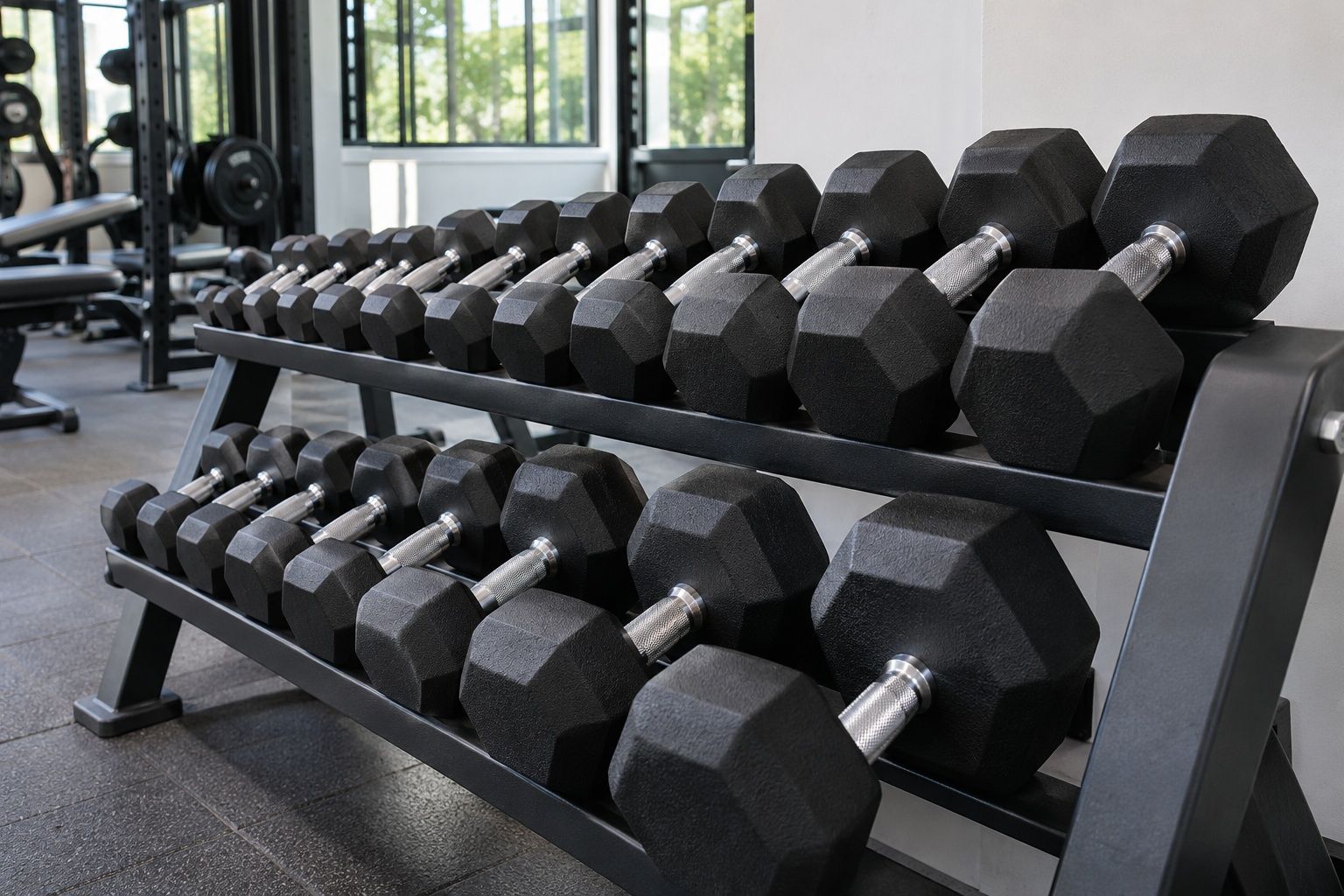
Black Friday represents an interesting opportunity for those who wish to expand their home gym equipment or improve the kit of a small personal training studio. When you already own some pairs of dumbbells, however, the problem is not simply finding new weights at a convenient price. The real challenge is understanding which loads are missing to make workouts more progressive, versatile, and consistent with the exercises practiced.
Research dedicated to gym dumbbell Black Friday can lead to evaluating complete sets, individual pairs, and different types of equipment. Before comparing offers, however, it is useful to analyze your own equipment. Buying 12 kg dumbbells when you already own 10 and 14 kg pairs can be a sensible choice for certain exercises, while adding another 10 kg pair might not offer any concrete advantage to those training alone.
In this guide, we will see how to build an inventory of available weights, identify truly useful load intervals, and define a list of priority purchases. The goal is not to own as many dumbbells as possible, but to organize a functional progression that is compatible with the available space and sustainable regarding the budget.
Analyze your dumbbell set before Black Friday
The first step consists of taking a snapshot of the current situation in your training area. Many enthusiasts purchase equipment at different times, often following immediate needs or commercial opportunities. The result can be a collection of dumbbells with loads distributed unevenly, some pairs used frequently and others almost always unused.
To complete a set effectively, one must distinguish between theoretical availability and actual usage. Owning five pairs does not necessarily mean having an adequate progression, just as having three well-selected pairs can be sufficient for numerous training programs. The evaluation must start from the exercises, not from the number of pieces present in the rack.
An accurate inventory also allows you to avoid duplicate purchases, especially when fixed dumbbells and adjustable load systems coexist in the same home gym. It is important to record the actual usable weight, the quantity available, and any operational limitations.
Record all available loads
To start, it is sufficient to create a table with four pieces of information: nominal weight of the dumbbell, number of pieces owned, type, and frequency of use. For example, a home gym might have two 6 kg dumbbells, two 10 kg, two 16 kg, and a single 20 kg dumbbell. This distribution immediately highlights some wide intervals and an asymmetrical availability in the heavier load.
It is fundamental to distinguish the weight of a single dumbbell from the total weight of the pair. Two 10 kg dumbbells constitute a total pair of 20 kg, but allow you to perform exercises with 10 kg per hand. This distinction avoids errors when comparing packaging, commercial descriptions, and product sheets.
Distinguish used loads from occasional ones
Next to each weight, it is useful to indicate the exercises in which it is actually employed. A 6 kg dumbbell might be fundamental for lateral raises and accessory work, while a 16 kg pair might be used primarily for rows and presses. Recording these uses allows you to understand which loads have a stable role in your programming.
A rarely used weight is not necessarily superfluous. It might be needed for specific exercises or for different periods of preparation. Before purchasing additional dumbbells, it is still advisable to verify if those already present meet real needs or represent purchases made without precise planning.
Identify gaps in weight progression
Once the inventory is completed, the next step consists of identifying the intervals that hinder a reasonable progression. Dumbbell weight progression does not necessarily require identical increments along the entire scale of loads. The useful distance between two pairs depends on the movement, the level of the user, and the possibility of modifying other training variables.
Going from 6 to 8 kg per hand means increasing the load by about 33%, while going from 20 to 22 kg entails a 10% increase. Even when the absolute difference is identical, the relative impact changes considerably. This aspect becomes particularly important in exercises performed with lighter loads.
There is, therefore, no universally correct sequence. A scale with 2 kg increments might be adequate for some movements, while others may benefit from smaller steps. The choice should derive from the observation of performance and the technical quality maintained during the sets.
Evaluate increments in relative terms
When comparing two weights, it is useful to calculate the percentage difference compared to the starting load. If an athlete uses 8 kg and the next available weight is 12 kg, the increase is 50%. If they instead use 24 kg and move to 28 kg, the increase is about 17%. This simple analysis helps to recognize potentially challenging intervals.
The percentage, however, does not determine the choice alone. The number of repetitions, control of movement, proximity to failure, and individual response also count. A relatively large increase might be manageable in one exercise but prove premature in another.
Recognize truly problematic weight jumps
An interval becomes a priority when it prevents you from increasing the load without compromising technique or forces you to excessively modify the program. For example, if presses are performed stably with 14 kg per hand and the direct jump to 20 kg is not yet manageable, an intermediate pair could offer greater flexibility.
Not all jumps need to be filled immediately. If an intermediate weight would not be used in current or foreseeable exercises, the purchase can be postponed. The main criterion remains the presence of an observable need, not the desire to obtain a perfect numerical sequence.
Choose loads based on the exercises practiced
The ideal composition of a set depends primarily on the type of training. A user who performs mainly isolation exercises will have different needs than one who uses dumbbells for presses, rows, lunges, and multi-joint movements. The same pair can be adequate for one exercise and insufficient or excessive for another.
For this reason, before buying new weights, it is advisable to select five or six exercises representative of your programming. For each, you need to note the load currently used, the expected repetition range, and the first higher available weight. Any distance between these values becomes a concrete element of evaluation.
This methodology is also particularly useful for personal trainers who manage small studios. In the presence of clients with different characteristics, the availability of intermediate loads can facilitate the adaptation of sessions without requiring an excessively large supply.
Isolation exercises and small increments
Lateral raises, curls, and other accessory exercises are often performed with lower loads than the main multi-joint movements. In these cases, even apparently modest differences can represent significant percentage increases. A jump from 4 to 6 kg, for example, corresponds to a 50% increase per hand.
When an exercise requires greater gradualness, it may be useful to evaluate intermediate steps, provided they are available in the chosen range. Before proceeding, it is appropriate to verify if the improvement can be managed temporarily through repetitions, control of movement, and series organization, without forcing premature increments.
Multi-joint exercises and higher loads
Bench presses, rows, lunges, and some variants of dumbbell squats can require significantly higher loads. In these exercises, the main requirement may be to expand the upper part of the scale or insert a pair between two weights already owned.
An athlete who uses 18 kg in presses and 26 kg in rows does not necessarily have to buy all the pairs between these values. It is more effective to evaluate the two movements separately, identifying the next realistic increment for each. In this way, every purchase is associated with a precise function.
Build a personalized progression table
An operational table allows you to transform observations into a verifiable purchase list. The method consists of linking each exercise to the load used and the subsequent increment that you wish to evaluate. In this way, Black Friday becomes a time to carry out a pre-defined plan, rather than choosing products exclusively based on the discount.
The following table presents an illustrative scenario related to a home gym with 6, 10, 16, and 20 kg pairs. The values do not constitute individual training instructions, but show how to identify possible intervals to delve into.
| Exercise |
Load used per hand |
First higher load owned |
Increment to evaluate |
| Lateral raises |
6 kg |
10 kg |
8 kg |
| Dumbbell curl |
10 kg |
16 kg |
12 kg |
| Bench press |
16 kg |
20 kg |
18 kg |
| Single-arm row |
20 kg |
None |
22 kg, if necessary |
| Dumbbell lunges |
10 kg |
16 kg |
12 or 14 kg to verify |
In this example, possible different needs emerge. The 12 kg pair could be useful in several exercises, while the 8 kg one would have a more specific application. The 22 kg load would instead represent an expansion of maximum equipment, to be considered only when performance and programming justify it.
Fill out your own table without choosing arbitrary weights
To use the model, it is sufficient to replace the illustrative exercises and values with the actual ones. A complete version should also include the number of repetitions, weekly frequency, and an indication of technical quality. This information allows you to distinguish a truly imminent increment from a still distant goal.
It is useful to update the table after a few weeks of training, rather than relying on a single particularly positive or negative session. An intermediate weight should respond to a need sufficiently stable to justify the investment.
Assign priority to missing loads
Once the possible purchases have been identified, they can be classified as priority, prospectively useful, or deferrable. A load usable in three frequent exercises can have a higher priority than a weight intended for an occasional movement. The expected frequency of use therefore becomes an economic criterion as well as a technical one.
A simple system consists of assigning each candidate pair a score based on the number of exercises involved, training frequency, and difficulty of the current jump. There is no need to obtain a scientific formula: the goal is to make the reasons for the choice explicit and avoid impulsive purchases.
Check the available space in the home gym
Before completing the shopping list, it is necessary to consider an often-underestimated constraint: physical space. A new pair of dumbbells must be able to be stored in an orderly manner and reached without hindering movements. In home gyms located in garages, multifunctional rooms, or small environments, this aspect can significantly influence the choice.
It is not enough to know the number of pairs to add. Dumbbells of different weight can have different bulk, and some types have specific geometries. It is therefore necessary to verify length, diameter, or overall dimensions reported in the product sheets, without assuming that all models occupy the same space.
The orderly management of equipment also contributes to the practicality of the sessions. When every pair has a defined position, it becomes easier to move from one exercise to another and keep the training area free.
Measure the storage area
To evaluate the available capacity, it is advisable to measure the width, depth, and height of the area dedicated to weights. One must also consider the space necessary to pick up and store the dumbbells without interfering with benches, racks, or other equipment present in the room.
In the case of an existing rack, it is necessary to check the dimensions of the slots and the capacity declared by the manufacturer. Not all structures are compatible with every shape of dumbbell, and the total weight of the new pairs might require a check of the load capacity.
Evaluate an adequate dumbbell rack
A dumbbell rack can make equipment composed of several pairs tidier, but it should not be purchased automatically. If the collection is still limited, a storage solution already available might be sufficient, provided it is stable and suitable for the equipment.
For a micro-studio with multiple users, however, a properly sized rack can facilitate the organization of sessions. The choice must consider compatibility, bulk, accessibility, and maximum load, in addition to the possibility of adding further pairs in the future.
Select the dumbbell types suitable for the identified gaps
After identifying the missing loads and checking the available space, it is possible to move on to the selection of products. The choice should not start from an abstract preference for a certain type, but from the function that the new weight must perform within the existing set.
Solutions to consider include rubber-coated hexagonal dumbbells, round dumbbells, and, in specific situations, dumbbells with adjustable load. Each family can respond to different needs in terms of practicality, organization, and compatibility with the equipment already present.
To explore the available alternatives, you can consult the Donatif gym dumbbells category, comparing the nominal weights and characteristics of the individual items. The availability of steps, configurations, and any promotions must be verified directly on the product sheets at the time of purchase.
When to evaluate hexagonal and round dumbbells
Rubber-coated hexagonal dumbbells represent a solution to consider when you want to add fixed pairs and keep every load immediately available. The geometry of the ends limits the tendency to roll on flat surfaces, a useful feature during breaks and in the organization of the work area. It is still necessary to use appropriate storage methods.
Round dumbbells can be evaluated when you want to maintain uniformity with an already existing setup or when the specific characteristics of the model are suitable for the environment. The choice should consider grip, coating, dimensions, and compatibility with any supports, without automatically attributing superior performance to one shape over another.
When to integrate an adjustable dumbbell
In some cases, an adjustable system can help cover different intervals without adding numerous fixed pairs. This possibility can be interesting when space is limited or when some loads are used only occasionally. However, it is necessary to verify which increments are actually selectable, the maximum weight, and the conditions of use provided by the manufacturer.
If the main goal is to understand the technical differences between modular and snap-adjustable systems, the Donatif deep-dive dedicated to this choice is also available: https://www.donatif.com/it/blog/notizie-generali/manubri-componibili-vs-regolabili-a-scatto-quale-scegliere-per-allenarti-meglio. In this guide, however, the central point remains the coverage of missing loads, regardless of the system used.
Plan the budget during Black Friday
Once the list of priority weights is defined, Black Friday can become an opportunity to compare economic conditions and availability. The advantage of early planning consists in already knowing which items to look for, avoiding changing your goal just because a large set is offered at an apparently interesting price.
The price of a pack is not enough to establish the convenience. It is necessary to check how many dumbbells are included, what nominal weight is indicated, if the price refers to a single piece or a pair, and what shipping costs affect the total. The comparison must take place between equivalent configurations.
An economically valid purchase should also be consistent with the intended use. A pair purchased at a lower price but destined to remain unused still represents an inefficient expenditure. On the contrary, an intermediate load used regularly can offer concrete utility even without a particularly high discount.
Compare the actual cost per pair
To avoid misinterpretations, it is useful to report the final price of each candidate pair in a table. When an item is sold individually, the cost to obtain two dumbbells must be calculated considering the necessary quantity. If, on the other hand, the product is a set, you must verify exactly which weights and how many pieces are included.
It is also appropriate to check any delivery conditions, indicative times, and product characteristics. Offers can change and availability should not be considered guaranteed before order confirmation. Commercial information must therefore be verified at the time of the decision.
Avoid the full-set effect
A set composed of many pairs can convey an impression of greater completeness, but the number of pieces does not automatically represent an indicator of utility. If four of the included pairs replicate loads already owned, the economic advantage could be lower than that suggested by the promotional price.
Before choosing a set, it is advisable to compare the total cost with that of just the missing pairs. You must also evaluate the required space and the probability of use of each weight. A complete assortment can be appropriate for a studio with different clients, while for an individual home gym a more contained selection can prove more consistent.
Adapt the set to home gyms and micro-studios
The same scale of weights can have a different value depending on the context. In an individual home gym, the equipment is generally selected based on one person or a small number of users. In a micro-studio, however, dumbbells must often respond to different needs and support sessions organized with multiple clients.
For those who train at home, the main criterion consists of maintaining a progression consistent with the usual exercises and expected goals. For a personal trainer, it becomes important to also consider the variability of experience levels, frequency of use, and the potential need to have multiple people engaged simultaneously.
These differences influence both the loads to buy and the number of pieces needed. An additional pair of the same weight might be redundant in an individual home gym, but useful in a studio where two clients need to use the same load simultaneously.
Practical scenario of an advanced home gym
Consider an athlete who owns 8, 12, 16, and 24 kg pairs. During training, they frequently use the 12 kg for some accessory exercises, the 16 kg for presses, and the 24 kg for rows. The interval between 16 and 24 kg appears wide, but it does not necessarily mean that all intermediate pairs are indispensable.
If the problem mainly concerns presses, it might be useful to evaluate an 18 or 20 kg pair, depending on actual performance. If, on the other hand, rows are performed correctly with 24 kg and no imminent increase is expected, there is no automatic reason to buy higher loads. The list is built based on the needs of the movements, not on the visual continuity of the scale.
Practical scenario of a small personal training studio
Imagine a studio with 4, 6, 10, 14, and 20 kg pairs, frequented by clients with different experience levels. In this case, the interval between 6 and 10 kg could limit some progressions, while the one between 14 and 20 kg could influence the selection of loads in multi-joint movements.
The professional can analyze the most frequent programs and verify which weights are requested during sessions. An 8 kg pair could offer greater flexibility to different clients, while an additional 10 kg pair could be justified only if two people need it at the same time. Planning therefore considers both progression and service organization.
Verify specifications and packaging before ordering
The final phase of selection requires an accurate check of commercial and technical information. Even when the desired weight has been identified correctly, it is possible to make mistakes by purchasing an insufficient quantity, choosing a model incompatible with the rack, or incorrectly interpreting the composition of a set.
Each item should be evaluated through its relative product sheet. The most important information includes nominal weight, quantity included, grip characteristics, dimensions, materials, and manufacturer instructions. When a detail is not explicitly available, it is preferable to request confirmation before proceeding.
This check assumes particular importance during promotional campaigns, when similar products can be presented with different packaging. The comparison must always refer to the item actually purchasable and not to an assumed configuration.
Check SKU, quantity, and composition
The product identification code, often indicated as SKU, helps distinguish apparently similar variants. Two items of the same family can differ by weight, coating, or quantity included. Noting the code of the selected variant reduces the risk of confusion when comparing multiple offers.
Before confirming the cart, it is useful to verify that each desired load is present in the correct quantity. If the goal is to buy an 18 kg pair, you need two 18 kg dumbbells, unless the chosen package already includes both. Even the total weights declared for any sets must be interpreted according to the seller's description.
Check compatibility and actual availability
Compatibility mainly concerns dimensions, storage systems, and conditions of use. A new dumbbell could have a different footprint compared to items already owned, even when it belongs to the same weight range. For this reason, it is useful to compare the declared measures with the actually available space.
The availability of individual steps must be checked at the time of purchase, without assuming that every weight in the range is always orderable. If a priority pair is not available, it is preferable to re-evaluate alternatives rather than automatically replacing it with a load that does not meet the same need.
Invest in the loads that truly improve your equipment
Completing a dumbbell set means building an outfit consistent with exercises, frequency of use, and progression possibilities. The investment should therefore start from an updated inventory, continue with the identification of problematic jumps, and arrive at a short list of truly useful loads. This process allows you to evaluate Black Friday opportunities with greater awareness.
For a home gym, the priority might be a single intermediate pair capable of making a load transition more manageable. For a small studio, on the other hand, it might be more useful to distribute the budget among weights frequently requested by different clients or to improve the organization of existing equipment. In both cases, the quantity of dumbbells purchased counts less than the function each item will perform during sessions.
Before allocating the budget to new weights, it is advisable to compare three elements: the progression problem you intend to solve, the expected frequency of use, and the total cost of the purchase. If a pair does not clearly meet any need, it may be appropriate to postpone it. If, on the other hand, it allows you to fill an effectively limiting interval, it becomes a concrete candidate to evaluate during promotions.
A gradual approach also allows you to maintain flexibility for future needs. Training programs can change, as can the loads used and the space intended for equipment. Buying in a targeted manner allows you to preserve resources for subsequent expansions, avoiding immobilizing budget in weights that could remain unused.
The most useful decision-making criterion consists of associating each purchase with an exercise, a load interval, and a verifiable need. Once these priorities are established, the comparison between models, prices, and availability becomes simpler. Black Friday can thus represent an opportunity to concretely improve your training area, without transforming the desire for a complete set into an expense lacking a precise function.


 Budgets
 Dumbers
 Discs
 Benches
 Racks and Rigs
 Weights Holders
 Isotonic machines
 Calisthenics
 Cardio
 Kettlebells
 Flooring
 Gym Set
 Accessories
 Combat
 ARTI MARZIALI
 CONTAINER GYM
 Tug-Of-War
 Used Gym Equipment
 PILATES MACCHINARI
 GINNASTICA ARTISTICA
 CAMPI DA PADEL
 Prodotti in Pronta Consegna
 Informazioni
 IRONMAN
 Gift Card