
Trolley
You have no items in your shopping cart

 Budgets
 Dumbers
 Discs
Discs
 Benches
 Racks and Rigs
 Weights Holders
 Isotonic machines
 Calisthenics
 Cardio
 Kettlebells
 Flooring
 Gym Set
 Accessories
 Combat
 ARTI MARZIALI
 CONTAINER GYM
 Tug-Of-War
 Used Gym Equipment
 PILATES MACCHINARI
 GINNASTICA ARTISTICA
 CAMPI DA PADEL
 Prodotti in Pronta Consegna
 Informazioni
 IRONMAN
 Gift Card
- Donatif
- Sports products
- 0 I like it
- 1877 Views
- 0 comments
- stress reduction, improved self-esteem, physical and mental well-being, gym training
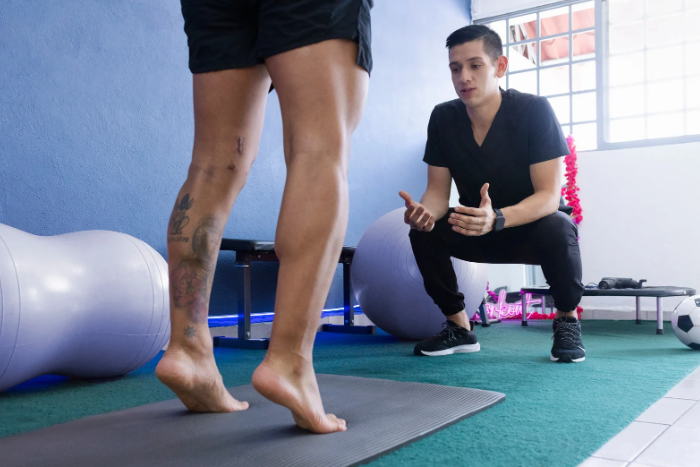
READING TIME: 5 MINUTES ➤➤
Rehabilitation Cable Machine: The Wildcard for Functional Recovery
Rehabilitation cable machine is an expression that effectively describes the role of a cable station when training goes beyond traditional strength work. In a personal training studio or a micro-gym, this equipment serves a precise purpose: it allows for controlled, progressive, and adaptable exercises suitable for individuals with different functional levels. It is not just about “doing cable exercises,” but about managing the transition between reactivation, coordination, and strengthening.
Its value becomes even more evident when the professional needs to work on both upper limbs and lower limbs without multiplying the number of machines in the space. The ability to modulate load and work along guided yet flexible movement paths makes the station useful in many contexts. This is why the cable machine is often considered a true wildcard: not because it does everything, but because it fits into multiple protocols with a coherent logic.
Why a rehabilitation cable station truly enhances technical work
A single machine for multiple pathways
Rehabilitation cable station refers to equipment that enables work along variable movement paths with adjustable resistance. In practice, professionals can modify the height of the pulley, type of handle, body position, and intensity of effort without changing stations. This is especially useful when alternating between reactivation sessions, non-medical post-injury work, and muscle reconditioning phases with different objectives.
Versatility is not a commercial detail but an operational advantage. Someone needing to restore scapular control requires different settings than someone working on hip or knee stability. With a well-designed cable machine, professionals can organize open or semi-closed chain exercises, single-leg work, assisted pulls, and diagonal movement patterns. This allows the equipment to integrate seamlessly into personalized programs without interrupting workflow.
From reactivation to progressive strengthening
Many effective protocols do not begin with high loads. Instead, they start with restoring movement quality, body awareness, and tolerance to resistance. The cable machine used in a functional recovery context supports exactly this transition. First comes control, then tension is introduced, and finally a more stable and functional level of strength is developed for daily or sport-specific movements.
For personal trainers or micro-gym owners, this means being able to support clients who need more than a standard isotonic machine. The equipment becomes a bridge between different training phases: active mobility recovery, selective strengthening, controlled resistance, and a return to more complex movement patterns. This continuity is what makes the machine truly strategic.
How the cable machine works for upper and lower limbs
Movement control for shoulder, elbow, and trunk
For the upper limbs, the cable station enables highly precise work on the shoulder, elbow, and scapular region. Adjusting the pulley height helps set rotations, pushes, adductions, and pulls at different angles, adapting the movement to the individual’s tolerance. This makes the equipment particularly useful when reintroducing movement gradually, avoiding abrupt transitions from inactivity to traditional free-weight training.
Another advantage involves the trunk. Many cable exercises do not isolate a single segment but require postural control, stabilization, and coordination across multiple areas. Work on scapulae and core, for example, benefits from cable resistance because the movement remains clear and easy to correct. This is why the machine is widely used in programs aimed at rebuilding clean movement mechanics before increasing intensity or speed.
Progressions for hip, knee, and ankle
For the lower limbs, the cable machine allows exercises that support the recovery of the hip, knee, and ankle through a progressive approach. The cable enables work on extension, flexion, abduction, lateral control, and stability in stance, maintaining continuous yet adjustable resistance. In a micro-gym, this is particularly valuable, as it allows progression from simple exercises to more complex patterns without switching equipment.
This continuity becomes even more relevant when protocols need to be tailored to the individual. Some clients tolerate controlled unloading well, while others require supports, intermediate steps, or assisted traction. A rigid isotonic machine may become limiting, whereas cables offer more functional variations. The station thus supports both movement recovery and preparatory strengthening.
Weight modularity and cable fluidity in personalized protocols
Why adjustable load improves work quality
Weight modularity means being able to build realistic progressions without excessive jumps between steps. In functional recovery protocols, this makes a tangible difference because load tolerance does not increase linearly or equally for everyone. A system that allows manageable increments helps professionals better dose training, reducing the risk of advancing too quickly.
Operationally, clear progression also improves communication with clients. When load increases are consistent and measurable, the path becomes more understandable and structured. In this sense, the equipment is not just mechanical support but also a methodological tool. Professionals know how important it is to demonstrate tangible progress, especially during intermediate recovery phases.
Cable fluidity and resistance continuity
Cable fluidity directly affects movement perception. When the motion is smooth, resistance follows the movement without interruptions that could disrupt motor control. In functional recovery, this is essential because the individual must focus on trajectory, rhythm, and stability—not compensate for machine inconsistencies. Poor cable fluidity compromises movement quality and feedback reliability.
For a brand like Donatif, emphasizing smooth motion means speaking a technical, not decorative, language. Professionals evaluating rehabilitation equipment focus on these aspects: mechanical response, tension continuity, and perceived precision. These elements reinforce authority, demonstrating attention to the machine’s real function. Reliability, in this case, is proven through daily use rather than marketing claims.
Integrating the cable machine into micro-gyms and PT studios
Operational versatility and space optimization
Micro-gym management always balances two factors: service effectiveness and space efficiency. Rehabilitation gym equipment must be useful in multiple scenarios, otherwise it risks occupying valuable space with limited application. The cable machine meets this need by supporting individual sessions, assisted technical work, selective strengthening, and transition to more athletic exercises, all within a more rational footprint.
This also has practical implications for daily organization. A single station can be used across various training programs, reducing downtime and unnecessary transitions. For personal trainers, this means smoother sessions; for owners, better equipment utilization. The equipment effect here is not just perceived completeness, but the real ability to offer more services with one versatile solution.
A tool that strengthens professional positioning
When clients enter a studio and see a cable station designed for functional recovery, they immediately perceive a different level of professionalism. The space communicates competence, attention to progression, and the ability to adapt training to individual needs. In the MOFU stage, this is crucial: clients are evaluating whether to trust a professional or a facility capable of delivering structured, credible support.
In this sense, the machine impacts not only technical execution but also reputation. Versatile, reliable equipment integrated into training pathways strengthens the studio’s positioning. There is no need for exaggeration. Demonstrating structured sessions with clear progressions and coherent goals is enough. This is how the machine shifts from being an accessory to becoming part of the professional identity.
When the machine becomes part of a working method
Designing progressive sessions with functional logic
A machine becomes truly valuable when it fits into a clear working system. With a cable station, this means designing sessions that start from the client’s current level and introduce variables progressively: angle, range of motion, stability demands, speed, and load. Progression does not rely on a single factor but on how the professional uses the rehabilitation cable station to build continuity between motor control and strength.
This approach is particularly suitable for personal trainers and micro-gym owners aiming to differentiate through technical service quality. The goal is not to medicalize training but to make it more precise and gradual. Clients returning after inactivity or dealing with residual limitations benefit from a machine that supports movement and from a professional capable of recognizing the right moment to increase intensity.
A technical support aligned with a complete service
Rehabilitation cable machine is not a trendy label but a useful synthesis describing equipment capable of addressing multiple needs with order and consistency. This is why it stands out as a true wildcard in functional recovery for both upper and lower limbs. It offers adaptability, progression, and continuity. When combined with smooth cable motion and modular weights, the station becomes a central asset in any training space.
For professionals managing a structured environment, this choice goes beyond individual exercises. It means introducing equipment that supports personalized protocols, enhances perceived service quality, and expands operational possibilities without dispersion. In a context like Donatif, where modularity, reliability, and functional logic matter, the cable machine represents a credible technical solution for precise functional recovery work.
Comments (0)