
Trolley
You have no items in your shopping cart

 Budgets
 Dumbers
 Discs
Discs
 Benches
 Racks and Rigs
 Weights Holders
 Isotonic machines
 Calisthenics
 Cardio
 Kettlebells
 Flooring
 Gym Set
 Accessories
 Combat
 ARTI MARZIALI
 CONTAINER GYM
 Tug-Of-War
 Used Gym Equipment
 PILATES MACCHINARI
 GINNASTICA ARTISTICA
 CAMPI DA PADEL
 Prodotti in Pronta Consegna
 Informazioni
 IRONMAN
 Gift Card
- Donatif
- Sports products
- 0 I like it
- 1660 Views
- 0 comments
- stress reduction, improved self-esteem, physical and mental well-being, gym training
READING TIME: 5 MINUTES ➤➤
Maintenance of the Compact Elliptical: Make It Last a Lifetime
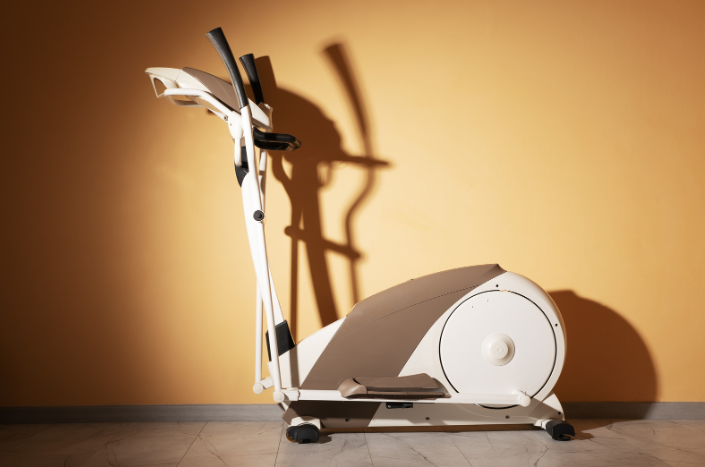
A compact elliptical is designed to fit into domestic environments where every centimeter matters. This feature, often decisive during purchase, results in closer proximity between surfaces, joints, and mechanical components. In a home gym, a dedicated room, or a living area adapted for training, dust, micro-residues, and humidity disperse less and tend to settle where movement is continuous.
Elliptical maintenance at home does not require complex actions, but it does require consistency. The goal is not to intervene only when noise or friction appears, but to build a simple routine that preserves smoothness, silence, and stability. For those who choose a well-built product, regular care becomes the most effective way to protect a technical and aesthetic investment over time.
Why compact models require more daily attention
Close components, dust, and friction: what changes at home
In a compact model, the reduced distance between casings, pedals, arms, and pivot points increases the likelihood of dirt accumulating in less visible areas. It’s not just surface dust. When fine residues settle near guides, joints, or screws, the movement may lose the smooth feel expected from a well-maintained cardio machine. For this reason, cleaning cardio equipment should be considered part of usage, not an optional step.
Placement in the home has a strong impact. An elliptical positioned near windows, fabrics, carpets, or poorly ventilated walls tends to collect more airborne particles. Sweat, if neglected, also leaves traces that over time affect handles, covers, and hardware. In a compact machine, these effects concentrate more quickly. Consistent but simple care reduces the risk of a silent, stable machine starting to show signs of mechanical neglect.
Maintenance as protection of long-term value
Choosing quality equipment means investing in expected durability, not just functionality. The lifespan of a home elliptical also depends on preventing minor wear from turning into mechanical play, abnormal friction, or deteriorated surfaces. Delayed intervention often leads to higher costs, not only in servicing but also in everyday comfort.
The key point is practical. A well-maintained machine retains its responsiveness, smooth motion, and perceived reliability during workouts. In a Donatif context, where Italian craftsmanship and build quality are central, routine maintenance is not about fixing weaknesses but about preserving a level of excellence that deserves continuity and care.
How to clean a compact elliptical without neglecting critical areas
Surfaces to clean regularly and the right method
Routine cleaning should begin with the most exposed areas: handles, console, pedals, and outer covers. A soft, slightly damp cloth is usually enough to remove dust and usage marks without damaging finishes. Cleaning should be done carefully, avoiding aggressive detergents that may leave residues or dull plastic and coated materials.
A good habit is to always dry surfaces afterward, especially where sweat tends to linger. This helps limit moisture on screws and joints. The most effective elliptical maintenance at home is balanced: minimal products, proper tools, and consistency. The goal is not to polish the machine but to prevent dirt and moisture from becoming mechanical issues.
Hidden areas where dirt accumulates more easily
In compact ellipticals, it is important to pay attention to less obvious areas: the inner side of the pedals, the base near support points, joints protected by covers, and spaces around moving arms. Dust tends to get trapped here more easily. It may not be immediately visible, but over time it affects movement quality and may cause subtle noises or friction.
A deeper clean of these areas does not require complex disassembly. Often, a dry cloth, a soft brush, or a delicate tool that reaches narrow spaces is enough. The correct approach is to remove residues, not push them deeper. In compact models, attention to hidden zones is just as important as visible surfaces, because this is where real prevention begins.
Elliptical lubrication: when it’s really needed and how to do it
Signs that indicate reduced smoothness
Lubrication should not be treated as an automatic action performed without evaluation. It is better to first observe the machine’s signals. Reduced smoothness, a dragging sensation, recurring squeaks, or uneven motion during use are signs that should not be ignored. In such cases, a careful check helps determine whether the issue comes from dirt, dryness, or the need for adjustment.
Noise does not always mean a lack of lubricant, but it often precedes or accompanies it. For this reason, a proper elliptical lubrication guide starts with listening and observation. Acting too late allows friction to affect components over time, while acting too early or incorrectly may create unnecessary residue.
How to use the right lubricant without creating residue or mistakes
When choosing an elliptical lubricant, it is important to stay consistent with the machine type and manufacturer recommendations. Using generic or overly dense products can attract dust and worsen the situation. In compact models, where working space is limited, excess product is almost always counterproductive.
The correct approach is precise: clean the area first, apply only what is needed, and then check movement quality. There is no need to chase an immediate dramatic effect. What matters is stable smoothness without visible buildup or greasy zones. Proper maintenance protects both functionality and appearance, preserving the feeling of a precise, well-maintained machine.
Periodic checks to prevent wear and avoid major servicing
Simple checks on support, tightening, and stability
Alongside cleaning and lubrication, a third habit plays a key role: periodic stability checks. A compact elliptical performs best when it remains properly positioned, aligned, and free of micro-movements in high-stress connection points. A quick visual inspection of the base, pedals, and accessible bolts helps detect early signs of imbalance.
These checks are not invasive. They confirm that the machine maintains its natural setup after weeks or months of use. If vibrations increase, if a pedal responds differently, or if the machine feels less stable on the floor, early intervention is recommended. Prevention, once again, is more effective than late correction.
When technical support helps preserve build quality
There are situations where routine maintenance is not enough, and recognizing them early is part of proper care. Persistent noise, unresolved changes in smoothness, or doubts about a specific mechanical point deserve attention from a reliable technical reference. Donatif support becomes relevant at this stage—not as a last resort, but as a natural extension of a serious post-purchase relationship.
For a brand focused on design, selected components, and service continuity, support is not separate from the product. It is part of its real lifespan. Access to correct guidance, compatible parts, and appropriate checks helps preserve the machine’s technical identity, avoiding improvised solutions that may increase wear over time.
A simple routine to preserve comfort, silence, and performance
Consistent small actions that prevent bigger interventions
The most effective routine is not the longest, but the most repeatable. Cleaning surfaces after use, periodically checking hidden areas, observing changes in smoothness, and managing lubrication carefully are simple yet highly effective actions. In a home environment, where the machine coexists with dust, fabrics, and air variations, consistency makes a real difference.
Most economic loss does not come from a single event but from accumulated small neglects. This is where the concept of caring for your equipment becomes concrete. A neglected machine loses perceived quality long before it actually breaks. A well-maintained one, instead, continues to provide stability, silence, and confidence in daily use.
The value of long-term care for well-designed equipment
Making a compact elliptical last does not mean treating it with excessive caution, but giving it continuity. Build quality creates a strong foundation, but routine maintenance turns that quality into a lasting experience. When cleaning, observation, and simple checks become part of regular use, the machine maintains its technical balance and presence in the training space for longer.
Over time, this approach protects not only the machine but also the logic behind its purchase: saving space, performing well, and remaining reliable. It is the most consistent way to preserve the excellence of a compact elliptical, without waiting for problems before taking action. Durability, in the end, almost always comes from a sequence of simple actions done at the right time.
Comments (0)