
Trolley
You have no items in your shopping cart

 Budgets
 Dumbers
 Discs
Discs
 Benches
 Racks and Rigs
 Weights Holders
 Isotonic machines
 Calisthenics
 Cardio
 Kettlebells
 Flooring
 Gym Set
 Accessories
 Combat
 ARTI MARZIALI
 CONTAINER GYM
 Tug-Of-War
 Used Gym Equipment
 PILATES MACCHINARI
 GINNASTICA ARTISTICA
 CAMPI DA PADEL
 Prodotti in Pronta Consegna
 Informazioni
 IRONMAN
 Gift Card
- Donatif
- Sports products
- 0 I like it
- 1301 Views
- 0 comments
- stress reduction, improved self-esteem, physical and mental well-being, gym training
READING TIME: 5 MINUTES ➤➤
Rehabilitation Parallel Bars Guide: How to Choose the Ideal Model
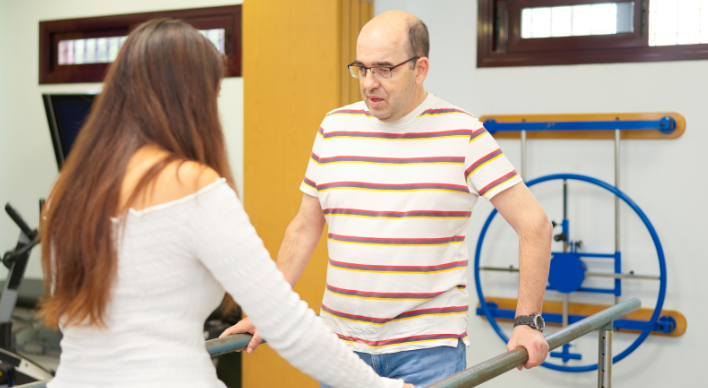
When evaluating the purchase of parallel bars for rehabilitation gyms, the first mistake is to consider them as a secondary accessory. In reality, in activities focused on gait recovery and stability training, this equipment directly impacts both the user’s experience and the professional’s precision. A structure that is not stable or not adaptable affects movement fluidity, reduces the perception of safety, and makes it harder to tailor the work to different functional needs.
For a personal trainer, a micro-gym owner, or a facility integrating motor recovery programs, the choice goes beyond price. What truly matters is whether the selected model offers structural solidity, reliable adjustments, consistent usability, and construction suited for repeated use. In this context, the concept of Made in Italy and design robustness becomes tangible: not as a stylistic element, but as a real parameter to distinguish a temporary purchase from an investment that maintains performance over time.
Safety and stability: the first criteria to evaluate
Why structural base impacts gait recovery
Within gait training equipment, stability is not an optional feature. It is the foundation that allows users to transfer weight gradually, maintain trajectory, and move with less uncertainty. A well-designed parallel bar must provide an immediate sense of support, without lateral oscillations, structural flex, or micro-movements that undermine user confidence. This becomes even more critical when individuals are recovering compromised motor patterns or experiencing instability during walking.
From an operational standpoint, a stable structure also enhances the professional’s work. Trainers and facility managers can focus on movement progression instead of compensating for equipment limitations. This is why in physiotherapy parallel bars and professional models, stability should be considered a factor of methodological precision. A reliable base reduces unnecessary variables, improves repeatability, and creates an environment where users perceive order, control, and safety.
Materials, finishes, and construction details that make the difference
When analyzing materials, it is essential to go beyond basic product descriptions. The quality of a parallel bar is reflected in the type of steel used, the consistency of welds, the thickness of the tubing, and the quality of surface finishes. A professional structure must withstand frequent use, repeated loads, and continuous contact without losing rigidity. Uniform surfaces and clean joints are also clear indicators of a product designed for long-term durability.
Finishes also influence maintenance and perceived reliability. High-quality coatings, well-designed supports, and precisely assembled components help preserve both functionality and appearance over time. In a professional setting, these elements are not secondary: a robust product communicates technical care and reduces the risk of premature wear. For this reason, those looking for adjustable parallel bars for rehabilitation should evaluate the product as a system of construction details, not just as a pair of support rails.
Height adjustment and operational adaptability
When adjustable parallel bars improve professional performance
Height adjustment is one of the most relevant criteria when choosing the ideal model. In real-world contexts, users differ in height, autonomy, and recovery goals. A fixed structure forces constant compromises, while a solution with adjustable height allows the work to be tailored to each stage of the rehabilitation process. This results in greater precision in exercise delivery and more efficient space management.
For facilities working with diverse clients, adaptability also means operational continuity. Rehabilitation parallel bars are not used once but become part of daily routines with varying needs throughout the day. Reliable adjustment systems allow quick transitions between setups without complexity or downtime. This is where professional products stand out: they do not just promise versatility, but make it truly functional in intensive, repeated use.
Ergonomics, adjustment fluidity, and session continuity
Good adjustment is not only about offering multiple height options. It depends on how the system behaves during use. Changes must be intuitive, stable once set, and free from mechanical play that could compromise safety perception. Ergonomics also plays a key role: grip quality and the relationship between bar height and user posture directly influence the overall experience. The goal is to make movement natural, progressive, and sustainable over repeated sessions.
From a session management perspective, adjustment fluidity has a real impact. Equipment requiring complex or time-consuming interventions tends to be underutilized or left in a fixed configuration. In contrast, a well-designed system encourages true personalization. This is particularly relevant for professionals seeking gait training equipment that integrates seamlessly into different protocols while maintaining high standards of practicality and technical consistency.
How to compare a professional product with a generic solution
Technical indicators to evaluate strength and durability
To distinguish a professional parallel bar from a generic solution, it is essential to examine specific technical indicators. Perceived quality must be supported by tangible elements: structural rigidity, precision of joints, reliability of adjustment mechanisms, and consistency of ground support points. A truly professional product is not only functional at the beginning but maintains stability even after numerous sessions and under varying conditions.
Another important factor is the ability to maintain consistent performance without frequent interventions. In this sense, structural robustness is not just about weight or visual solidity, but about the overall quality of design. A well-engineered structure distributes stress effectively, minimizes wear on critical components, and supports daily operations. This is why technical evaluation should always precede commercial considerations: only then does product comparison become truly meaningful.
The relationship between initial cost, maintenance, and long-term value
In BOFU decisions, price is always a factor, but it should not be viewed in isolation. In the case of physiotherapy parallel bars, the initial cost must be evaluated alongside durability, reliability, and continuity of use. A cheaper product that is unstable, difficult to adjust, or prone to wear generates indirect costs: early replacement, higher maintenance, negative user perception, and reduced service quality.
The right approach is not simply “spend more” or “spend less,” but understanding which solution retains value over time. A well-built professional structure protects the investment by supporting consistent and organized use. For personal trainers and micro-gym owners, this logic is crucial: investing in solid equipment reduces unexpected issues, preserves service quality, and supports a more reliable operational model as workload increases.
The role of Made in Italy production in the final choice
Manufacturing control, supply continuity, and brand reliability
In the professional segment, referencing Italian production only makes sense when it reflects real quality control. A more controlled supply chain ensures construction consistency, component availability, and continuity of supply. For technical equipment like parallel bars, this translates into practical advantages: predictable performance, easier post-sale management, and closer alignment between design, production, and real-world use.
The focus on Made in Italy is therefore particularly relevant for professional buyers. A brand that invests in robustness, construction quality, and technical support conveys reliability beyond the product itself. In this perspective, Donatif’s offering fits into a logic of durability and operational efficiency, providing a concrete answer for those seeking rehabilitation parallel bars suited for intensive use.
Why a solid structure also supports your facility’s reputation
Every piece of equipment in a facility communicates something about its positioning. When it comes to tools for gait recovery, the message is even more sensitive, as users evaluate not only effectiveness but also the sense of safety conveyed by the environment. A robust, stable, and well-finished parallel bar builds trust from the first use, enhancing the overall experience and reinforcing the professional’s credibility.
For facility managers, making the right choice means protecting functionality, image, and service continuity. Adjustable parallel bars designed with solid structural criteria represent a consistent solution for daily professional use. Ultimately, the ideal model is not defined by a single feature, but by the balance between safety, adaptability, construction quality, and long-term value. It is within this balance that a purchase becomes a well-grounded technical decision rather than a simple expense.
Comments (0)