
Trolley
You have no items in your shopping cart

 Budgets
 Dumbers
 Discs
Discs
 Benches
 Racks and Rigs
 Weights Holders
 Isotonic machines
 Calisthenics
 Cardio
 Kettlebells
 Flooring
 Gym Set
 Accessories
 Combat
 ARTI MARZIALI
 CONTAINER GYM
 Tug-Of-War
 Used Gym Equipment
 PILATES MACCHINARI
 GINNASTICA ARTISTICA
 CAMPI DA PADEL
 Prodotti in Pronta Consegna
 Informazioni
 IRONMAN
 Gift Card
- Donatif
- General information
- 0 I like it
- 281 Views
- 0 comments
- gym flooring, safety flooring, gym safety, shock-absorbing materials
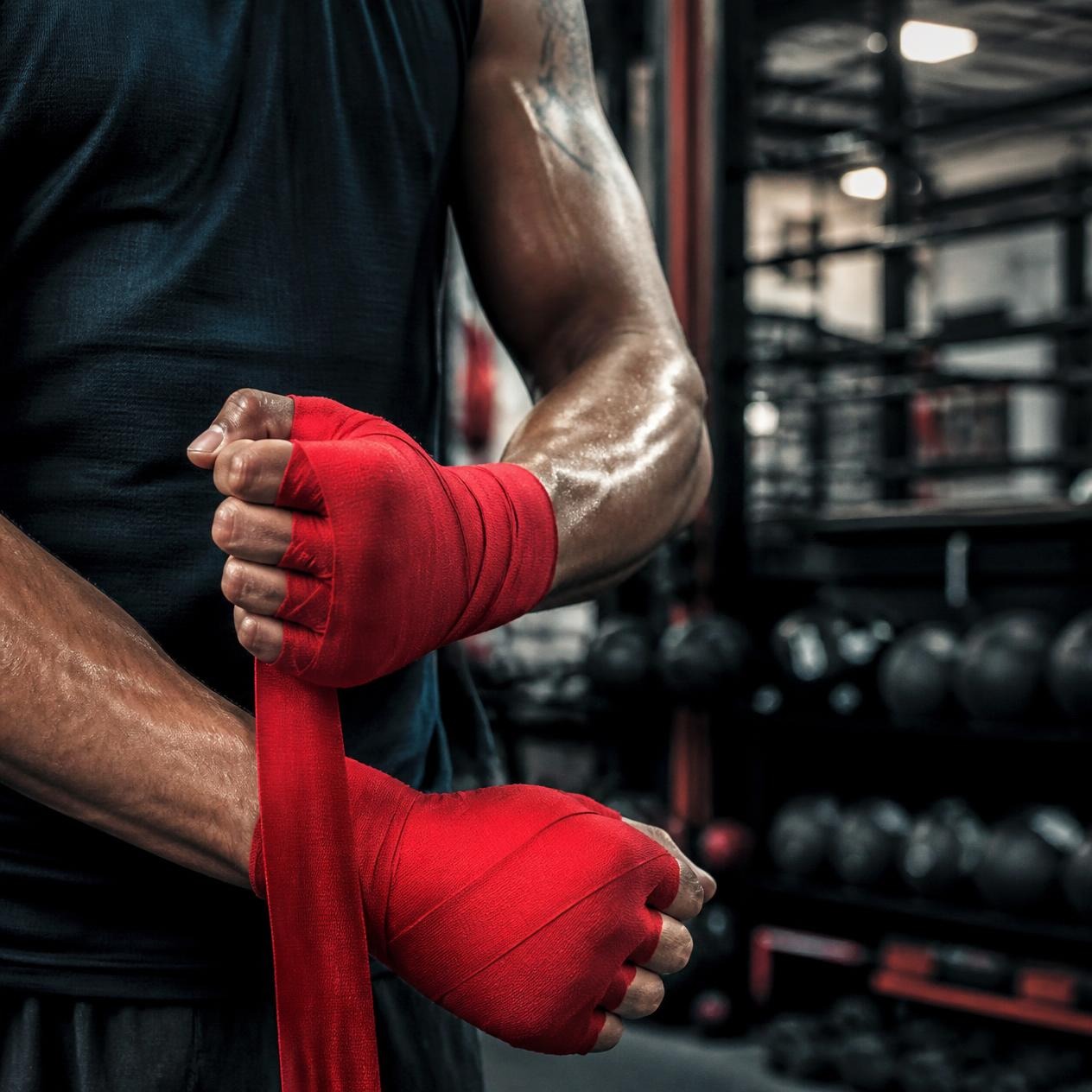
Boxing Hand Wraps: Why You Can't Do Without Them Under Your Gloves
Those approaching boxing often focus all their attention on choosing gloves, neglecting an accessory that more experienced boxers consider indispensable: boxing hand wraps. Although seemingly simple, they represent one of the most important elements for hand protection during training, sparring, and heavy bag work.
Every punch generates considerable forces that are absorbed by the bones, joints, tendons, and ligaments of the hand. Without proper wrapping, the risk of strain and minor injuries increases significantly, especially as training intensity grows over time.
In addition to their protective function, wraps improve wrist stability, increase comfort inside the glove, and also contribute to equipment hygiene by absorbing a good portion of sweat. For this reason, they are used by virtually all athletes, from beginners to professionals.
- What are boxing hand wraps
- Why they protect your hands
- How to wrap your hands
- Which length to choose
- Boxing inner gloves vs. wraps
- Hygiene and maintenance
- Mistakes to avoid
- Why they are a smart investment
What are boxing hand wraps
Wraps are long strips of elastic or semi-elastic fabric designed to wrap around the hand, knuckles, thumb, and wrist before putting on gloves. Their function is to create a support system that better distributes the forces developed during impact.
Contrary to what many beginners think, the glove is mainly used to absorb part of the external impact, while the wrap protects the internal structure of the hand. The two elements work together and cannot be considered substitutes.
In boxing gyms, it is rare to see an experienced athlete training without wraps. This is because injury prevention is fundamental to maintaining consistency in training and improving in the long term.
Available materials
Wraps can be made of cotton, cotton-elastane blends, or more advanced technical materials. Slightly elastic versions are often the most appreciated because they allow for uniform wrapping without creating excessive pressure points.
Who should use them
Whether you practice boxing, kickboxing, Muay Thai, or fitness training with a bag, the use of wraps is recommended for practically everyone, regardless of experience level.
Why they protect your hands
Repeated impact against a bag, pads, or an opponent can cause micro-trauma that, over time, can turn into more serious problems. Wraps help keep the metacarpal bones compact and reduce stress on the joints.
The wrapping also stabilizes the wrist, decreasing the risk of it bending during a punch thrown with imperfect technique or in situations of severe fatigue.
An additional benefit concerns the distribution of pressure on the knuckles, which are better protected and less subject to irritation or abrasions.
Protection of the metacarpals
The metacarpals represent one of the most exposed areas during a punch. Proper wrapping helps keep them aligned and supported during every impact.
Greater wrist stability
The wrist is a delicate joint. Proper wrapping limits unwanted movements without compromising the mobility necessary for good technique.
How to wrap your hands
Boxing hand wrapping takes a few minutes but must be done with care. The goal is not to tighten as much as possible, but to create a uniform support that accompanies the natural movements of the hand.
Generally, you start at the wrist, go over the thumb, wrap the knuckles, and subsequently make several passes between the fingers to improve the stability of the entire structure.
Every athlete develops a personal technique over time, but it is important to respect some fundamental principles: avoid fabric folds, distribute tension evenly, and verify that circulation is not hindered.
Correct sequence
An effective wrap always follows a logical progression that protects the wrist first, then the thumb, and finally the knuckles, subsequently consolidating the entire hand.
How tight to wrap
A wrap that is too loose offers little protection, while one that is excessively tight can cause discomfort and reduce circulation. It is essential to find the right balance.
Which length to choose
One of the most frequent doubts concerns boxing hand wrap length. Models ranging from about 2.5 meters to 5 meters are available on the market.
Shorter wraps are suitable especially for children or people with very small hands, while most adults prefer lengths between 4 and 4.5 meters, which allow for complete protection.
Those who practice intensive training or wish to make numerous passes over the knuckles can opt for longer wraps, obtaining greater customization of the wrap.
For beginners
For a beginner, a wrap of about 4 meters often represents the best compromise between ease of use and level of protection.
For experienced athletes
Those who train frequently may prefer longer lengths to increase the number of wraps and adapt the wrapping to their technical needs.
Boxing inner gloves vs. wraps
Many beginners wonder what the difference is between boxing inner gloves vs. wraps. Inner gloves are practical and quick to put on, but they do not guarantee the same level of customization and support.
In fact, wraps allow you to adapt the wrapping to the shape of your hand, offering superior protection especially during intense training.
Inner gloves can be an occasional solution, but for those who practice regularly, traditional wrapping remains the preferred choice for most instructors.
Advantages of wraps
Greater support, better pressure distribution, and the ability to adapt tension make wraps a standard in boxing.
When to choose inner gloves
Inner gloves can be useful during short workouts or for those looking for speed, but they do not completely replace a traditional wrap.
Hygiene and maintenance
Wraps also perform an important hygienic function, absorbing most of the sweat that would otherwise end up directly inside the gloves.
Washing them regularly limits the proliferation of bacteria and bad odors, helping to increase the life of your equipment.
For this reason, it is advisable to own at least two or three pairs of wraps to alternate during the week.
How to wash them
It is preferable to use a laundry bag and delicate cycles, avoiding temperatures that are too high, which could compromise their elasticity.
Correct drying
Letting wraps and gloves dry completely after every workout reduces humidity and preserves the materials over time.
Mistakes to avoid
One of the most frequent mistakes is using worn or too-short wraps for your hand. Even a hastily made wrap can significantly reduce protection.
It is equally important to avoid folds on the knuckles and check that the thumb is always adequately stabilized.
Relying on your coach's advice during the first few weeks allows you to quickly acquire a correct and safe technique.
Replacing worn wraps
Over time, the fabric loses elasticity and support capacity. Periodically replacing your wraps maintains a high level of protection.
Learning the technique
Dedicate a few minutes to perfecting your wrapping: it is a habit that can make a big difference in the long run.
Why they are a smart investment
Wraps are one of the least expensive accessories in boxing gear, but also one of those with the greatest impact on safety. Protecting your hands and wrists means reducing the risk of forced breaks and training with greater consistency.
For those who want to choose quality equipment, it is advisable to consult a selection of professional boxing hand wraps designed to offer comfort, resistance, and support during every session.
Considering the low cost compared to the benefits offered, investing in a good pair of wraps represents a smart decision for any combat sports practitioner. Adequate protection improves comfort, extends the life of your gloves, and helps preserve the health of your hands over time, allowing you to train with greater confidence and consistency regardless of your experience level.
Comments (0)