
Trolley
You have no items in your shopping cart

 Budgets
 Dumbers
 Discs
Discs
 Benches
 Racks and Rigs
 Weights Holders
 Isotonic machines
 Calisthenics
 Cardio
 Kettlebells
 Flooring
 Gym Set
 Accessories
 Combat
 ARTI MARZIALI
 CONTAINER GYM
 Tug-Of-War
 Used Gym Equipment
 PILATES MACCHINARI
 GINNASTICA ARTISTICA
 CAMPI DA PADEL
 Prodotti in Pronta Consegna
 Informazioni
 IRONMAN
 Gift Card
- Donatif
- General information
- 0 I like it
- 755 Views
- 0 comments
- gym flooring, safety flooring, gym safety, shock-absorbing materials
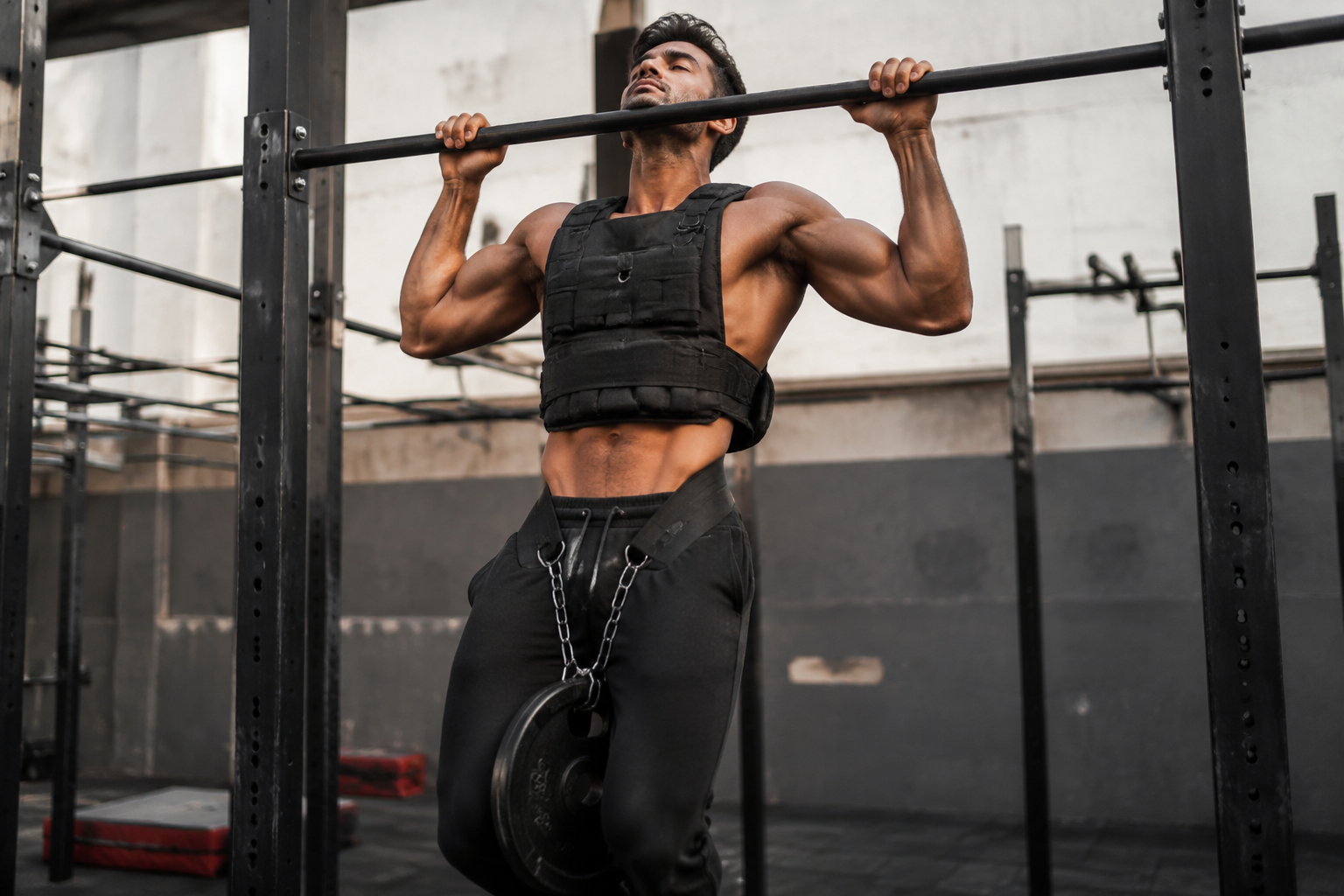
Calisthenics and Weights: How to Program Weighted Calisthenics
When fundamental calisthenics exercises start to become too simple, the time comes to introduce a stimulus capable of continuing to develop strength and muscle mass. This is precisely the phase where weighted calisthenics programming comes into play, which is the integration of progressive overload into bodyweight exercises through the use of weights, belts, plates, and specially designed vests.
Weighted calisthenics represents the natural evolution of bodyweight training. Pull-ups, dips, push-ups, and squats can be progressively made more challenging without altering the quality of the movement, allowing for continued improvement in maximal strength, hypertrophy, and neuromuscular capacity. This approach is adopted by numerous advanced athletes because it combines the advantages of calisthenics with the principles of strength training.
In this guide, we will analyze how to correctly insert progressive overload, which accessories to use, how to choose the most suitable weights, and why a stable structure compatible with different types of plates represents a strategic investment for a performance-oriented home gym.
- Why introduce weighted calisthenics
- The principles of progressive overload
- The best exercises to add weight to
- Belts, plates, and weighted vests
- How to organize programming
- The importance of professional equipment
- Errors to avoid
- How to evaluate the investment in a home gym
Why introduce weighted calisthenics
At the beginning of a calisthenics journey, simple body weight represents a sufficient stimulus to improve rapidly. As the months pass, however, the body adapts and the number of repetitions increases without there being a real increase in maximal strength.
Inserting a weight allows you to keep the number of repetitions low while increasing the intensity of the exercise. This promotes new muscular and neurological adaptations, allowing you to progress even when fundamental exercises are now consolidated.
Weighted calisthenics also constitutes excellent preparation for many advanced skills. Greater strength in pull-ups and dips translates, in fact, into a better ability to tackle muscle-ups, front levers, planches, and other complex movements.
Developing maximal strength
The gradual increase in load allows for improved recruitment of motor units and increased relative strength without modifying the exercise technique.
Promoting hypertrophy
Using progressive overloads keeps mechanical tension high, one of the main factors responsible for muscle growth.
The principles of progressive overload
The success of weighted calisthenics depends on the ability to increase the load gradually. Increases that are too high compromise the quality of execution, while increases that are too small may not produce sufficient stimuli.
Good programming involves constant progressions, always maintaining impeccable technique. It is preferable to complete all sets with control before further increasing the weight.
Recovery also plays a fundamental role. Very intense workouts require adequate regeneration times to allow the nervous and muscular systems to adapt to the stimuli.
How much to increase the load
Small progressive increments allow for continuity in improvements while reducing the risk of plateaus or injuries.
Managing volume and intensity
Alternating periods oriented toward strength with phases dedicated to hypertrophy allows for more complete development.
The best exercises to add weight to
Not all calisthenics exercises are suitable for the immediate use of additional loads. It is advisable to start with fundamental movements that allow for stable and easily controllable execution.
Pull-ups, parallel bar dips, advanced push-ups, and squats represent the ideal base for developing strength using overloads. Only later will it be possible to extend the work to other more technical variations.
Before adding weight, it is essential to possess a consolidated technique. Poor execution amplified by overload increases the risk of compensations and joint strain.
Weighted pull-ups
Weighted pull-ups are probably the most representative exercise of weighted calisthenics and represent one of the most effective methods for increasing pulling strength.
Weighted dips
Dips allow for the development of the pectorals, triceps, and shoulders while maintaining high transferability toward numerous dynamic skills.
Belts, plates, and weighted vests
The choice of accessories directly influences comfort, safety, and practicality during training. Each solution presents specific advantages that must be evaluated based on personal goals.
The weighted belt represents the preferred solution for pull-ups and dips because it leaves full freedom of movement while distributing the weight in a natural way. Vests, on the other hand, are particularly suitable for dynamic exercises and movements that require greater load stability.
Those who already have a home gym should orient themselves toward systems compatible with different types of plates, so as to be able to use the equipment already present without incurring unnecessary expenses.
The calisthenics weight belt
A sturdy belt, made with resistant materials and reliable carabiners, allows you to work safely even with heavy loads.
Why choose 50mm cast iron plates
50mm Olympic plates represent a professional standard, but multi-diameter systems allow for the use of plates with different holes as well, increasing the compatibility of the entire home gym.
How to organize programming
Effective programming alternates sessions dedicated to strength with sessions more oriented toward technique and skills. This approach allows for the simultaneous improvement of the ability to produce force and the quality of movements.
A widely used strategy consists of inserting weighted calisthenics at the beginning of the session, when the nervous system is still fresh. Subsequently, it is possible to dedicate space to complementary exercises and technical work.
Every four to six weeks, it is advisable to re-evaluate loads, verify progress, and plan any increments while always maintaining an adequate technical margin.
Strength-oriented blocks
Working with low repetitions and high loads allows for the rapid development of relative strength while maintaining high executive quality.
Periodizing training
Alternating cycles of strength, hypertrophy, and deloading avoids adaptation and allows you to progress for longer.
Why equipment makes the difference
Training with overloads requires structures designed to withstand high stress. An unstable bar or a structure that is not very rigid limits the effectiveness of the training and can compromise safety.
A professional home gym should guarantee high load capacity, stability, and compatibility with different accessories. The ability to use multi-diameter systems represents an important advantage because it allows you to use both Olympic plates and other formats already available.
For this reason, many athletes choose a professional calisthenics structure capable of integrating perfectly with the evolution of their equipment and their training needs.
Stability during exercises
A rigid structure transmits all the force developed by the athlete without dispersion, improving technical quality and safety.
Thinking about future growth
A modular solution allows you to add new accessories, stations, and training systems without having to replace the entire structure.
The most common errors
One of the most frequent errors consists of increasing the load too quickly, sacrificing technical quality. In weighted calisthenics, the precision of the movement always remains the absolute priority.
Many athletes also neglect joint warm-ups, which are fundamental when working with significant overloads. Shoulders, elbows, and wrists must be carefully prepared before tackling the main sets.
Recovery should also not be underestimated. Inserting deload days and monitoring fatigue allows you to continue to progress while limiting the risk of injury.
Do not sacrifice technique
The load should only increase when every repetition is performed with complete control and correct trajectories.
Recover to improve
Strength and muscle mass grow during recovery: scheduling adequate breaks is an integral part of training.
How to evaluate the investment in a home gym
Integrating progressive overload represents one of the most effective ways to continue improving when body weight no longer constitutes a sufficient stimulus. Correct weighted calisthenics programming allows you to develop strength, hypertrophy, and motor control while maintaining all the characteristics that make calisthenics a complete discipline.
Choosing reliable accessories, using systems compatible with different plate formats, and training on professional structures means protecting the investment made and making the most of all the equipment already available. Multi-diameter compatibility avoids having to replace your weights, allowing you to easily integrate new components into your home gym.
Intelligent programming, a gradual increase in loads, and a stable structure constitute the foundations for obtaining lasting results, improving performance, and confidently facing every new phase of your journey in weighted calisthenics.
Comments (0)