
Trolley
You have no items in your shopping cart

 Budgets
 Dumbers
 Discs
Discs
 Benches
 Racks and Rigs
 Weights Holders
 Isotonic machines
 Calisthenics
 Cardio
 Kettlebells
 Flooring
 Gym Set
 Accessories
 Combat
 ARTI MARZIALI
 CONTAINER GYM
 Tug-Of-War
 Used Gym Equipment
 PILATES MACCHINARI
 GINNASTICA ARTISTICA
 CAMPI DA PADEL
 Prodotti in Pronta Consegna
 Informazioni
 IRONMAN
 Gift Card
- Donatif
- General information
- 0 I like it
- 453 Views
- 0 comments
- gym flooring, safety flooring, gym safety, shock-absorbing materials
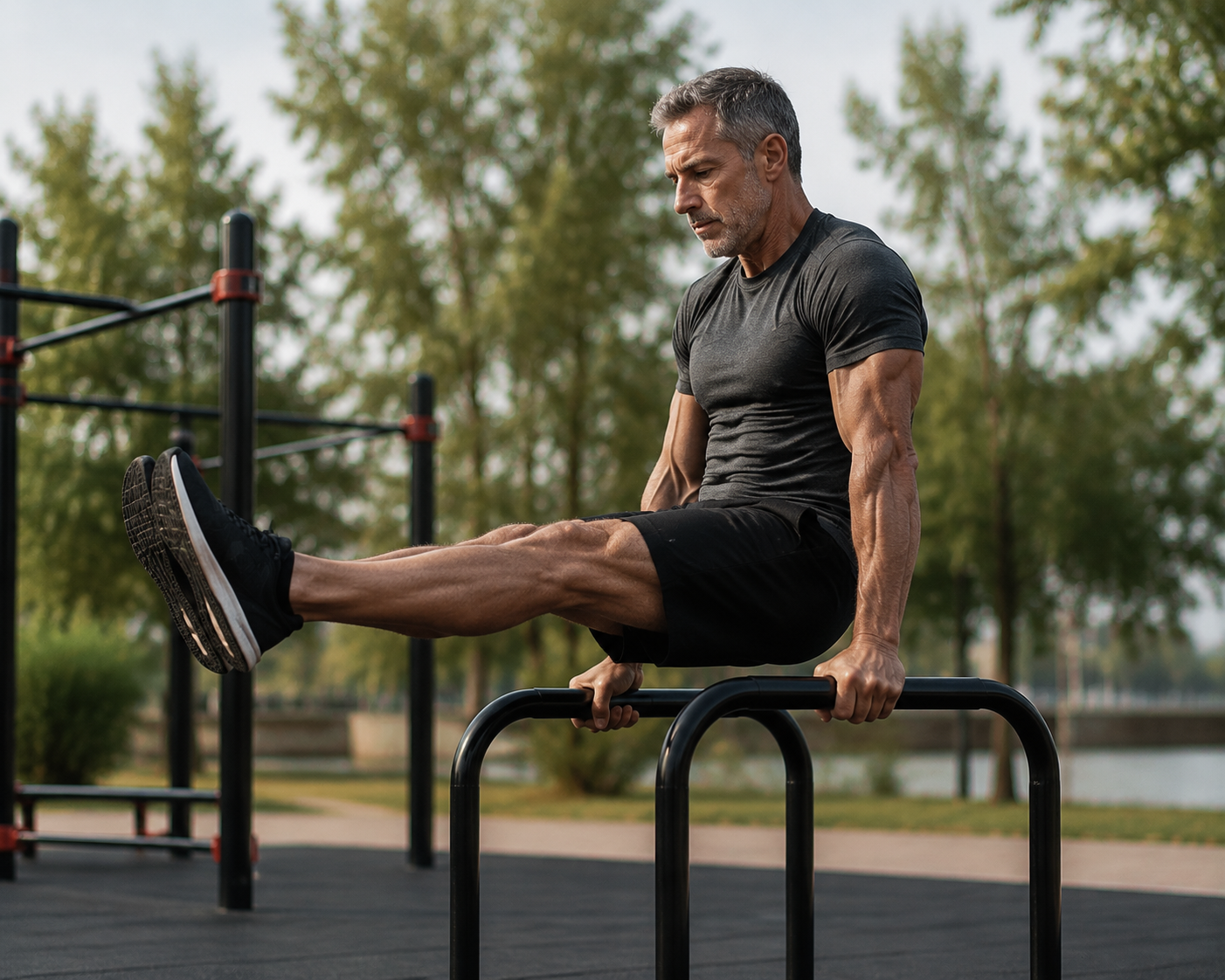
Calisthenics Programming for Over 40s: Strength and Longevity Without Injury
Calisthenics for over 40s represents one of the most effective training methods for improving strength, mobility, balance, and quality of life even in adulthood. Contrary to what many think, you don't need to be in your twenties to learn bodyweight skills or develop a strong and functional physique. What changes after forty is not the possibility of improvement, but the way you need to program workouts, recovery, and progressions.
As the years go by, recovery capacity decreases, the importance of joint mobility increases, and it becomes essential to pay closer attention to the body's signals. However, intelligent programming allows you to achieve excellent results while minimizing the risk of overtraining, inflammation, and injury.
In this guide, we will analyze how to structure a calisthenics program after forty, which exercises to prioritize, how to manage recovery, and why the quality of the equipment used is one of the most important elements for training safely in the long term.
- Why start after 40
- The principles of programming
- Mobility and joint preparation
- Building strength without overloading joints
- Recovery and fatigue management
- Recommended equipment
- Mistakes to avoid
- A longevity-oriented approach
Why start after 40
Starting a calisthenics journey in adulthood means investing in joint health, movement quality, and the preservation of muscle mass. The main goal is not just to learn new skills, but to build a body that is more efficient and resistant to daily activities.
Bodyweight work improves coordination, increases core stability, and promotes better neuromuscular control compared to workouts based exclusively on guided machines.
With proper progression, it is possible to develop functional strength without subjecting joints to unnecessarily high loads, obtaining benefits both in terms of aesthetics and health.
Long-term benefits
Training consistently helps preserve bone density, improve balance, keep muscles efficient, and promote a better quality of life during aging.
Realistic goals
After forty, it is important to focus on constant and sustainable progress. Consistency produces much better results than periods of extremely intense training followed by long breaks.
The principles of programming
Effective programming must respect the principle of progressivity. Gradually increasing the volume, intensity, and complexity of exercises allows tissues to adapt, reducing the risk of inflammation.
Every session should include a balance between pushing, pulling, core work, and mobility, avoiding muscle imbalances that could compromise posture over time.
Monitoring fatigue is an essential element: learning to recognize when to reduce the load allows you to maintain high-quality workouts for many years.
How often to train
For most adults, three or four sessions per week represent an excellent compromise between training stimulus and recovery.
Intelligent progressions
Skills must be approached through preparatory exercises and simplified variations, consolidating each phase before increasing the difficulty.
Mobility and joint preparation
One of the most important aspects of calisthenics for adults concerns joint preparation. Dedicating time to it means improving the quality of movement and significantly reducing the risk of injury.
Shoulders, wrists, hips, and the thoracic spine require particular attention because they are the joints most involved in calisthenics skills.
A good warm-up should include dynamic exercises, controlled mobilizations, and specific muscle activation before tackling the main work.
Shoulder mobility
Good joint range of motion facilitates exercises like pull-ups, dips, and handstands, also improving the technical quality of execution.
Wrist preparation
Gradually increasing the load on the wrists allows tissues to adapt and makes exercises performed on the hands more comfortable.
Building strength without overloading joints
The goal is not to perform spectacular exercises in the shortest time possible, but to develop solid and lasting strength through controlled movements.
Calisthenics progressions allow you to modulate difficulty while always maintaining high technical quality, a characteristic that is particularly important after forty.
Integrating multi-joint exercises with specific stabilization work promotes balanced muscle development and improves body control.
Fundamental exercises
Push-ups, assisted pull-ups, rows, squats, lunges, and planks form the basis of any effective program oriented toward functional strength.
When to introduce skills
More advanced skills should only be tackled after building solid foundations of strength, mobility, and motor control.
Recovery and fatigue management
Recovery plays an even more important role than in younger years. Getting enough sleep, eating correctly, and scheduling deload days promotes physiological adaptations.
Always training at maximum intensity increases the risk of tendon overload and slows progress in the medium term.
Alternating demanding sessions with days dedicated to mobility or technical work allows you to maintain the overall quality of the programming at a high level.
The role of sleep
Adequate nightly recovery promotes protein synthesis, nervous system recovery, and the maintenance of motivation.
Deload weeks
Periodically reducing volume and intensity allows you to recover completely and prepare for new training cycles.
Recommended equipment
A stable and sturdy structure is a fundamental investment for training safely. Equipment that wobbles or is unstable increases stress on the joints and makes it more difficult to control movements.
For this reason, it is advisable to choose professional structures, solid parallel bars, and supports designed to withstand high loads even during complex exercises.
Those who wish to build a reliable home gym can look toward a professional calisthenics structure, capable of offering stability, safety, and the possibility of long-term progression.
Why stability counts
A rigid base allows you to apply force without dissipation, improving technical quality and reducing compensatory movements that can unnecessarily fatigue joints and tendons.
Useful accessories
High-density mats, resistance bands, rings, and parallel bars can make workouts safer and adaptable to different levels of preparation.
Mistakes to avoid
One of the most common mistakes is trying to replicate programs designed for much younger athletes. Every journey must be adapted to one's own capabilities, prioritizing technical quality and recovery.
Neglecting calisthenics joint mobility is also a significant limitation. Reduced joint range of motion increases the risk of compensations and makes it more difficult to perform exercises correctly.
Finally, ignoring small aches in the hope that they will disappear on their own can turn simple overloads into more serious problems that require long periods of rest.
Wanting to progress too quickly
Increasing the difficulty of skills without having consolidated the basics often leads to plateaus, loss of motivation, and possible injuries.
Listening to your body
Recognizing signs of fatigue allows you to modify the program before small discomforts become significant limitations.
A longevity-oriented approach
Training with calisthenics after forty means choosing a methodology capable of developing strength, coordination, balance, and motor control while keeping joint health at the center. With intelligent programming, it is possible to learn new skills, improve body composition, and continue to progress for many years.
The key to success does not lie in the search for maximum intensity, but in consistency, quality of execution, and the ability to respect recovery times. A gradual approach produces more solid and sustainable results than excessively aggressive programs.
Relying on stable equipment designed for intensive use is an investment that increases safety, improves the quality of every workout, and allows you to tackle calisthenics progressions with the confidence needed to build strength and longevity without compromising your joints.
Comments (0)